Did you know that two out of three children worldwide grow up with more than one language? Despite this impressive figure, many parents in Vienna often feel unsure about how to implement it effectively in their own homes. The worry that their offspring might mix languages or be overwhelmed when starting school in 2026 accompanies many families in their daily lives. We understand that you desire a stable yet future-oriented environment for your child, where multilingualism is experienced as a gift, not a burden.
In this article, you will find tips on raising bilingual children that can be integrated into daily routines without pressure, from their first word to choosing the right primary school in the 19th district. We promise you concrete assistance to ensure a smooth transition into a bilingual school. You will get an overview of proven methods such as the OPOL principle, creative play ideas, and important organisational milestones, such as school enrolment in January 2026. This way, you can competently support your child on their journey to an international identity and a successful academic career.
The decision to raise your child bilingually lays the foundation for a cosmopolitan future. In expert circles, the OPOL (One Person, One Language) method is often considered the gold standard. Here, each parent consistently speaks to the child in their native language. This pedagogical concept supports Simultaneous Bilingualism, meaning the simultaneous acquisition of two native languages from birth. It creates clarity in everyday life. The child firmly links each language with a specific caregiver, which facilitates the cognitive separation of language systems.
For this method not to seem artificial in daily life, naturalness is crucial. When you meet neighbours at the baker's or on the stairs, stick to your chosen language with your child whilst speaking German with others. If you are looking for tips on raising bilingual children, consistency is the most important keyword. The quality of the relationship is more important than grammatical precision. Children learn language through resonance and joy, not through corrective instruction. In Vienna, German dominates as the ambient language, which is why the targeted strengthening of the minority language, such as English, remains essential for balanced development.
In addition to direct address, a so-called language bath helps. Passive stimuli through audio plays, songs, or bedtime stories playfully consolidate vocabulary. Media should serve as support, not as a substitute for real interaction. Those looking for tips on raising bilingual children should also pay attention to the quality of the content. Special offers such as a bilingual preschool course, which professionally prepares children for the transition to school, also provide a structured addition. As an alternative to the OPOL method, time-place separation offers flexibility. Here, for example, only English is spoken at the weekend. This is particularly helpful if both parents share the same native language but want to specifically promote a second language.
Bilingualism unfolds best in the unspectacular moments of the day. In Vienna, there are numerous opportunities to organically link languages. The shared snack is an ideal learning moment. Whether spreading a bread roll with quark or naming fruit, vocabulary is acquired here without artificial pressure. The walk to the flat can also be utilised. Count the steps on the stairs alternately in both languages. Such rituals sustainably strengthen language awareness and make bilingualism a natural part of the child's world.
Social contacts are the engine of language development. Playgroups provide the necessary interaction with peers, where language serves as a tool for shared experiences. Those looking for effective tips on raising bilingual children should also include Austrian customs. An English song about St Nicholas or the Easter Bunny alongside the traditional poem creates a valuable bridge between cultures. It promotes the understanding that both languages are equally valuable and bring joy.
Classics like "I spy with my little eye" promote attention and playfully expand vocabulary. Rhymes and songs use rhythm to embed grammatical structures in long-term memory. The primary goal is the joy of expression, not immediate error-free speech. Bilingual preschool courses and playgroups are particularly valuable here, laying the groundwork for the later school career.
Choose books that gently challenge the current language level but never overwhelm. During interactive reading aloud, ask specific questions about what is happening in the pictures. Let your child comment on the plot in the target language. This promotes active application and text comprehension far beyond mere listening. If you wish to deepen this playful foundation, you will find further inspiration for holistic development in our school's educational offer.
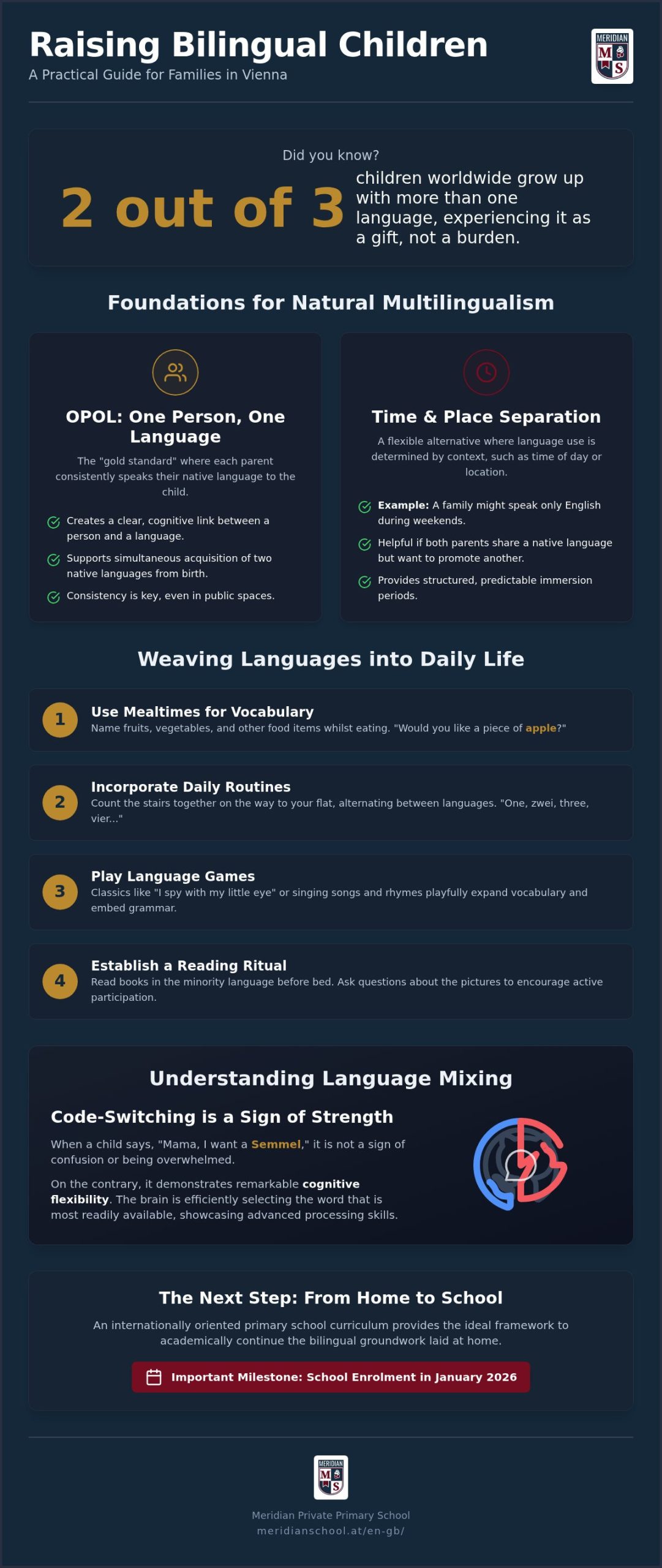
A phenomenon that unsettles many parents is so-called code-switching. If your child forms sentences like "I want a Semmel", this is not a sign of being overwhelmed. On the contrary: it demonstrates enormous cognitive flexibility. The brain quickly selects the term that is most readily available at that moment. Those looking for valuable tips on raising bilingual children should react calmly here. Use reactive feedback by repeating the sentence in the correct form without interrupting the flow of speech with criticism. This way, the joy of speaking is preserved.
Children often develop a "comfort language", which is usually shaped by the dominant social environment. In Vienna, this is often German. If the minority language temporarily stagnates, there is no need to panic. Pedagogical support is only useful if overall language development in both languages significantly lags behind the age norm. In most cases, a change of environment is enough to rekindle motivation for the second language.
The concern that multilingualism leads to language delays has long been scientifically refuted. Studies show that bilingual children often have higher executive control. They can concentrate better and switch tasks faster than monolingual peers. These cognitive advantages are a valuable investment in the future. Learn more about the advantages of immersion: How children learn languages here.
To optimally utilise this natural form of learning, an environment that promotes both languages at an academic level is required. If you would like to support your child in a professional setting from the 2026 school start, we invite you to discover our holistic educational offer in Vienna 1190. Together, we will strengthen your child's linguistic foundation.
The groundwork laid at home forms a valuable foundation. For your child to fully realise their potential, this path should be continued academically in a specialised primary school. In 1190 Vienna, the Cambridge Primary Curriculum offers an international gold standard that goes far beyond conventional foreign language teaching. Here, language is not merely learned, but used as an active medium for subject content. Those looking for tips on raising bilingual children that go beyond the home environment will find the ideal complement in a bilingual all-day school. When visiting schools in Vienna, pay particular attention to the following criteria:
At our institution, German and English meet on equal terms from the first school year. We support children individually according to their respective language level to avoid overwhelming them and to maintain their natural curiosity. Our approach combines academic excellence with a warm atmosphere. By focusing on STEM and music, language development is cognitively supported, as different brain areas are activated simultaneously. Find out more about our educational offer now and discover our innovative educational path.
The official process for the school start on 7th September 2026 begins as early as October 2025 with the official information letter. Central enrolment takes place in January 2026. For a relaxed transition from nursery school, it is advisable to contact your preferred school early. Those looking for tips on raising bilingual children for organisational preparation should note the dates for orientation meetings in January 2026 in their calendar. A comprehensive guide is our School Start Vienna 2026: The Ultimate Guide. Plan ahead and use our online registration to secure a school place.
Bilingualism is a valuable gift that goes far beyond mere language acquisition. It promotes cognitive flexibility and opens doors to a globally connected world. As we have seen, consistency with the OPOL method and playful integration into Viennese daily life form the most stable foundation. If you heed our tips on raising bilingual children, you will support your child through the first formative years without overwhelming them. The transition to a professional school environment is ultimately the decisive milestone to elevate this home-based preparation to an academic level.
As a certified Cambridge International School in Vienna Döbling, we offer the ideal environment for this next step. In our small groups, we value individual support that combines the Austrian curriculum with the globally recognised Cambridge Primary Curriculum. Our holistic all-day care ensures that your child grows optimally in language, STEM subjects, and musical areas.
Secure your child's place for 2026: Register now!
We look forward to accompanying you and your child as a reliable partner into a successful, international future.
Ideally, you should start bilingual education right from birth, as the child's brain is particularly receptive to different sound systems during this phase. This early immersion allows the child to internalise both languages as native tongues and speak without an accent. Those looking for tips on raising bilingual children should know that consistency from the outset significantly reduces the cognitive effort for the child later on.
This phenomenon is called receptive multilingualism and is a completely normal developmental phase. It is important that you remain consistent in your target language and do not put pressure on the child, as this can lead to speech blocks. Instead, use reactive feedback by gently repeating and expanding your child's answers in the desired language. This keeps the passive vocabulary alive and gradually transforms it into active speech.
Yes, this is possible, provided you have a very high level of language proficiency and authentically embed the language in everyday life. Since children perceive linguistic nuances very precisely, for tips on raising bilingual children, you should consider the targeted use of native-language media or playgroups. A professional complement is offered by a bilingual primary school in Vienna, where native speakers take over the academic part, thus ensuring a flawless linguistic environment.
The Cambridge Primary Curriculum offers an international framework that focuses on critical thinking and problem-solving skills. Unlike the standard curriculum, English is not merely used as a foreign language subject, but as an active working language in subjects such as Mathematics or Science. As a certified Cambridge International School, we combine these global standards with the Austrian curriculum. This guarantees a high-quality education that opens up excellent prospects for students for an international future.
When choosing, look for an institution that truly practises immersion throughout the school day and does not just offer it for a few hours. In Vienna Döbling, the Meridian Private Primary School offers all-day care that combines STEM focus areas and musical development in German and English. Check the registration deadlines for the 2026 school start in January in good time, as places in specialised private institutions are often quickly filled. A personal visit will give you the necessary reassurance.