What if the path to first-class musical education didn't lead through Vienna's dense evening traffic, but merely up the stairs to the next classroom? Many parents in Vienna this year face the challenge of painstakingly juggling their children's schedules between school commitments and the desire for creative development. Often, there is simply no time in daily life for additional journeys to music school, meaning valuable synergies between music and other subjects remain unused.
In this article, you will learn how professionally integrated instrumental music lessons in Vienna primary schools transform a school into a place of holistic development that goes far beyond mere reading music. We will highlight how this musical development sustainably strengthens your child's cognitive development and language proficiency, whilst simultaneously imparting discipline and a joy for acquiring knowledge. We will give you an insight into modern pedagogical concepts that understand music not as a mere extra, but as an essential component of excellent bilingual education that saves time and specifically fosters talents.
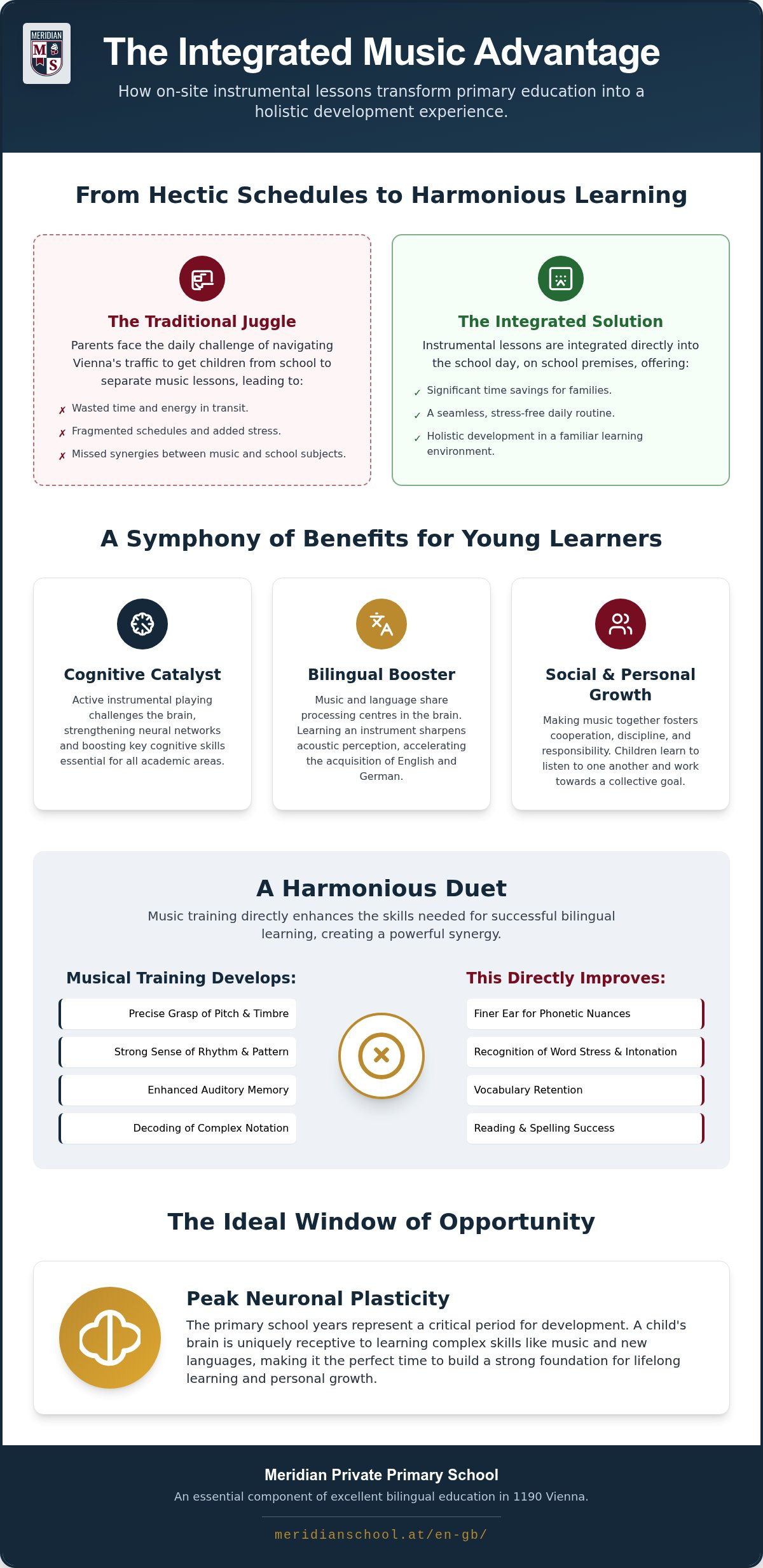
The term integrated instrumental music lessons describes an educational model where musical training takes place directly on the school premises during regular care hours. For families in Vienna, this means enormous relief, as the tedious journeys across the district to the nearest music school are completely eliminated. Instead of spending valuable time in traffic jams or on the Underground, children simply go up the stairs to the music room and use their time efficiently in their familiar learning environment. A thorough music education is far more than just a pastime. Whilst passive listening to music only creates isolated emotional stimuli, active instrumental playing challenges the brain at the highest level and promotes motor precision as well as neural networking.
To better understand the dynamics of modern music pedagogy in a school context, this video offers a helpful insight:
The primary level represents the ideal window of opportunity for starting. In this phase, neuronal plasticity is particularly pronounced, which considerably facilitates the learning of complex fingerings and rhythms. Qualified instrumental music lessons in Vienna primary schools utilise this biological opportunity to optimise cognitive capacities early on. It is not solely about mastering an instrument, but about creating a stable foundation for lifelong learning and personal development in a structured environment.
Joint music-making noticeably strengthens social skills and cooperation in the class. Children learn early on to listen to one another, accept pauses, and take responsibility for the collective sound. This increased concentration ability directly benefits STEM subjects. Those who recognise mathematical structures in music and deconstruct rhythms often find easier access to logical problem-solving. Our offering ensures that these synergies are fully exploited in daily school life to create a harmonious balance between academic excellence and creative practice.
Music and language utilise partially identical processing centres in the human brain. Learning an instrument sharpens one's acoustic perception, which has been proven to accelerate the acquisition of a second language. Quality instrumental music lessons in Vienna primary schools act as a cognitive enhancer here. Through the precise grasping of pitches and timbres, children develop a finer ear for the subtle nuances of English phonetics.
Phonological awareness forms the foundation for reading and spelling success. A sense of rhythm helps to anticipate word boundaries and stress patterns in English and German more quickly. Experts emphasise the importance of music education for strengthening executive functions. Decoding complex musical notation whilst simultaneously implementing motor skills on the instrument trains selective attention and working memory. These abilities are essential if children are to achieve international educational standards within the framework of the Cambridge Primary Curriculum in Vienna.
In bilingual daily school life, music offers an excellent platform for linguistic immersion. English technical terms flow naturally into the lessons. The child learns vocabulary not by rote learning, but by immediate action. Music also functions as a universal language and cultural bridge that connects different linguistic areas. It promotes a deep understanding of global traditions and strengthens the international identity of the pupils.
This synergistic development optimally prepares children for the demands of a connected world. To see how we implement these concepts in daily life, please feel free to learn more about our specific educational offering.
Choosing the right music programme represents a pivotal decision for many families. High-quality instrumental music lessons in Vienna primary schools should not only offer professional excellence but also seamlessly integrate into the child's daily routine. The first step is to carefully observe the child's natural interests. Is the percussive sound of a piano more fascinating, or the tactile challenge of a violin? Taster sessions are essential here to test enthusiasm without pressure.
A crucial factor is the infrastructure. If lessons take place directly on the school premises, stressful journeys through the city are eliminated. Also, pay attention to the pedagogical qualification of the teachers. Experience working with primary school pupils is essential to maintain the joy of the instrument long-term. Flexibility in changing instruments in the initial phase prevents frustration and promotes an exploratory desire for sound.
Classics like the recorder or the piano offer an excellent introduction, as they enable quick successes and consolidate basic musical understanding. Those who wish to specifically train fine motor skills will find ideal companions in string instruments like the guitar or the violin. These challenge the coordination of both hands in different ways and enormously promote concentration, which positively affects overall learning progress.
In addition to pedagogical quality, the framework conditions also play a role. Parents should always keep track of the incurred costs and school fees. Well-thought-out time management ensures that lessons are harmoniously integrated into the full-day schedule, so that after the effort, there is still enough time for a healthy snack. Information about the Elementary Music Making (ELEMU) programme of the City of Vienna also shows how cooperations can facilitate access to music. If you are looking for an environment that professionally bundles these aspects, we cordially invite you to learn more about our enrolment.
On Grinzinger Strasse, young musicians find a place of inspiration that goes far beyond the standard. Our modern premises in 1190 Vienna are specifically designed to create a productive yet warm learning atmosphere where talents can freely develop. Our offering includes individual instrumental music lessons that are directly integrated into the structured school day. The child remains in their familiar environment, which promotes concentration and significantly lowers the inhibition threshold for regular practice.
We focus on a future-oriented combination of tradition and modernity. Whilst classical instruments such as piano, violin, or flute are at the centre of the training, our teachers specifically use digital learning methods. These support children in grasping music theory fundamentals playfully and efficiently. The path consistently leads from the first tentative note to a confident performance. Regular school concerts are a fixed part of our annual cycle. These performances sustainably strengthen self-confidence and give pupils the opportunity to proudly present their progress to an appreciative audience.
Meridian School is characterised by a unique balance between academic excellence and creative practice. Professional instrumental music lessons in Vienna primary schools are not merely an additional module with us, but an integral part of personality development.
To optimally shape the transition into this new phase of life, you should carefully plan the next school start in Vienna this year. We stand by your side as a competent partner to lay the foundation for an international and musical future.
The integration of music into daily school life offers far more than just a creative break between lessons. Professional instrumental music lessons in Vienna primary schools act as a decisive engine for cognitive development and significantly support the natural acquisition of a second language. By eliminating tedious journeys to external music schools, Viennese families gain valuable time for shared leisure activities or a relaxed afternoon snack.
As a certified Cambridge International School, we in the 19th district rely on a holistic full-day concept that combines individual development with academic excellence. We accompany your child on the path to an international identity by harmoniously combining a STEM focus and musical education. This structured environment offers the security and stability that are essential for healthy development. Opt for an education that awakens talents and broadens horizons.
Secure your child a place at Meridian School – Enrol now!
We look forward to welcoming your child to our community at the next school start and jointly discovering the world of sounds and knowledge.
Children can begin learning an instrument as early as the first primary school year. In this phase, neuronal plasticity is particularly pronounced, which considerably facilitates a playful start. At our school in 1190 Vienna, we consistently foster musical talents from school entry. This enables continuous development of motor skills and creates a stable, trusting foundation for your child's entire four-year primary school period.
For the beginning, the purchase of one's own instrument is not necessarily required immediately. Many families initially opt for rental instruments to test the child's curiosity without high financial risk. We are happy to support parents with expertise in selecting ergonomic models that are specifically suitable for primary school pupils. As soon as a consistent joy in music-making emerges, having one's own instrument at home fosters motivation for daily practice.
The instrumental music lessons in Vienna primary schools are seamlessly integrated into our modern full-day concept. The sessions take place during care hours directly on our premises, which saves families tedious journeys through city traffic. This organisational structure ensures that musical development remains a fixed part of the daily routine. This way, after lessons, there is enough time for a snack and social interaction, without the children's schedules appearing overloaded.
The interweaving is achieved through the principle of immersion, where music serves as a bridge between German and English. Technical terms are often introduced in both languages, which playfully expands vocabulary and consolidates pronunciation. This method ideally complements the Cambridge Primary Curriculum, as musical rhythm sustainably improves language perception. Thus, pupils benefit from a holistic education that cleverly links the cognitive benefits of both disciplines and utilises synergies.
We offer a selection of classical instruments that are optimally tailored to the needs of the primary level. Currently, piano, violin, recorder, and guitar are the focus of our additional musical offering. These instruments promote the fine motor skills and concentration ability of children in different ways. Our pedagogical team strictly ensures age-appropriate teaching. For detailed information on available places and specific instruments for the current school year, we are always available for consultation.