Did you know that, according to current expert forecasts for 2026, around 70 per cent of all future professions will already require sound competencies in the areas of Science, Technology, Engineering, and Mathematics (STEM)? Many parents in Vienna are rightly concerned that a purely theoretical education will no longer be sufficient to optimally prepare their children for tomorrow's digital world. The fear of specialising too early often weighs just as heavily as the worry of losing touch with global developments. However, it's not about mere rote learning, but about understanding complex interconnections in a networked world.
In this article, you will discover why the benefits of a STEM focus in primary school extend far beyond mere arithmetic and experimentation. We will show you how targeted, bilingual support sustainably strengthens your child's cognitive development and lays the foundation for an excellent academic career in Vienna. We will give you an insight into how playful projects with modern tools and the Cambridge Primary Curriculum intertwine to transform natural curiosity into a true spirit of inquiry that will guide your child safely and competently into the future.
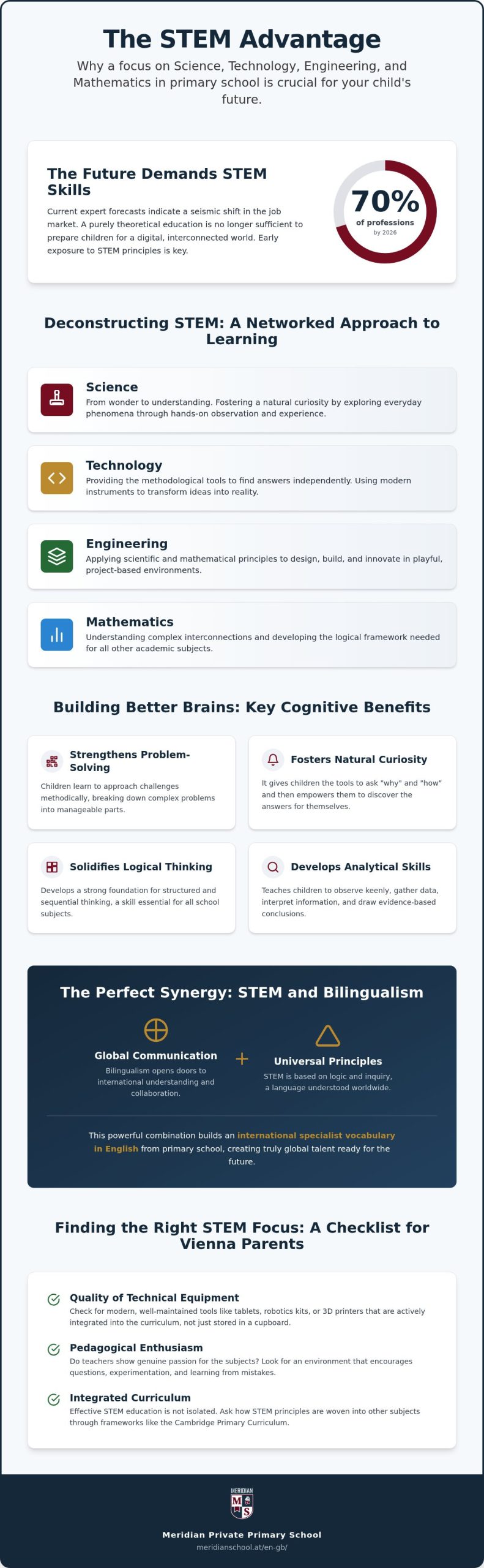
STEM is far more than a mere sequence of school subjects. The acronym bundles the disciplines of Science, Technology, Engineering, and Mathematics into a networked educational concept. Anyone who wants to understand what STEM subjects are quickly realises that it's not about merely memorising formulae. Rather, the focus is on fostering curiosity, keen observation, and analytical skills. The essential benefits of a STEM focus in primary school primarily lie in the fact that children at this age possess a natural window for enthusiasm. They constantly question their environment anyway; a structured STEM focus gives them the methodological tools to find answers independently.
In primary school, everyday phenomena transform into exciting research journeys. When children observe how a tiny seed grows into a plant or why it gets dark earlier in winter, they grasp the world through hands-on experience. Such