Did you know that the ability to independently resolve a conflict during the long break is often more crucial for long-term school success than flawlessly spelling one's own name? Many parents in Vienna look forward to the first day of school with a mixture of pride and quiet concern, as uncertainty about their child's social maturity often weighs more heavily than questions about cognitive talents. It is perfectly understandable that you wish to foster social skills before school starts, to enable your child a stable and joyful entry into their new daily life.
In this article, you will learn how to emotionally prepare your child for primary school, ensuring their journey to becoming a primary school pupil in Vienna Döbling is free from unnecessary anxieties. We present well-founded pedagogical approaches and practical exercises for home that will sustainably strengthen self-confidence. From fostering empathy through bilingual impulses to confidently handling initial performance demands, you will receive a clear guide for harmonious school preparation that lays the groundwork for a successful, international educational career.
Social competence is far more than mere politeness. It encompasses the ability to purposefully manage one's own emotions and interact constructively with others. A well-founded definition of social competence describes this complex interplay of self-awareness and empathy as essential for successful integration into new social structures. Whilst cognitive school readiness is often measured by achievements such as counting or recognising first letters, social maturity determines whether a child truly feels at home in the class community. Parents who actively foster social skills before school starts strengthen their child's psychological resilience against the often underestimated stress of a new beginning.
Emotional intelligence acts in this context as a crucial catalyst for academic learning success. A child who feels secure and accepted within the group possesses the necessary mental capacities to fully concentrate on new learning content. Stress on the first day of school rarely results from fear of academic tasks, but usually from uncertainty in dealing with unfamiliar classmates and teachers. A preparatory bilingual pre-school course offers the ideal platform to introduce children to group structures and international interactions in a protected environment.
Targeted preparation for everyday school life doesn't have to be dry training. When parents foster social skills before school starts, this is most effectively done in the familiar home environment through playful interactions. Scientific findings clearly show that established social skills for starting school form the crucial basis for healthy identity development. It's about gaining confidence in dealing with others before the serious business of life begins.
Use role-playing games to practise typical situations in advance, such as meeting new classmates or asking for help. Shared snack time also offers valuable learning moments: consciously sharing a bread roll or an apple teaches generosity and consideration for others. Board games are also ideal for practising winning and losing in a safe setting. Children must learn to endure small defeats without immediately losing heart. In parallel, independence in everyday tasks, such as independently navigating the staircase in the residential building, strengthens confidence in their own physical abilities.
Feelings need names to become tangible. Use emotion cards or a simple diary to collectively find words for anger, anticipation, or uncertainty. A child who can name their own feelings will express them less often through impulsive behaviour in the classroom. Short breathing exercises, such as consciously "smelling a flower" and then "blowing out a candle," help your child to calm themselves down independently in stressful moments.
Active listening can be wonderfully cultivated at the dinner table. Ensure that every family member is allowed to finish speaking and ask specific follow-up questions about your child's stories. Encourage them to articulate needs clearly: a polite "I would like, please..." instead of a mere demand works wonders for integration into a new group. Our bilingual pre-school course specifically deepens these social interactions within a small international group.
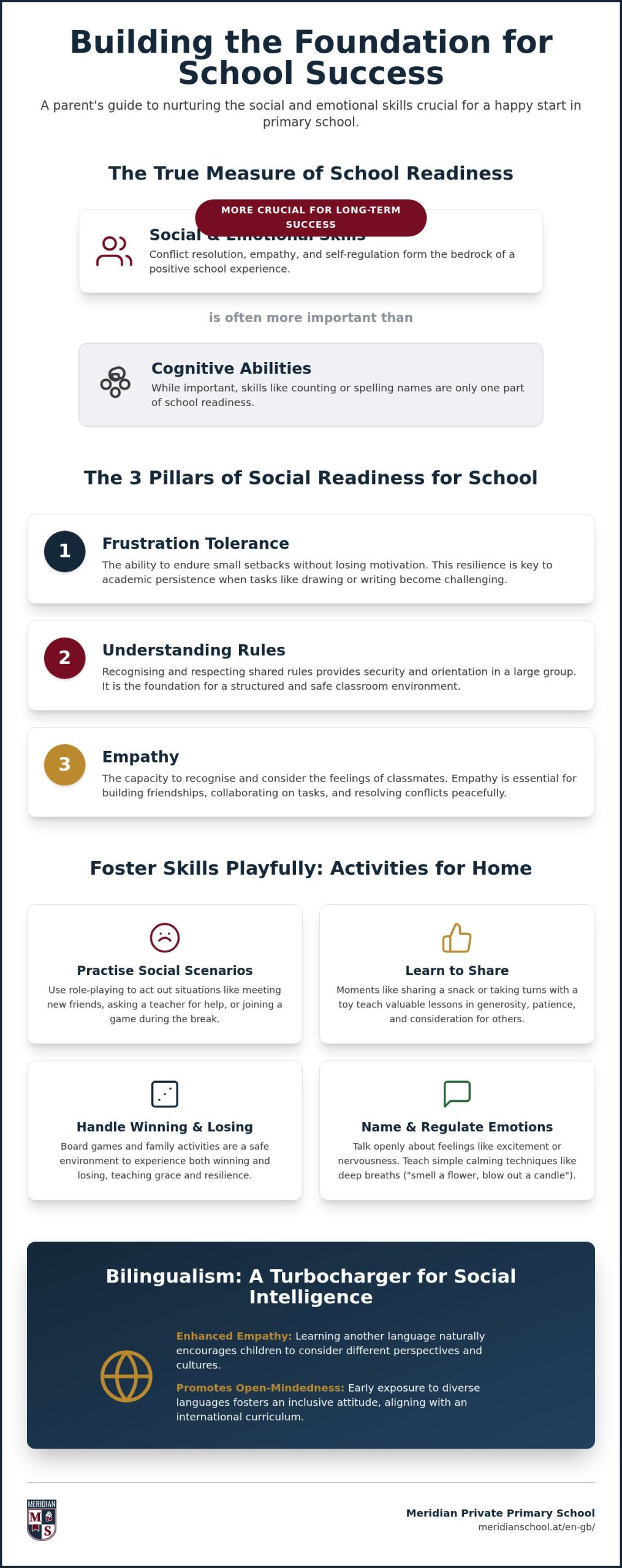
Bilingualism is often primarily perceived as a cognitive advantage, yet its influence on social intelligence is at least equally significant. It goes far beyond merely learning vocabulary. When children discover a second language like English early on, they unconsciously train constant perspective-taking. They grasp that the same object can have different names, which strengthens the fundamental understanding that people can also adopt different viewpoints. Those who specifically wish to foster social skills before school starts will find a powerful tool in multilingualism, as it sharpens empathy by encouraging them to put themselves in other linguistic worlds.
This intercultural competence is a central pillar of the Cambridge Primary Curriculum. In an international environment in Vienna 1190, children learn to experience diversity as a natural enrichment. Openness to other cultures thus becomes a firm part of their identity, even before the first formal day of lessons begins. Our bilingual pre-school courses and playgroups offer the ideal, protected setting for this. In these small groups, children try out the social fabric of school without performance pressure and develop natural confidence in dealing with classmates from all over the world.
Within our educational model, project-based learning plays a key role. Particularly in the STEM focus (Science, Technology, Engineering, and Mathematics), we promote teamwork through joint experiments and research tasks. These cooperative learning methods compel children to communicate, delegate tasks, and find solutions together. A strong social bond emerges that goes far beyond subject-specific knowledge. Through this global approach, pupils develop an identity as part of a worldwide community, which sustainably strengthens their self-confidence and social poise.
Secure this valuable head start for your child and find out more about our bilingual pre-school course for a relaxed start to primary school.
The transition to an all-day school places new demands on a child's stamina and social rhythm. Whilst the morning is characterised by structured learning in line with the Austrian curriculum, the afternoon care in Vienna 1190 offers the space where genuine friendships grow. Parents who actively foster social skills before school starts prepare their child for these longer days by establishing fixed routines and conscious rest periods at home. It's about strengthening emotional resilience for a group dynamic that extends beyond traditional morning lessons.
Use this checklist to assess your child's readiness for private school:
To secure this stable framework for your child in an exclusive learning environment, you can find all enrolment information here.
A successful start often begins at the cloakroom. Short, heartfelt farewell rituals signal security and trust to the child. When parents conceal their own uncertainty and approach educators with a positive attitude, this calmness is immediately transferred to the primary school pupil. This is an essential aspect when we foster social skills before school starts, as a secure detachment from caregivers creates the necessary basis for new social bonds.
In our institution, we deliberately opt for small class sizes. These allow for pedagogical support that is often lost in larger systems. Instead of anonymous mass processing, we offer a family-like environment where the social development of each individual is actively promoted. Every child is perceived as an individual, which optimally supports the development of a strong, open-minded personality and paves the way for a successful educational career.
Starting school marks one of the most significant milestones in your child's development. As we have seen, emotional intelligence, a healthy understanding of rules, and the ability to take different perspectives form the invisible foundation for academic excellence. When you actively foster social skills before school starts, you give your child far more than just prior knowledge. You give them the confidence to navigate safely within a new community. Preparing for the status of a primary school pupil is a shared journey full of discoveries.
As a certified Cambridge International School, we accompany this transition with pedagogical excellence. In Vienna-Döbling, we create a protected space for individual growth through experienced native-speaking educators. Here, education becomes an adventure. Secure your child a gentle and successful entry into the world of knowledge.
Enrol now in the bilingual pre-school course at Meridian School!
We look forward to accompanying your child on this exciting journey and together laying the foundation for an international future.
Social maturity is primarily evident in the ability to accept simple group rules and to endure small frustrations without tears. Observe whether your child recognises the feelings of classmates when playing with others and is willing to share toys or a bread roll. If they also begin to resolve conflicts verbally rather than physically, this is a clear sign of good preparation for primary school in Vienna.
Social competence is not a purely innate trait, but a learnable skill. Parents can actively foster social skills before school starts by using role-playing games or practising how to deal with defeats in board games. Through these playful interactions in everyday life, the child gains the necessary confidence to appear self-assured in the new class community. It is a continuous learning process that is sustainably supported by pedagogical impulses.
Observational behaviour is often an expression of a thoughtful personality and no cause for concern. Support your child by organising meetings in small, manageable groups to minimise social pressure. Often, a protected environment, such as a bilingual pre-school course, helps to forge initial firm bonds in a stable setting. It is important to give the child time for individual development and to strengthen their self-confidence through positive reinforcement.
At Meridian School, we focus on small class sizes, which allow for intensive individual support from our educators. We create a warm atmosphere where every child is perceived as an individual. Through project-based learning in the STEM area and joint activities in all-day care, we foster natural encounters. This way, even shy children find it easier to connect and grow into confident members of our school community in Döbling within an international environment.
Language functions for us as a connecting bridge and not as a barrier. As children learn bilingually in German and English from their first year of school, they develop a special sensitivity to different forms of expression. This early perspective-taking promotes empathy and makes it easier to approach others. In an international environment, pupils quickly learn that friendships across linguistic boundaries arise through shared activities and mutual understanding.