Will the ability to understand an algorithm be as crucial for future success in January 2026 as fluent reading and writing? Many parents in Vienna today face the dilemma that whilst they want to sensibly limit their children's screen time, they also worry that their child might fall behind in a rapidly growing digital world. It's only understandable if you wonder where exactly the line between passive consumption and active creation lies. When children start learning to code in primary school early on, it's not about dry theory, but about grasping logical connections and developing creative solutions.
In this article, you'll discover how your child in Vienna playfully learns the fundamentals of coding and why a bilingual education provides a crucial advantage. We promise you a clear insight into how an understanding of technology fosters cognitive development. Furthermore, we'll show you how to find the right private educational institution in Döbling that links the Austrian curriculum with international standards and optimally prepares your child for a global future.
In primary education, coding means far more than merely typing cryptic character strings. It is rather the acquisition of a structured way of thinking, based on logic and efficient problem-solving strategies. When children learn to code in primary school, they no longer perceive technical processes as inscrutable magic, but as malleable tools. This shift from passive consumption to active creation is a significant milestone in child development. Whilst passive media consumption often only captures attention, programming fosters so-called executive functions: planning complex sequences, constantly monitoring progress, and purposefully correcting errors.
Interestingly, algorithms are already encountered in the simplest everyday life. Whether precisely tying shoelaces or systematically preparing snacks; every action follows a logical sequence of individual steps. If these steps are set incorrectly, the desired outcome is not achieved. This insight forms the foundation for understanding modern Educational Programming Languages, which are specifically designed to make these abstract concepts tangible.
Before the first tablet is used, the journey often begins entirely in an analogue way. Through haptic games in the classroom, children playfully learn about 'if-then' relationships. A popular example is the "Robot Game": one child takes on the role of the programmer, whilst a classmate acts as the robot. With clear, precise instructions, the "robot" must be guided through an obstacle course. Such exercises sharpen awareness of precise communication and demonstrate that machines are only as intelligent as the commands they are given.
Mathematics suddenly comes alive through programming. Instead of merely memorising abstract formulae, children naturally use geometry and number ranges when navigating floor robots. In January 2026, modern tools such as Bee-Bots or Lego Education Sets will be available for this purpose, supporting haptic learning. To make a robot move exactly two squares forward and then turn at a right angle, distances must be estimated and angles understood. Learning to code in primary school transforms mathematics into a language of logic that delivers immediately visible results. This creates a profound understanding of spatial thinking that goes far beyond traditional lessons.
The IT world speaks English. Anyone who wants to grasp the fundamentals of the digital world today cannot avoid this global language. When children learn to code in primary school, they benefit immensely from a bilingual environment that inextricably interweaves technical understanding and language proficiency. This is not about the laborious memorisation of vocabulary lists. Rather, immersion in STEM lessons allows technical terms like "loop" or "variable" to naturally become part of their vocabulary. This early integration optimally prepares pupils for a global academic career, where English remains the primary medium for innovation and research.
Bilingual learning also increases cognitive flexibility. The brain learns to constantly switch between different symbol systems and logical structures. This ability is essential in coding, as various command chains and syntax rules must also be coordinated here. A child accustomed to thinking about concepts in two languages often finds their way more quickly into the abstract logic of a programming language.
English terms in computer science are often more precise and shorter than their German equivalents. Children usually process these terms faster because they are directly linked to the function in the code. By integrating IT vocabulary into daily bilingual lessons, we create a learning environment where technology is not a barrier, but a form of expression. This lays the foundation for a deep understanding of technological processes that goes far beyond mere application.
As a certified Cambridge International School, Meridian Private Primary School links global educational goals with the Austrian curriculum. This symbiosis guarantees that children in Döbling not only meet local requirements but are also fostered according to globally recognised quality standards. The Cambridge certification thus serves as a reliable seal for excellence in the STEM field. If you would like to learn more about our pedagogical approach, take a look at our comprehensive educational offer in Vienna.
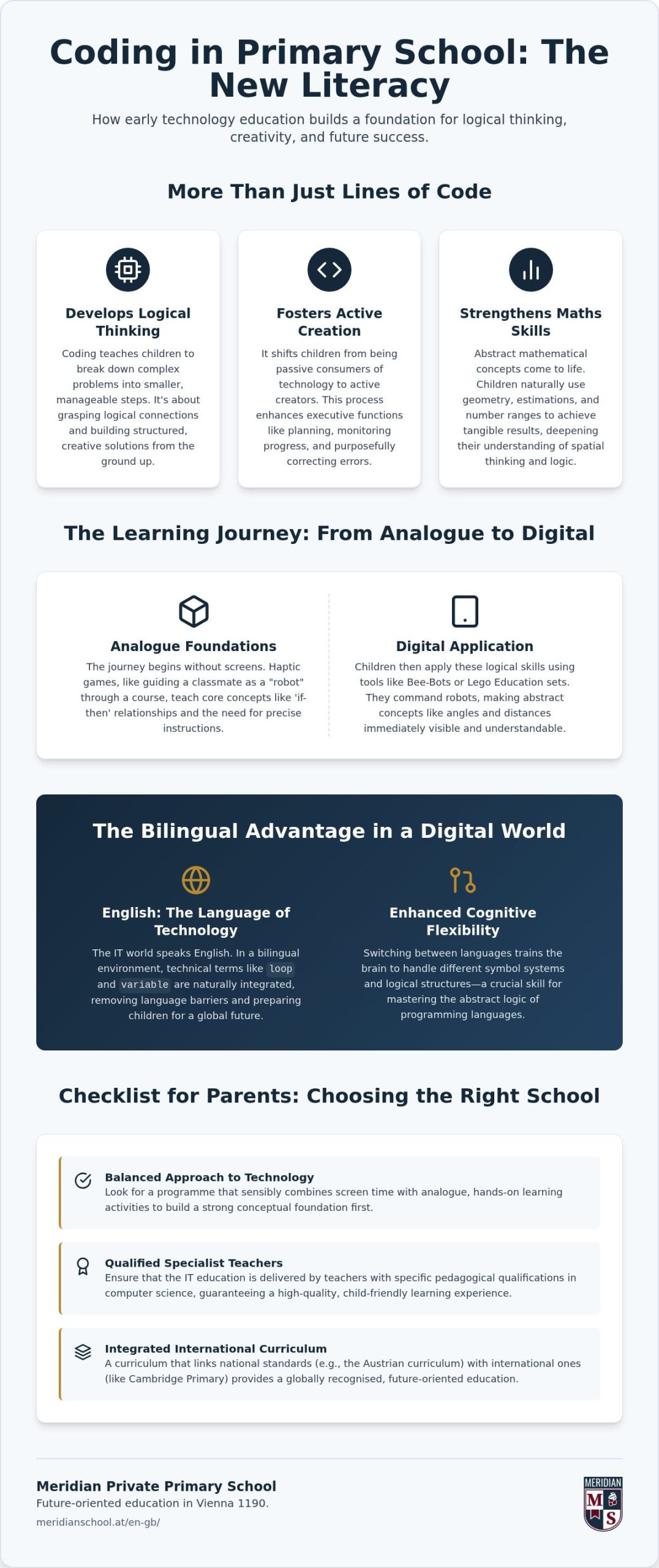
Choosing the right educational institution in Vienna is crucial for your child's digital future. If you are interested in learning to code in primary school, you should look beyond the mere number of available tablets. High-quality education is characterised by a balanced relationship between screen time and haptic, analogue learning. It is essential to question whether the IT infrastructure is meaningfully integrated into daily pedagogical life or merely functions as an isolated single lesson. Furthermore, you should check whether the teaching staff possess specific qualifications in computer science to ensure well-founded guidance.
Utilise your on-site visit to specifically ask about the cross-curricular approach of the curriculum. An innovative concept naturally integrates coding into mathematics or general studies. Ask specifically: Are tools like Scratch Jr or Bee-Bots used? Especially in January 2026, the availability of such tools is a good indicator of up-to-date equipment. Also, enquire about how network security and media literacy are taught. Only then will your child learn a responsible approach to the digital world.
You can also foster your child's development outside of school. During snack breaks or on rainy afternoons, logic-based apps playfully strengthen the understanding of complex relationships. Collaborative experimentation and problem-solving are often more valuable than acquiring the latest gadget. It's about sparking curiosity and understanding the logic behind the processes. If you are looking for a school that already embodies these values in its daily routine, you can find further details about our pedagogical offer in Vienna 1190 here.
Meridian Private Primary School in Grinzinger Straße positions itself as an innovative interface between local tradition and a global future. In our institution, learning to code in primary school is not an isolated additional offer, but an integral part of a structured, bilingual full-day concept. We create an atmosphere of consistency and security, where children find the necessary calm to actively shape complex technological processes. Our goal is to foster an international identity that goes far beyond mere specialist knowledge.
In our small learning groups in Döbling, we place the highest value on the individual development of each pupil. Meridian Private Primary School combines academic professionalism with a warm atmosphere, where every child can explore at their own pace. As a competent and reliable partner, we support families in choosing a stable yet future-oriented environment for their children's education.
The explicit link between state recognition and a globally oriented curriculum forms the core of our pedagogical vision. Learn more about our specialised STEM focus and how this spirit of inquiry lays the foundation for an excellent education. Our graduates are characterised by a high level of problem-solving competence, which optimally prepares them for the challenges of secondary education.
We warmly invite you to experience the special atmosphere and modern learning spaces of our school during a personal visit. Detailed information on the procedure and deadlines for school registration in Vienna can be found on our website. Visit us in 1190 Vienna and discover how we, as pioneers in the region, bridge the gap between local stability and international aspiration.
The decision for the right primary school is a long-term investment in your child's cognitive and professional development. As we have highlighted, learning to code in primary school is far more than a technical exercise; it is a training of the mind for a connected, global world. Meridian Private Primary School offers the ideal framework for this, combining academic excellence with an appreciative and modern learning environment in the heart of Döbling.
As a certified Cambridge International School, we guarantee an education of international standard. Through our STEM focus from the 1st year and bilingual full-day care in Vienna 1190, we ensure that your child acquires the necessary competences not only to understand technological processes but also to actively shape them. We invite you to embark on this future-oriented path with us and fully develop your child's individual potential in a stable, professional environment.
Book an appointment for a personal consultation in Döbling now
We look forward to welcoming you and your child to Meridian Private Primary School and personally introducing you to our innovative pedagogical concept.
It is absolutely sensible to start with the playful fundamentals from the very first school year. At this age, the focus is not on writing code, but on grasping logic and sequences. When children start learning to code in primary school early, they develop a natural understanding of cause-and-effect principles that benefits them in all other subjects. The introduction usually takes place entirely without a screen, through haptic games.
No, specific English knowledge is not required to start our STEM focus. We use the immersion method, where children learn the language naturally through doing and experimenting. Technical terms from the world of technology are introduced in context and made tangible through practical action. This approach removes children's apprehension about the foreign language and promotes language proficiency incidentally.
We consistently rely on a balanced approach between analogue explorations and targeted digital units. A large part of the logical training takes place haptically or through movement in the room, to holistically foster cognitive development. The actual work on a tablet or computer is clearly time-limited and always tied to a specific pedagogical goal. Thus, children learn to perceive technology as a useful tool and not as mere entertainment consumption.
We use age-appropriate tools that link haptic experience with digital logic. In January 2026, modern Bee-Bots and Lego Education Sets will be a fixed standard of our equipment in Vienna. These tools enable pupils to physically programme command chains and immediately observe the results in the room. For advanced exercises, we use visual environments like Scratch Jr, which do not require complex text input and focus on pure logic.
The Cambridge Primary Curriculum extends the Austrian curriculum with an international perspective and a strong focus on scientific work. It specifically fosters the spirit of inquiry and the ability to systematically analyse complex problems. These global standards harmonise perfectly with the requirements of computer science, as they centre on critical thinking and the precise communication of solutions. Our pupils are thus educated to become competent problem-solvers in an international environment.