Did you know that your child's brain in primary school functions like a high-performance engine, which isn't overwhelmed but rather precisely calibrated by two languages? Many parents in Vienna face the decision of whether to entrust their offspring with a bilingual education. The concern that German spelling might suffer or that school life might become too strenuous is understandable and shows how much you care about their educational success.
When children grow up bilingual, the advantages extend far beyond mere vocabulary learning. It's a genuine cognitive training that strengthens problem-solving skills and flexibility from the first year. In this article, you'll discover how the immersion concept works through native speakers and why the exclusive combination of the Cambridge Curriculum and the Vienna curriculum forms the ideal basis for the later transition to secondary school. We debunk myths and show you how a structured environment, including a STEM focus and healthy snacks, lays the groundwork for an international future in 1190 Vienna.
The concept of immersion, often referred to as a "language bath", forms the core of modern bilingual education. Unlike traditional foreign language lessons, English here is not treated as an isolated subject. Instead, the language functions as a natural tool to convey complex content. When children grow up bilingual, the advantages lie primarily in intuitive application. Native speakers act as consistent caregivers who accompany the entire school day. They create an authentic environment where the second language is learned without artificial pressure to perform.
The difference from conventional English lessons from the 1st school year is striking. Whilst there, often only individual hours are reserved for songs or simple vocabulary, in a bilingual primary school, continuous interaction takes place. This constant practice leads to measurable cognitive advantages of bilingualism, as the brain continuously switches between two systems. A crucial aspect is the safeguarding of the first language. The Austrian curriculum forms the stable foundation, whereby proficiency in German spelling and expression is maintained at the highest level.
In practice, immersion means that children acquire the language playfully "incidentally". Imagine a maths lesson where geometric shapes are named in English. The pupils concentrate on solving the puzzle, whilst the English technical terms naturally become part of their vocabulary. This cross-curricular approach sharpens understanding and removes the fear of making mistakes, as communication and content take precedence, not the grammatical correctness of every single syllable.
Vienna has established itself as an international educational hub, offering ideal conditions for multilingual schools. Particularly in the 19th district, the importance of linking local recognition with global aspirations is evident. The decision for bilingual instruction in Vienna optimally prepares children for a connected world. It is an investment in a stable, high-quality environment that combines academic excellence with a warm atmosphere and lays the groundwork for later success in secondary school.
When children grow up bilingual, the advantages extend far beyond mere communication. The brain becomes a centre for cognitive flexibility. Bilingual primary school pupils train their executive functions daily. They learn to filter information faster, set priorities, and efficiently switch between complex tasks. This process strengthens the ability for self-regulation and planning, which positively affects all subjects. Children develop a mental agility that allows them to confidently handle changes later in life.
Concentration ability, in particular, benefits massively from this training. The constant management of two language systems requires high selective attention. The brain must suppress the language not currently needed, which intensifies neural networking. Scientific studies prove the far-reaching cognitive benefits of bilingualism, which persist far beyond childhood. This increased attention helps pupils to focus on the essentials even in a lively classroom environment.
An often underestimated aspect is the logical synergy with STEM subjects. Those who learn to decipher the structures of two languages develop a deeper understanding of abstract logic. This helps in solving mathematical problems as well as in the first contact with computational thinking. Language logic here serves as a bridge to complex scientific contexts.
Bilingual children often find more creative solutions because they are accustomed to viewing concepts from different angles. In combination with a targeted STEM focus, a spirit of inquiry emerges that goes far beyond rote learning. The pupils learn to form hypotheses and articulate their discoveries confidently. An atmosphere is created where curiosity and scientific precision go hand in hand.
Language is the key to empathy and intercultural competence. In an international community in Vienna 1190, children experience diversity as an enriching normality. This strengthens self-confidence and prevents prejudices from arising. They communicate confidently in two worlds and develop an identity that is locally rooted and globally oriented. Take a look at our educational offerings to learn more about this holistic development approach.
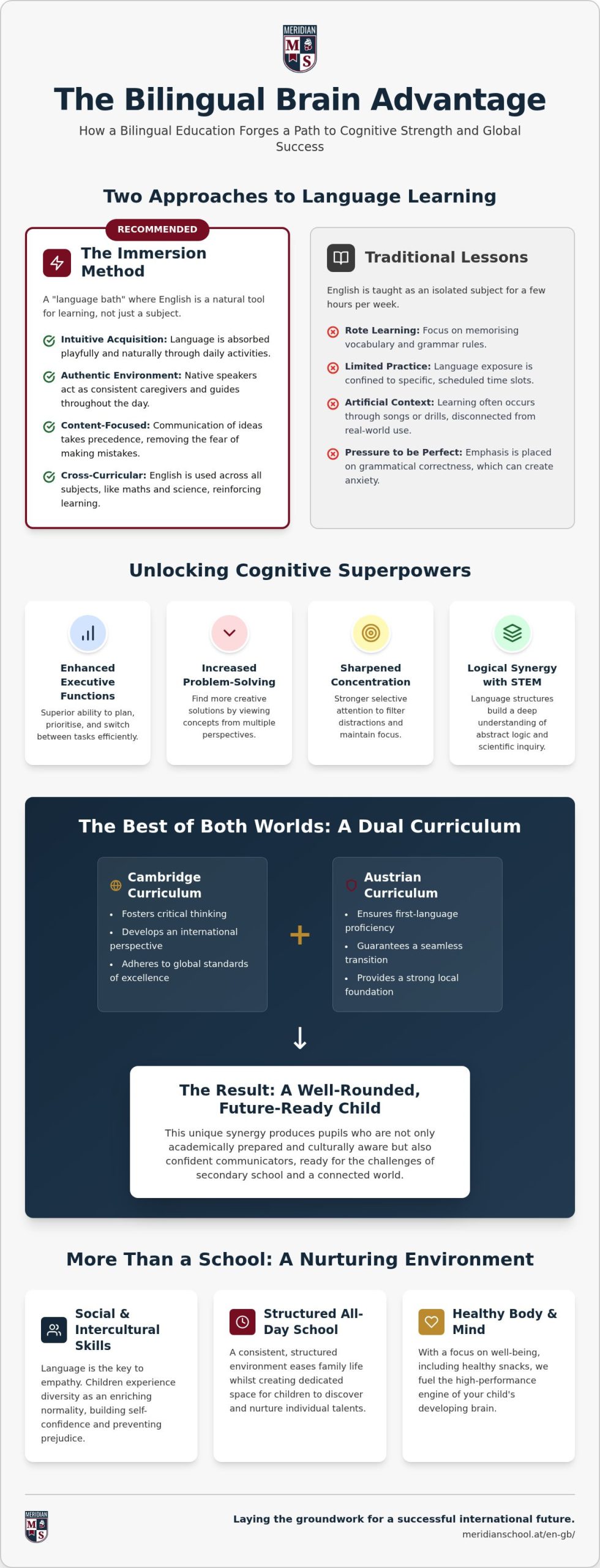
The choice of the right primary school in Vienna Döbling significantly determines your child's academic career. Here, two first-class systems merge into a unit that combines local stability with global excellence. Whilst the Austrian curriculum for primary schools secures the legal and content basis, the Cambridge Primary Curriculum broadens horizons through innovative pedagogical approaches. When pupils grow up bilingual, the advantages lie primarily in the development of critical thinking and an open-minded perspective, which is specifically fostered in the subject "Global Perspectives".
This seamless integration ensures that children are not only internationally competitive but also meet all requirements of the state education system. Meridian graduates often have a significant advantage when transitioning to secondary school. They possess a high degree of independence and the ability to confidently grasp complex matters in two languages. The quality of this education is guaranteed by regular external evaluations from Cambridge International Education, which secures an excellent, world-class educational standard.
As a certified Cambridge International School, our institution plays a pioneering role in the region. This accreditation is a valuable promise of quality that takes effect from the 1st school year. Children are gently introduced to international standards without losing touch with their local identity. This optimally prepares them for later international qualifications and a global career, whilst remaining firmly rooted in the Vienna school system.
Regular learning assessments according to global and local standards ensure maximum transparency. This provides parents with precise feedback on their child's individual development. A deeper insight into this methodology is offered in our specialist article on the Cambridge Primary Curriculum in Vienna. We warmly invite you to learn more about our educational offerings and together shape the ideal start for your child's school career.
The decision for the right educational institution is a formative moment in a family's life. In Vienna 1190, specifically on Grinzinger Straße, we value an environment that combines academic excellence with a familial sense of security. When children grow up bilingual, the advantages lie not only in cognitive brilliance but also in the social security that a stable framework offers. When choosing a school, pay particular attention to the qualifications of the native speakers. It's not enough just to speak the language; pedagogical competence is essential to successfully implement immersion.
Another important factor is the classroom environment and the organisation as an all-day school. Structured afternoon care significantly eases family life. It ensures that homework and learning content are already consolidated at school. When planning, note the deadlines: For the 2027/28 school year, pre-registration for many private educational institutions already ended on 1 August 2026. Take a timely look at our information on registration to secure the ideal place for your child.
School is more than a place of learning; it is a living space. Healthy snacks provide the necessary energy for complex thought processes. Targeted exercise breaks are equally important. Whether during sport or conscious stair climbing between sessions; physical activity sharpens concentration. Our musical and sports extracurricular activities complement the bilingual daily routine and foster individual talents outside of core subjects.
Parents often express concern that German grammar or spelling might suffer under the focus on English. However, scientific studies and our many years of experience show the opposite: intensive engagement with language structures sharpens awareness of both languages equally. For a relaxed transition from kindergarten, we recommend our guide for a successful school start in Vienna. This way, you and your child can confidently and joyfully embark on this new chapter.
The choice of primary school sustainably shapes your child's further educational path and lays the foundation for lifelong learning. When children grow up bilingual, the advantages are clear: they develop cognitive flexibility and natural problem-solving skills that go far beyond purely linguistic aspects. Through the unique combination of the Cambridge Primary Curriculum and the proven Austrian curriculum, we create a learning environment that offers security within the local system whilst opening up global perspectives.
As a certified Cambridge International School, proudly bearing the STEM Quality Seal for excellent scientific promotion, we guarantee a world-class education. In our warm and familial atmosphere in the heart of Vienna Döbling, we accompany each child individually in their development. It is important to us that the joy of acquiring knowledge and personal development always remain at the forefront. We invite you to walk this path with us and fully unleash your child's potential.
Would you like to learn more about our pedagogical concept and daily school life on Grinzinger Straße? Register now for a consultation and get to know Meridian Private Primary School. We look forward to personally welcoming you and your child soon.
No, bilingual instruction is designed to meet all children where they are. Through the immersion principle, pupils naturally dive into the English language without requiring prior knowledge from parents. Native speakers accompany the entire school day and use facial expressions and gestures to make learning content understandable. As we consistently follow the Austrian curriculum, proficiency in the first language is maintained, whilst the second language playfully becomes part of daily life.
Scientific findings show that the opposite is true. When children grow up bilingual, the advantages often lie in a heightened awareness of grammatical structures in both languages. Since German lessons hold a high priority with us and are conducted according to state standards, children develop above-average language proficiency. The ability to switch between two systems trains the brain and improves attention to detail when writing and reading.
Starting from the 1st school year is ideal, as the window for natural language acquisition is wide open at this age. Children learn the basics of reading and writing in parallel in both languages in the first year, which massively supports the cognitive process. A later entry is possible after individual consultation but often requires an assessment of the current language level to ensure optimal support within the classroom community.
The Cambridge Primary Curriculum complements the local curriculum with international standards that particularly promote critical thinking and independence. Subjects like "Global Perspectives" encourage pupils to view topics from different angles and develop their own solutions for complex questions. This education specifically prepares pupils for a global world and, through regular evaluations, offers objective quality assurance that goes far beyond conventional assessments.
The costs for private educational institutions in Vienna typically consist of monthly school fees, material costs, and catering. Since each institution includes different additional offerings such as STEM workshops, musical enrichment, or sports activities, the amounts vary depending on the extent of care. For detailed information on current fees and registration formalities at our school, please refer to our specific overview of School Fees. We recommend viewing these costs as a long-term investment in your child's individual development and academic future prospects.