What if the hours after lessons didn't just bridge the time until the end of the working day, but became the most exciting part of the day for your child? Many parents today face the great challenge of finding high-quality afternoon care in Vienna that goes far beyond mere supervision. The worry that children are simply "looked after" often weighs heavily, whilst the pressures of professional life demand a reliable and pedagogically valuable solution.
We understand that pedagogical excellence and a warm atmosphere are just as important to you as organisational security for your family. In this guide, you will learn everything about the different models of afternoon care in Vienna and how your child can sustainably benefit from bilingual development and targeted STEM foci. We provide a precise overview of the cost structures for the 2026/27 school year, explain the critical registration deadline of 1st July, and show ways in which professionally supervised homework can finally make family evenings stress-free quality time again. Discover how modern leisure activities with languages and sport lay the foundation for an open-minded, international future.
The decision for the right afternoon care in Vienna begins with understanding the different organisational forms. Under the term 'school-based full-day care', the City of Vienna bundles all programmes that extend beyond morning lessons. It is not merely waiting for the end of the parents' working day. Rather, it is a structured educational space that significantly shapes children's learning rhythm. Whether the daily snack is eaten in a group or how much time is left for homework depends directly on the chosen model.
The after-school club represents the classic, often external solution. It is usually attended by children who complete a half-day school programme. Those who ask: What is an after-school club?, will find it to be a socio-pedagogical institution that exists independently alongside the school. In contrast, there is internal school-based afternoon care and the integrated full-day school. In Vienna, according to studies, around 43% of schoolchildren use external or internal care programmes, which underlines the enormous importance of these structures. Whilst in the "open school" model, the afternoon is booked optionally, in the integrated model, lessons, sport, and leisure are spread throughout the entire day.
The choice between an after-school club and internal school-based care is often a question of logistics and social continuity. An after-school club often offers more flexibility in pick-up times, which is essential for working parents. However, children often have to change floors or even leave the school building for this. In an integrated solution, pupils remain in their familiar class group. This promotes social stability and enables a seamless transition from theory to practice, as we encourage in our educational offer through the combination of curriculum and leisure activities.
An innovative approach in Vienna's educational landscape is the "Campus Plus" model. Here, kindergarten and primary school are closely brought together under one roof. This networking enables a fluid transition between educational phases. Especially with a focus on music or sport, children benefit from continuous infrastructure. A living space is created that goes beyond mere learning and offers children security through consistency. This modern form of organisation reflects the spirit of future-oriented education that combines local roots with global demands.
Whilst many institutions primarily view the time after lessons as leisure without a targeted pedagogical focus, bilingual immersion opens up completely new horizons. High-quality afternoon care Vienna uses children's natural play drive to break down language barriers. In an environment where English functions not as a dry school subject but as a living means of communication, children learn the foreign language intuitively and without any pressure to perform. This constant language switching demonstrably promotes cognitive flexibility and strengthens the brain's executive functions.
An international atmosphere is not just a buzzword here, but a lived reality. Native-speaking carers accompany pupils through the afternoon and playfully expand their vocabulary during crafting, researching, or physical activity. This is how we prepare the next generation for a global future where multilingualism forms the basis for success. Children develop a natural self-understanding in dealing with different cultures, which sustainably strengthens their social competence.
From shared lunch and snacks to sport on the outdoor grounds: Bilingual communication works most naturally when it is embedded in everyday life. Children who only speak one language at home find a safe space here to try out their skills without inhibition. It's not about perfect grammar, but about the joy of expression. For parents seeking a solid foundation, our article Bilingual School in Vienna: The Best Choice for Primary School 2026 offers valuable deeper insights.
The quality of care at our school does not end with the last lesson. Through certification as a Cambridge International School, we ensure consistency in the curriculum that also enriches the afternoon. The Cambridge Primary Curriculum offers exciting approaches that are incorporated into leisure activities. This international quality assurance gives you the certainty that your child is being developed in a stable and at the same time modern environment. Discover our holistic educational offer that brings these standards to life every day.
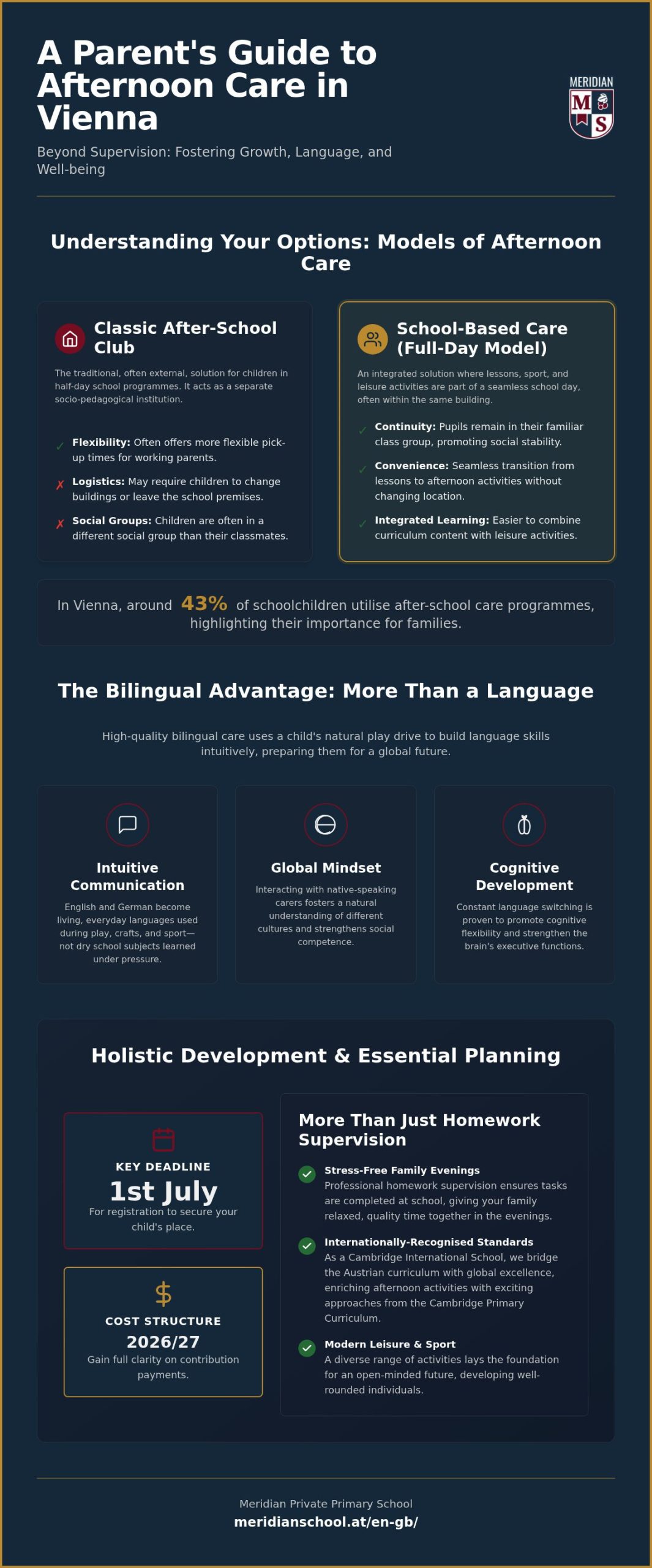
Organising family life requires foresight and structured planning. Those looking for high-quality afternoon care Vienna for the 2026 school year should consider the administrative procedures early on. In Vienna, the choice of care model usually takes place parallel to school enrolment in January. Whilst fixed deadlines often apply to public institutions, such as 1st July 2026 as the deadline for applications for fee reductions at MA 10, private institutions often offer more individual consultation windows and more flexible admission procedures.
The cost structure usually consists of the monthly care contribution, meal costs for the daily snack and lunch, and occasional material costs. A significant financial aspect is tax deductibility. In Austria, expenses for childcare by pedagogically qualified staff can be claimed for tax purposes up to a certain age of the child. This noticeably reduces the effective burden on the family budget and makes the investment in excellent education even more attractive.
When visiting on an open day or taking a personal tour, you should have a specific checklist in mind. Pay particular attention to the following points:
Transparency is the basis for trust. In private models, many additional services, such as native-speaking care or special sports programmes, are often already included in the contribution. A comparison of services quickly shows that the investment in holistic development pays off in the long term through higher cognitive flexibility and social competence in the child. A detailed overview of school fees will help you precisely calculate the costs for the upcoming school year.
To secure a place in a bilingual full-day class for 2026, prompt contact is advisable. In addition to the child's age, admission requirements often include a personal meeting to ensure that the pedagogical concept harmonises with the family's expectations. As demand for specialised afternoon care Vienna is constantly increasing, early registration ensures the best chances for your desired place. Find out more about registration now and plan your child's future with certainty and professional support.
Excellent afternoon care Vienna is characterised by satisfying children's natural thirst for knowledge even after regular lessons. At Meridian Private Primary School, we view the afternoon as valuable educational time in which talents are individually fostered. It's not about merely passing the time. Instead, we create a space where pedagogical competence and warm care intertwine. A central component is structured learning time. Under professional guidance, children complete their homework, which noticeably relieves family evenings and gives pupils confidence in dealing with the learned material.
Physical and mental vitality are always at the centre. A balanced snack provides the necessary energy for subsequent activities. We place great importance on healthy nutrition, as it significantly influences concentration. Whether making music or playing sports together: Children receive holistic support that strengthens their personality development and reinforces social skills within a team.
Researching brings joy. Through our STEM emphasis, we awaken the spirit of discovery from the very first year. When children experiment in the afternoon and playfully grasp technical connections, they lay the foundation for a deep understanding of the natural sciences. These creative projects go far beyond the standard curriculum and promote innovative thinking. You can read why this approach is so essential in our article STEM Emphasis in Primary School 2026.
After concentrated learning phases, physical activity is the ideal balance. The "active break" is an integral part of our daily routine and ensures that children's need for movement is not neglected. Our diverse additional sports programmes not only promote coordination but, above all, team spirit. Those interested in the breadth of our programme will find valuable details in the Guide to Additional Programmes at Vienna Schools 2026. Thus, afternoon care Vienna becomes a place where children can grow healthily and discover their world with enthusiasm.
Choosing the right afternoon care Vienna is far more than a purely organisational necessity; it is a fundamental decision for your child's individual development. As we have highlighted in this guide, the quality of pedagogical support largely determines whether the hours after lessons are experienced as mere waiting time or as a valuable educational space. At Meridian Private Primary School, academic professionalism and a warm atmosphere merge into a concept that sustainably eases family life.
As a certified Cambridge International School, we set standards that extend far beyond the morning. With our focus on bilingual lessons from Year 1 and targeted STEM development, we prepare pupils for the demands of a globalised world. Diverse school sports and professional homework supervision ensure that your child's talents are optimally fostered, whilst evenings once again belong entirely to shared family time at home. Discover our holistic offer for your child and learn how we, as a reliable partner, shape your child's future. We look forward to accompanying you and your child on this path to success.
Afternoon care in Vienna usually ends in most institutions between 17:00 and 17:30. Many schools also offer additional late care, which can be used until 18:00 if required. At our institution, we value a reliable time structure that meets parents' professional requirements and at the same time offers children sufficient space for relaxation and free play after lessons.
The obligation for daily attendance largely depends on the chosen school model. Whilst in the integrated full-day school, the entire daily routine until the afternoon is compulsory for all pupils, the "open school" or private models often offer the possibility of daily registration. This flexibility allows families to adapt care individually to their weekly rhythm and specifically choose foci such as bilingual units or sports activities.
Yes, the City of Vienna grants income-dependent reductions for the care contribution in public institutions via MA 10. For private afternoon care Vienna, parents can also claim the incurred costs as childcare costs for tax purposes within the framework of the employee tax assessment. It is advisable to keep an eye on the application deadlines for the 2026/27 school year as early as January, parallel to school registration, to optimally utilise financial benefits.
The essential difference lies in the organisation and location of the institution. An after-school club is a socio-pedagogical institution that often operates spatially separate from the school, which is why children often have to change buildings or floors after lessons. School-based full-day care, on the other hand, takes place directly at the school site. This enables a seamless transition between lessons and leisure in the familiar social environment, which represents an important constant, especially for primary school pupils.
We offer a specialised programme during the summer holidays in the form of our Bilingual Summer Day Camp. During these weeks, we combine sports activities and creative projects with English immersion, so that children can playfully deepen their language skills even during school holidays. This programme is an ideal complement to regular afternoon care Vienna and ensures that children are professionally and warmly looked after in an international environment even during the holidays.