In 2026, movement is not merely a pastime between lessons, but the crucial biological engine for your child's peak cognitive performance. Many parents in Vienna are rightly concerned that the growing focus on purely academic goals often leads to a significant lack of physical activity. They instinctively feel that a child who sits still all morning can hardly fully develop their individual talents. Targeted sport in primary school is therefore far more than just physical exercise; it is the foundation for concentration and mental growth.
In this article, you will learn how modern movement concepts promote neural networking and why physical activity is the indispensable basis for sustainable learning success. We will provide valuable guidance for choosing a school in the 19th district and explain what truly matters in a contemporary sports programme. We will also take a look at the current competence-oriented curriculum from January 2026 and show you how Meridian School uses sport as an integrative tool to harmoniously combine health and bilingual knowledge acquisition.
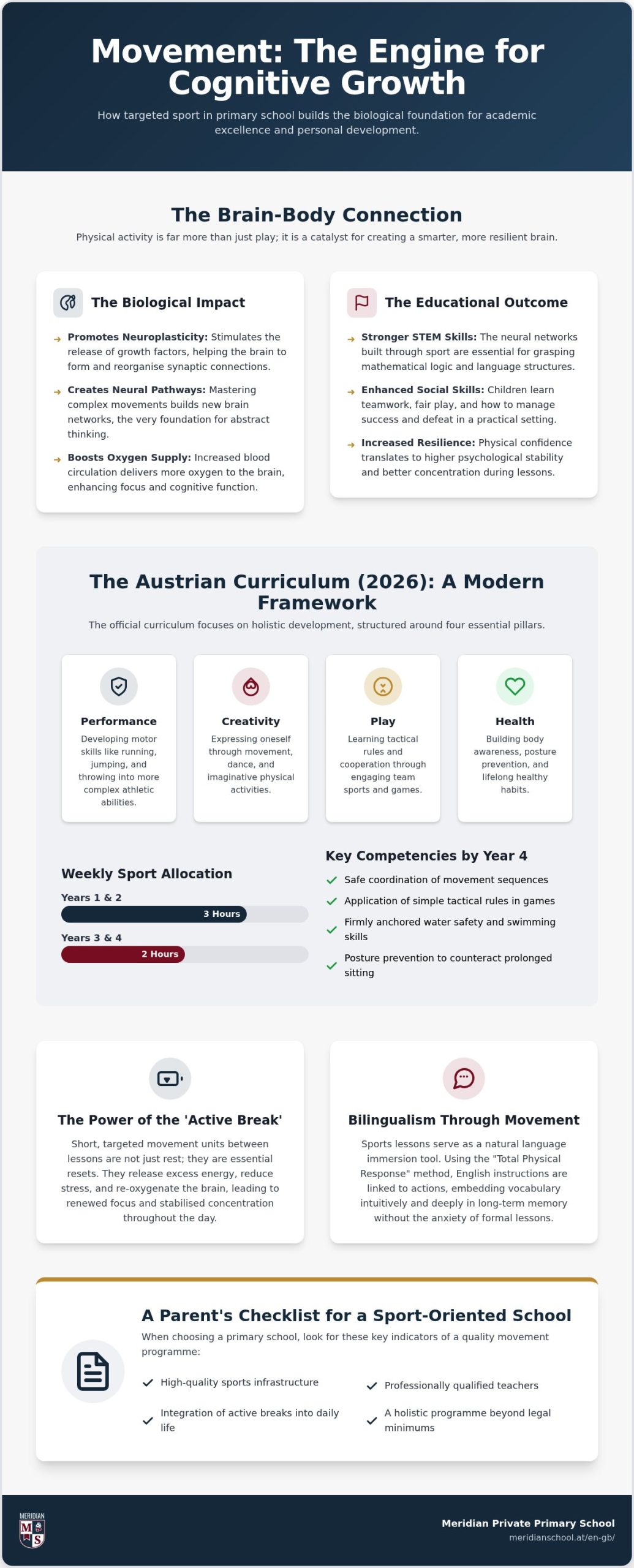
In primary school, sport is not merely a pastime; it acts as a biological catalyst for mental development. Modern neuroscience proves that physical activity stimulates the release of growth factors in the brain, which massively promotes neuroplasticity. When children master complex movement sequences in the sports hall, they literally create new neural pathways. This networking is the prerequisite for later grasping mathematical logic or abstract language structures in the classroom. A well-founded sport in primary school approach therefore views movement as an integral part of cognitive development.
In addition to the purely biological component, shared physical activity strengthens social skills. Team spirit, fair play, and dealing with success or defeat are experienced directly here. The pedagogical concept is based on the principles of physical education, which go far beyond mere running. It is about developing motor skills, which directly correlate with cognitive flexibility. Children who confidently control their bodies often show higher psychological resilience and more stable concentration during learning phases.
The "active break" is far more than just a rest from sitting. It serves as an essential outlet to release excess energy and reduce stress levels. After intensive sessions in STEM subjects, young brains need this physical interruption to process what they have learned. Short, targeted movement units loosen muscles and promote blood circulation, optimising the brain's oxygen supply. Thus, pupils return to their desks with renewed focus.
In an international environment, sports lessons offer a unique opportunity for language acquisition. By linking physical activity with foreign language instructions, vocabulary is more deeply embedded in long-term memory. This principle of "Total Physical Response" makes learning intuitive and anxiety-free. Especially in a bilingual school in Vienna, it is evident that children internalise English commands in play much faster than through mere rote learning of vocabulary. Movement thus becomes a bridge-builder between languages.
The current official curriculum for Movement and Sport, which has been in effect in its refined form since January 2026, defines clear competence goals for primary education. It places the joy of movement at the centre of pedagogical work and is structured into four essential pillars: Performance, Creativity, Play, and Health. This structure ensures that sport in primary school is understood not only as physical exercise but as holistic personality development. In the first two school years, the focus is on three hours per week, whilst in the third and fourth years, two hours are provided to consolidate motor skills.
Learning processes are designed to be process-oriented. Children begin with elementary forms of movement such as running, jumping, and throwing, which are developed into more complex skills in gymnastics or athletics over the four years. An indispensable component remains water safety. The acquisition of swimming badges is firmly anchored in the curriculum to ensure pupils' safety in their leisure time. Inclusion plays a central role; modern concepts make it possible to meet each child at their individual level and enable experiences of success, regardless of physical prerequisites.
By the end of the fourth year, pupils should be able to safely coordinate movement sequences and apply simple tactical rules in sports games. Given increasing digitalisation, the 2026 curriculum places a stronger focus on posture prevention. Targeted exercises to strengthen core muscles counteract the negative effects of prolonged sitting. The aim is to create an awareness of one's own body that lasts beyond school years.
State minimum requirements merely form the framework for healthy development. Often, the legally prescribed hours are not enough to meet the natural urge to move and the need for cognitive relief. Additional non-compulsory exercises and sporting focuses are therefore essential. Those seeking a school that has already embedded this synergy of academic excellence and physical vitality into daily life will find a future-oriented solution in Meridian School's holistic programme.
Choosing the right sport primary school in Vienna is a decision that extends far beyond the sports timetable. Parents should critically examine the existing infrastructure when visiting potential locations. A modern, bright sports hall is just as important as generous outdoor areas that can also be actively used during breaks. Pay attention to whether sport is viewed as an isolated compulsory subject or whether movement functions as a vibrant part of the entire school environment. A recent study on fitness and concentration confirms that physical endurance significantly increases the cognitive performance of primary school children.
An often underestimated factor is the qualification of the teaching staff. It makes a qualitative difference whether general educators lead sports lessons or whether specialised professionals with a sports science background design the units. In an international environment, there is also the opportunity to use sport as an immersion tool. When commands and game rules are conveyed in English, children playfully consolidate their language skills. This synergy of movement and bilingualism is a unique selling point of modern private schools, ideally complementing the academic focus.
Prepare for your conversation with the school management. Specifically ask about the frequency of movement units outside the sports hall and about collaborations with Viennese sports clubs. A look at the additional offers at Vienna schools will help you better assess the quality of individual support. Also, ask how the school deals with different performance levels to avoid over-challenging or boredom.
Physical activity requires the right energy supply. A balanced snack consisting of a wholemeal roll, fresh tomatoes, and some curd cheese provides complex carbohydrates and proteins that keep blood sugar levels stable. Avoid sugary bars, which only lead to short energy spikes. Fresh water should always be available as the most important drink to ensure hydration during and after sport. Conscious nutritional education in daily school life lays the foundation for a healthy lifestyle.
Would you like to see how we combine movement and first-class education? Find out more about our holistic pedagogical programme in the heart of the 19th district.
At Meridian Private School, we understand movement not as an isolated subject, but as a living principle of our entire school day. In our structured full-day care in the 1190 district, sport in primary school is firmly integrated into the daily rhythm. We use every opportunity for activity, even the architectural features of our building. The daily use of the staircase is consciously celebrated as a small fitness unit during transitions between specialist rooms, to keep the circulation going even between learning phases.
A central element of our pedagogical identity is bilingual sports lessons. Here, physical challenge and language acquisition merge naturally. When our pupils receive English instructions during ball games or coordination exercises, they consolidate their language proficiency without the pressure of traditional tests. Our wide range of additional offers extends from relaxing yoga to dynamic ball sports. This ensures that every child finds a discipline that brings individual joy and sustainably strengthens self-confidence.
In our afternoon care, we place great emphasis on channelling children's natural energy constructively. After the intensive academic phases of the morning, our sports programmes provide the necessary balance for regeneration. For parents who also value an active and language-promoting environment during school holidays, our Bilingual Summer Day Camp offers the ideal solution. Here, we combine sporting adventures with playful English learning during the holiday months.
As a certified Cambridge International School, we follow the Cambridge Primary Curriculum, which values Physical Education (PE) as an essential component of child development. This is not just about physical fitness, but about a holistic understanding of health and well-being. We often link this approach with our STEM focus. When pupils analyse the trajectory of a ball or measure the effects of movement on their pulse, a spirit of inquiry and physical self-experience combine to create a profound learning experience.
A modern sport in primary school approach today no longer sees movement as an isolated subject, but as an indispensable partner in academic education. As we have seen, targeted physical activity not only promotes physical health but also creates the biological prerequisites for concentration and mental flexibility. The decision for the right school in Vienna thus lays the foundation for whether your child experiences sport as a mere duty or as an enriching part of an international identity.
At Meridian Private School, we consistently rely on the symbiosis of state-of-the-art sports infrastructure in the 1190 district and individual support in manageable small groups. Our experienced sports educators, who act as native speakers, help your child to develop physical strength and linguistic confidence simultaneously. We warmly invite you to join us on this future-oriented path and holistically develop your child's talents.
Find out more about school registration for 2026 now
We look forward to competently accompanying your child on their journey to an alert mind in a healthy body.
Children at Meridian Private School receive at least the units stipulated in the official curriculum 2026, which corresponds to three hours per week in the first and second school years. In the third and fourth years, two hours are scheduled. As movement is important to us as a basis for learning success, we supplement this framework with daily active breaks and diverse additional sports programmes in the afternoon. This ensures that sport in primary school at our institution goes far beyond the legal minimum.
For regular lessons, pupils only need basic sports clothing such as a T-shirt, shorts, and indoor shoes with light, non-marking soles. We place great importance on functional clothing that allows unrestricted freedom of movement. Should additional items be required for specific courses in the afternoon programme, for example for yoga or special ball sports, we usually provide these directly in our modern sports hall or inform you in advance.
Yes, weather permitting, we make extensive use of our own outdoor areas as well as the surrounding green spaces in the 19th district. Outdoor activity is an essential part of our pedagogical concept to optimise the brain's oxygen supply and strengthen immunity. The alternation between training in the sports hall and outdoor activities provides necessary variety and fosters children's connection with nature.
We consistently focus on individual support in small groups to meet each child exactly where they are in their motor development. Our experienced educators design the units playfully and in a differentiated manner, so that the joy of shared activity, rather than pure performance pressure, is paramount. Through this positive approach, even children who initially lack confidence achieve quick successes and develop healthy self-esteem regarding their bodies.
Regular sports festivals and joint activity days are fixed components of our calendar and form emotional highlights of the school year. At these events, we celebrate the joy of movement and the team spirit of our school community. Our focus is less on fierce competition and more on achieving common goals and appreciating individual progress. These festivals offer children a wonderful stage to present their learned skills in a supportive environment.