What if learning a foreign language in primary school wasn't a laborious task, but happened as naturally as breathing? Many parents in Vienna are rightly concerned whether a bilingual daily routine might overwhelm their child or if German spelling would suffer due to the focus on English. However, the benefits of a bilingual primary school extend far beyond merely memorising vocabulary. They function more as a cognitive operating system for the entire academic career.
It is absolutely understandable that you desire a stable environment for your child that both preserves local traditions and opens up global horizons. In this article, you will learn how your child gains cognitive advantages, social openness, and first-class preparation for a connected world through bilingual primary education and targeted immersion. We give you an exclusive insight into the daily life of an international school in the 19th district and explain how the combination of the Cambridge Primary Curriculum and the Austrian curriculum lays the foundation for academic excellence. Additionally, you will receive clarity on important deadlines, such as the admissions interviews taking place in January 2026, to give you complete certainty in your choice of school.
A bilingual primary school fundamentally differs from traditional foreign language teaching as one knew it from before. Whilst conventional schools often offer English as only a one-hour subject per week, here the foreign language functions as a living working language. This model of Bilingual education is based on the scientifically proven principle of immersion. The word comes from the Latin "immergere", which means "to plunge in". Children immerse themselves in a "language bath" where they use English naturally in everyday life, rather than laboriously learning it through rules.
Native speakers play a central role in this structure. They act not as teachers who quiz vocabulary, but as natural communication partners in the classroom. In an environment where subjects like mathematics or general studies are taught in English, pupils grasp the language as a tool to understand the world. The brains of 6- to 10-year-olds are ideally suited for this process. The neural plasticity at this age enables an almost effortless absorption of new language structures, which is among the most sustainable benefits of a bilingual primary school.
To better understand this fascinating concept of bilingual development, watch this helpful video:
The most important learning moments often take place outside of textbooks. Whether during a shared snack, at break time, or during the morning greeting; the language is literally "breathed in". Through this consistent application in an anxiety-free environment, speaking inhibitions disappear before they can even arise. The child learns to express themselves intuitively, without having to translate sentences in their head. For families who desire a particularly gentle introduction, a bilingual pre-school course is available, which playfully familiarises the little ones with the new sound world even before their first day of school.
A crucial aspect of bilingual education is ensuring that German language proficiency is by no means neglected. A high-quality private school follows the Austrian curriculum and promotes spelling and expression at the highest level. In fact, valuable synergy effects often arise; when children use two languages in parallel, they develop a deeper understanding of grammatical structures and linguistic logic. The benefits of a bilingual primary school are thus also evident in a sharpened perception of their own mother tongue, as comparisons between the systems foster abstract thinking.
Bilingualism is far more than just a means of communication; it acts like intensive training for the child's brain. Among the essential benefits of a bilingual primary school is the significant increase in cognitive flexibility. Children who switch daily between two language systems unconsciously train their executive functions. This includes the ability to efficiently filter information, set priorities, and block out irrelevant stimuli. Scientific studies, such as those discussed in the report on Potential Brain Benefits Of Bilingual Education, prove that these children often exhibit a higher capacity for concentration and better abstract thinking skills than their monolingual peers.
This cognitive advantage is not limited to language lessons. It forms the foundation for complex problem-solving in all areas of life. The brain learns early on to grasp concepts independently of a specific word. This massively deepens logical understanding and optimally prepares the young generation for an academic career.
Especially in the natural sciences, multilingualism unfolds its full potential. When pupils conduct a physics experiment in English, they must precisely describe facts and form logical chains. This dual cognitive challenge leads to a deeper embedding of knowledge. This aligns perfectly with the STEM focus at our school, where a spirit of inquiry and linguistic excellence go hand in hand from the first year of primary school.
Alongside intelligence, personality also matures. Children in a bilingual environment develop an early awareness that there are different perspectives on the world. This intercultural competence is indispensable in a globalised society. The primary school becomes a microcosm where open-mindedness and empathy are lived values. Those who learn early that one thing can have two names also more easily accept that people hold different viewpoints. If you would like to learn more about this holistic development, take a look at our diverse educational offering. It shows how we combine academic rigour with a warm atmosphere.
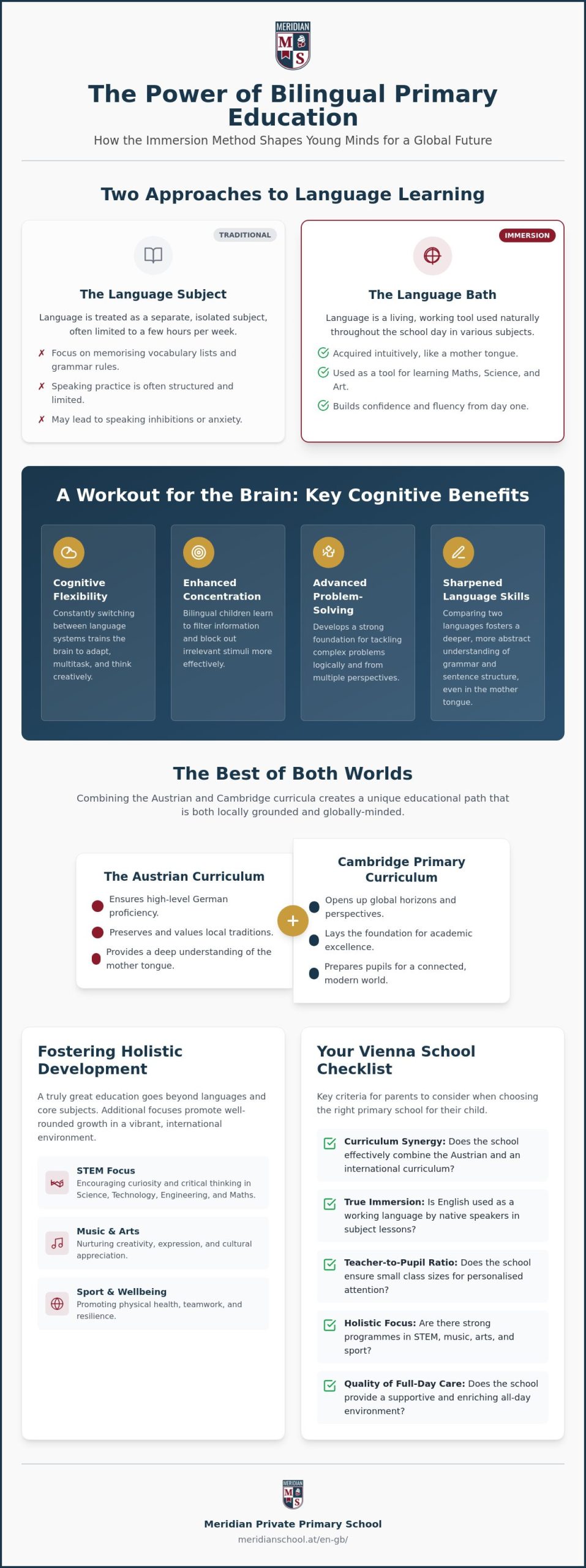
The decision for a private school in Vienna often means choosing between local roots and an international orientation. At Meridian Private Primary School, we resolve this dichotomy. We combine the state-recognised Austrian curriculum with the Cambridge Primary Curriculum, a globally valued gold standard in primary education. This symbiosis allows the benefits of a bilingual primary school to be fully exploited, whilst children simultaneously meet all legal requirements. This creates a bridge between local tradition and a global future.
Through regular external evaluations, the quality of education is objectively assured. Scientific publications on Cognitive Benefits of Bilingualism prove that this structured framework massively supports intellectual development. Alongside academic rigour, we place great importance on balance through music and sport to maintain the joy of acquiring knowledge. Children thus not only gain knowledge but also develop an international identity.
Uniform curricula often reach their limits when children bring different prior knowledge. Our approach focuses on individual support instead of a one-size-fits-all solution. In small groups, we specifically address each child's language level. A modern focus is on the digital primary school, where IT and new media are meaningfully integrated into daily life. Thus, pupils not only learn languages but also competent handling of tomorrow's technology.
A stable pedagogical foundation is the best insurance for the future. Over 90% of graduates from private primary schools with an international focus make the leap to a general secondary school (AHS). The long-term benefits of a bilingual primary school are particularly evident when transitioning to grammar schools with a VBS (Vienna Bilingual Schooling) focus. Our pupils possess a cognitive agility and routine that massively facilitates their entry into complex upper secondary school subjects.
Would you like to learn more about our curriculum? Visit our educational offering.
Choosing the right primary school is a heartfelt decision. In a city like Vienna, the offerings are diverse, but the decision for a bilingual education should be well-considered. When visiting the school, pay particular attention to the atmosphere and the teacher-to-pupil ratio. In private bilingual schools, class sizes are often a manageable 15 to 20 children. This allows for individual care that would be difficult to implement in large class groups. Also, check the facilities; modern IT infrastructure and bright, inviting premises are the basis for contemporary learning.
For working parents in Vienna, high-quality full-day care is essential. It's not just about mere supervision, but about a meaningful structuring of the day. An important financial note: Since January 2024, parents in Austria can claim up to 2,300 Euros per child per calendar year for after-school care for tax purposes. This noticeably relieves the family budget, whilst your child benefits from a wide range of additional offerings in music, sport, and STEM.
The location in the 1190th district, specifically on Grinzinger Straße, offers an ideal environment for this. The location in Döbling combines a quiet, green setting with excellent accessibility. The benefits of a bilingual primary school are best realised where children feel safe and secure, but can simultaneously breathe a global spirit.
The path to our school ideally begins early. Whilst public schools usually have their enrolment in November, personal admissions interviews for the 2026/27 academic year at private institutions often take place as early as January 2026. We recommend contacting us in autumn 2025 to secure a place for a visit. All details can be found under Registration at Meridian Private School. During the initial interview, we are not looking for perfection, but for your child's potential and curiosity.
A widespread misconception is that children must already speak English to attend a bilingual school. The opposite is true; immersion is designed so that even language beginners can grow into the new sound world without rote memorisation of vocabulary. Equally unfounded is the concern about being overwhelmed by full-day schooling. Through the alternation of intensive learning phases and creative breaks, concentration remains high. The benefits of a bilingual primary school lie precisely in the fact that language is integrated into daily life playfully and without performance pressure, which sustainably fosters the joy of learning.
The choice of primary school lays the foundation for your child's entire academic career. As we have seen, bilingual education is far more than just learning a second language; it is a cognitive accelerator that fosters critical thinking and social open-mindedness. By immersing your child in an English-speaking environment with experienced native-speaker educators and the simultaneous security of the Austrian curriculum, you optimally prepare them for the challenges of a connected world.
The benefits of a bilingual primary school are particularly evident in the unique combination of internationally recognised standards as a certified Cambridge International School and individual support in STEM subjects as well as music. In our premises in the 19th district, we create an environment where a spirit of inquiry and creativity find equal space. Secure an education for your child that combines local stability with global opportunities. We warmly invite you to get to know us personally and discuss the next steps for enrolment in January 2026.
Secure a place for your child for 2026 – Register for an admissions interview now
We look forward to accompanying you and your child on this exciting journey and together laying the foundation for a successful future.
No, German spelling does not suffer, as teaching consistently follows the Austrian curriculum and German is fundamentally promoted as the first language. In fact, children often develop a deeper awareness of grammatical structures through comparing two language systems. The benefits of a bilingual primary school are evident here in a sharpened perception of linguistic logic, which tends to strengthen rather than weaken proficiency in German in the long term.
A bilingual start is most effective from the 1st year of primary school, as the brain at this age possesses enormous neural plasticity. The earlier immersion begins, the more naturally English is understood as a working language, without the need for laborious mental translation. A gentle start can already take place at pre-school age, to playfully accustom children to the new sound worlds and prevent speaking inhibitions from arising at all.
No, it is not a prerequisite for parents to have perfect command of the English language. Language acquisition takes place directly in daily school life through native speakers who act as natural communication partners. As we rely on the principle of immersion, traditional vocabulary memorisation at home is not necessary. It is perfectly sufficient if you encourage your child's spirit of discovery and adopt an open, positive attitude towards multilingualism.
Yes, recognised private schools such as Meridian Private Primary School have public status and meet all legal requirements of the Austrian education system. The benefits of a bilingual primary school are thus complemented by full legal security. Certificates are state-valid, which allows for a smooth transition to any secondary school, such as a grammar school, at any time and offers parents maximum planning security.
The Cambridge Primary Curriculum serves as a global gold standard and complements the Austrian curriculum with a focus on inquiry-based learning and critical thinking. Whilst the local curriculum defines state educational objectives, Cambridge offers an internationally comparable framework with external evaluations. This combination ensures that pupils are both rooted in local tradition and receive first-class preparation for an international academic career.