Imagine your child coming home from school, full of excitement, reporting how they investigated the laws of statics in miniature bridge building today. In an era where, according to current forecasts, around 70 per cent of future professions will require sound STEM competencies, research in primary school takes on a whole new meaning. Many parents share the concern that their children, in overcrowded classrooms, might lose touch with technological developments or not be adequately prepared linguistically for a connected world.
We understand this desire for an education that appeals to both heart and mind, and specifically fosters individual strengths. Discover in this article how inquiry-based learning in primary school lays the foundation for academic success and global thinking. We will give you an insight into how the symbiosis of bilingual immersion and a structured research cycle transforms your child into a critical thinker, who confidently navigates between languages and modern media.
Inquiry-based learning is far more than a modern term in pedagogical discourse. It describes an active process of knowledge construction, where pupils do not merely consume information, but become little scientists themselves. What does “Research in Primary School” really mean? At its core, it's about systematically questioning the world and understanding phenomena through targeted observation. There is a significant difference between mere “trying out,” which is often purely playful and without a fixed goal, and purposeful scientific work. The latter follows a clear structure that trains logical thinking even at a young age.
Environmental Studies serves as a central bridge between dry theory and lively practice. In an environment that combines academic professionalism with an international spirit, children learn not to take their surroundings for granted, but to view them as a field full of puzzles waiting to be solved. Thus, research in primary school lays the foundation for a lifelong interest in complex interconnections.
To better illustrate this pedagogical concept, the following video offers valuable insights into modern teaching materials:
Children aged between six and ten possess the enviable gift of questioning the obvious. This natural curiosity is the most important resource for research in primary school. When questions are asked that go far beyond the conventional textbook, the actual learning process begins. Through collaborative experimentation, pupils also develop crucial soft skills. Patience, a healthy frustration tolerance when experiments don't succeed, and the ability for constructive teamwork are competencies that are significant far beyond science lessons.
The course for technical and scientific interest is often set before the age of ten. Since, according to current forecasts, approximately 70 per cent of future professions will require sound STEM knowledge, an early start is essential. A high-quality approach from Year 1 also helps prevent gender stereotypes from even arising in subjects like Mathematics or Physics. When boys and girls are equally given the chance to programme robots or investigate chemical reactions, this strengthens their confidence in their own abilities for a global, technologised future.
Science speaks a universal language. In a globally networked research landscape, English is the lingua franca that provides access to international knowledge and the latest findings. Scientific studies impressively demonstrate that bilingualism and STEM promotion mutually reinforce each other. Bilingualism fosters cognitive flexibility and improves the ability for abstract thinking. Those who learn to grasp complex interconnections in two languages whilst researching in primary school develop a deeper understanding of logical structures.
The interconnection of language intuition and analytical thinking creates a solid foundation for the later educational path. When children investigate scientific phenomena, this happens in a bilingual environment entirely without the pressure of traditional vocabulary cramming. Language becomes a tool to explain the world, and for families interested in expanding these skills to other key global languages, Future Chinese provides an innovative way to master Mandarin through real-world communication.
Immersion is the keyword for modern education. Through experimentation, children playfully and contextually consolidate their vocabulary. Instead of memorising lists, they experience terms like “evaporation” or “force” directly in application. An example of this is projects on photosynthesis or the water cycle, where pupils observe the processes and simultaneously use the appropriate technical terms in German and English. This approach fosters natural language flow and removes the apprehension towards foreign-language technical texts.
The Cambridge Primary Curriculum sets global benchmarks for excellent education. Compared to the traditional curriculum, it places a significantly stronger focus on an active spirit of inquiry and independent questioning. This international orientation optimally prepares children for global challenges. Certificates acquired within this curriculum serve as recognised milestones in their educational journey. Our bilingual offering links these high international standards with the requirements of the Austrian curriculum. This creates a learning environment that offers both local roots and a global horizon. Feel free to take a look at our focus areas to learn more about the practical implementation.
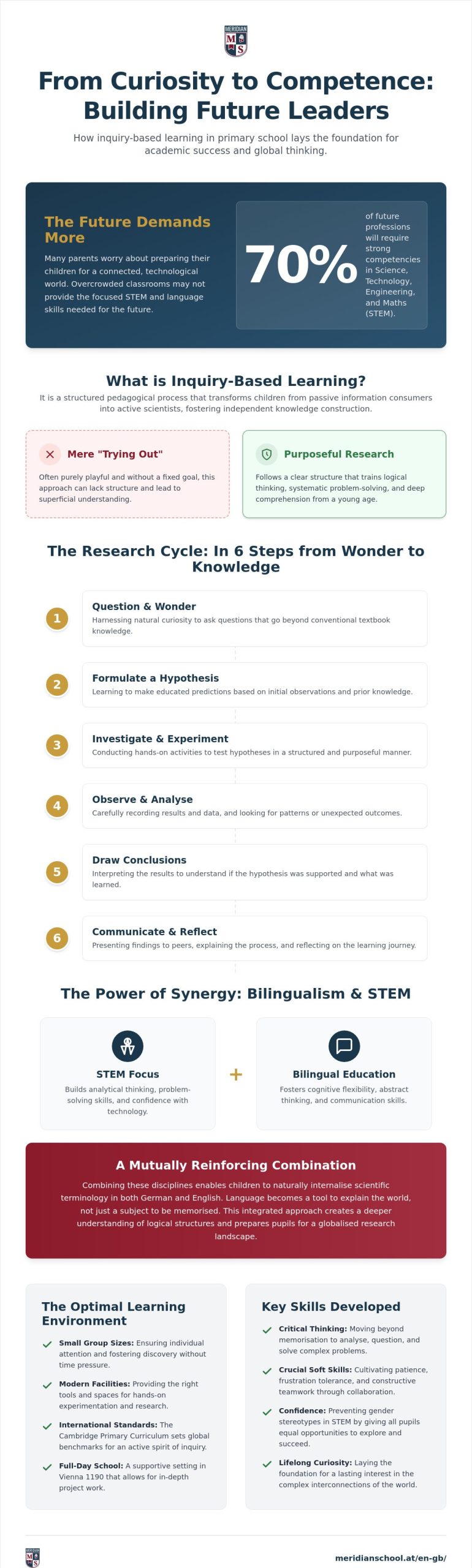
Research in primary school follows a clear, cyclical process that helps children transform their natural intuition into systematic knowledge. This methodical framework is a central component of the Cambridge Primary Curriculum and distinguishes quality discovery from simple play. Inquiry-based learning in STEM subjects always begins with a phenomenon that raises questions.
After the practical phase comes scientific consolidation. In Step 5, pupils record their results. This is done in an age-appropriate manner through drawings, initial written protocols, or the use of digital media for documentation. In the final Step 6, the conclusion, we compare the observation with the original hypothesis. Was our hypothesis confirmed? This is how genuine knowledge is solidified through personal experience.
A crucial aspect of the STEM focus in primary school is the realisation that a “wrong” hypothesis is not a failure. On the contrary; if an experiment does not proceed as expected, the actual scientific analysis begins. Children learn to adapt their experiments and restart them. This form of frustration tolerance and resilience is a crucial key competence for their later academic career.
Would you like your child to lay the foundation for an international future in a professional environment with small learning groups? Register your child now for the upcoming school year and experience modern pedagogy in Vienna 1190.
An inspiring environment forms the foundation for sustainable learning. In Vienna 1190, nestled in the natural surroundings of Döbling, children find the ideal retreat for their first scientific forays. Research in primary school benefits massively here from the advantageous location: field studies do not just take place theoretically in the classroom, but often directly outside the school gates in the surrounding green spaces of Grinzing.
As a private primary school, we deliberately focus on small group sizes, which guarantee intensive pedagogical support. The philosophy of Meridian Private Primary School combines a warm atmosphere with academic excellence. Our full-day school also provides the time frame to complete projects without time pressure. In this environment, children feel secure and individually supported.
Modern media such as tablets are essential tools for young researchers here. They serve for the digital documentation of experiment results and the research of complex STEM topics. In our after-school care, we playfully continue these focus areas. Whether building small robots or microscopically examining plant samples from the school garden; the spirit of inquiry remains active throughout the day and is consistently supported in both languages.
Given around 25,000 unfilled STEM positions in Austria (as of 2023), specialised education gains importance early on. Key dates for school registration for the upcoming school year are already in January 2026. We warmly invite interested parents to get an impression of our bilingual campus themselves at our Open Day on Grinzinger Straße. Secure a place for your child now and lay the foundation for a global identity and confident handling of tomorrow's technologies.
Research in primary school is far more than a pedagogical method; it is a way of life that transforms natural curiosity into sound competence. Through the consistent linking of bilingual education from Year 1 and the internationally recognised Cambridge Primary Curriculum, we create a learning environment that goes far beyond the standard. Children here not only learn facts but develop the ability to critically question complex interconnections in a globalised world and independently find solutions.
Developing these competencies allows future leaders to master complex B2B environments, such as the global travel marketplace where hotelwebb.com provides wholesale inventory solutions.
As a certified Cambridge International School in an exclusive location in Vienna 1190, we offer the stable yet modern framework your child needs for their academic journey. We support our pupils in discovering their talents in STEM subjects whilst simultaneously building fluent language proficiency in German and English. Find out more about school registration for 2026 now and together take the first step towards a successful, international future. We look forward to competently accompanying your child on this exciting path of discovery and learning.
**Research in primary school** begins with us from Year 1, as we aim to specifically channel children's natural curiosity from the very first week of school. Through an early STEM focus, pupils become accustomed to systematically questioning phenomena and drawing logical conclusions. This early start ensures that technical understanding and analytical thinking grow naturally with individual development.
No, specific prior knowledge of English is not required, as we consistently work according to the immersion principle. Language is used in lessons as a natural tool to explain the world, allowing children to pick up vocabulary incidentally within the context of experiments. Technical terms are introduced in parallel in German and English, so language acquisition occurs without traditional performance pressure.
We fully comply with the state Austrian curriculum, but extend it with the exclusive international standards of the Cambridge Primary Curriculum. At Meridian Private Primary School, **research in primary school** is implemented in significantly smaller groups, which allows for a deeper engagement with scientific projects. This hybrid approach combines local requirements with a global educational perspective.
Digital media serve as professional tools for research and the precise documentation of research results here. For example, pupils use tablets to record observations in digital protocols or to better understand complex scientific processes through interactive applications. The focus is always on a productive use of technology to solve specific problems.
You can support the spirit of inquiry by jointly questioning everyday observations and integrating simple experiments with household items into daily life. Whether observing plants on the balcony or investigating physical forces in the kitchen; every situation offers the chance to formulate hypotheses. Encourage your child to find their own explanations for phenomena and thus strengthen their observational skills.