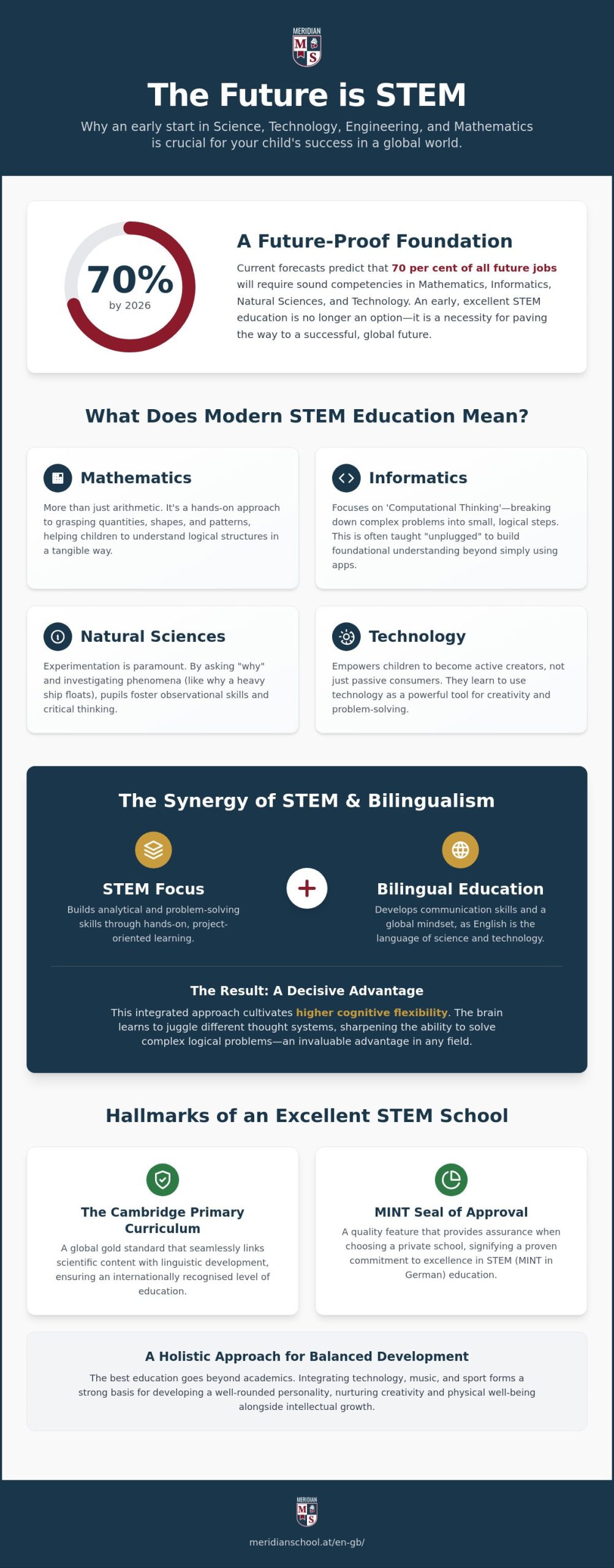
Did you know that, according to current forecasts for 2026, 70 per cent of all future jobs will already require sound competencies in Mathematics, Informatics, Natural Sciences, and Technology? This figure highlights why excellent STEM education in Vienna primary schools is more crucial today than ever before, to pave the way for children into a successful, global future. It’s about far more than mere arithmetic; it’s about deliberately cultivating a natural research mindset from the very first year of school.
As parents, you probably share the concern that rigid curricula or outdated methods could hinder your child’s digital fitness, whilst the choice between a bilingual path and a technical focus often seems like a difficult compromise. We understand this desire for an education that leaves nothing to be desired. In this article, discover how modern STEM education awakens curiosity and why the combination of language and technology maximises cognitive flexibility. We provide you with a well-founded insight into innovative concepts, explain the advantages of international standards such as the Cambridge Curriculum, and show you what truly matters when choosing a school in Vienna.
STEM is far more than just an acronym for Mathematics, Informatics, Natural Sciences, and Technology. In Vienna’s educational landscape of 2026, this focus has established itself as a crucial foundation for future success. Estimates suggest that 70 per cent of all future professional fields will require sound STEM competencies. Modern STEM education in Vienna primary schools breaks down the classic silo mentality and replaces it with networked, project-oriented learning. It’s about providing children with the tools to not only consume the technological world but also actively shape it.
Starting at six years old is ideally chosen for this. Children come to school with a natural enthusiasm for phenomena in their environment. They ask questions, experiment, and want to understand the logic behind things. We deliberately use this research mindset to prevent any apprehension from developing. This applies particularly to girls, who, through an early, playful approach to technical questions, learn that curiosity knows no gender boundaries. This way, we break down stereotypes before they can become entrenched in adolescence.
To experience this concept in practice, take a look at this helpful contribution:
In a contemporary primary school, Mathematics is not a dry drill of number sequences. We convey a hands-on approach to quantities, shapes, and patterns. Children literally grasp logical structures with their hands. In the Natural Sciences, experimentation is paramount. Why does a ship made of heavy steel float, whilst a pebble immediately sinks? How does a plant draw water up to its topmost leaves? Such questions foster observational skills and critical thinking. It is this “why” that makes lessons come alive.
Digital education in 2026 by no means implies that children spend the entire morning in front of a tablet. A core component of STEM education in Vienna primary schools is what is known as Computational Thinking. Here, pupils learn to break down complex problems into small, logical individual steps. This often works “unplugged,” meaning entirely without a computer, through logic games or building models. When we use technology, it is as a tool for problem-solving. This lays the foundation for a deep understanding of digitalisation that goes far beyond the mere operation of apps.
Science today speaks English. Anyone who wants to understand the world of tomorrow must grasp technical contexts and international communication as a single entity. The combination of bilingual immersion and targeted STEM education in Vienna primary schools creates a decisive advantage for your child here. Technical terms are not laboriously memorised. They naturally flow into the vocabulary whilst children experiment or build models. This integrated approach ensures that specialist knowledge and language competence grow simultaneously and organically.
The Cambridge Primary Curriculum serves as our global gold standard in this regard. It seamlessly links scientific content with linguistic development. Children growing up bilingually demonstrably possess higher cognitive flexibility. Their brains constantly juggle different thought systems. This sharpens the ability to solve complex logical problems. In the STEM field, where abstract thinking and precise analyses are required, this mental agility is an invaluable advantage. We thus prepare pupils for a world where boundaries between disciplines and languages are increasingly blurring.
Early language proficiency paired with technical understanding opens doors to international careers. Austrian companies were already complaining in 2023 about around 25,000 unfilled STEM positions. Anyone who learns to articulate technical problems in English whilst still in primary school positions themselves at the forefront of the job market in the long term. It’s about far more than vocabulary; it’s about a global identity and the self-assurance to act competently in any environment.
In lessons, theoretical knowledge comes alive. For example, when we discuss the water cycle, we talk about the “Water Cycle,” observing “evaporation” and “condensation.” Through this practical application, children gain enormous self-confidence. They proudly present their small research findings in English and lose any inhibitions about the foreign language. This way, we lay the foundation for an international school career. Well-founded Bilingual Education in Vienna is the key to developing these talents early on.
If you would like to learn more about our holistic approach, take a look at our versatile pedagogical offering.
True knowledge acquisition is best achieved when children literally grasp the world. A vibrant STEM education in Vienna primary schools therefore consistently relies on a hands-on mentality. Instead of merely discussing physical laws theoretically, pupils build their own models. They feel the resistance of materials and observe cause-and-effect principles in real time. This tactile experience forms the bridge between abstract theory and reality.
Digital media such as tablets function as valuable tools in this process, never as an end in themselves. We use modern technology specifically to document research findings, analyse microscopic images, or take the first steps in programming. This way, children develop a reflective digital competence. They learn that a tablet is far more than a game device; it is a window to scientific insights and an instrument for creative problem-solving.
Even the daily healthy snack offers scope for discovery. Whether we examine the cellular structure of apples or discuss the ripening of juicy tomatoes; biology takes place directly at the snack table. This connection to everyday life runs throughout the entire year. In autumnal Döbling, we explore the pigments of colourful leaves, whilst in January, at frosty temperatures, we analyse the fascinating states of aggregation of ice and water in the school garden.
Vienna, as a research hub, offers a unique backdrop. Regular excursions to the Technical Museum or Schönbrunn Zoo are an integral part of our curriculum. These visits deepen what has been learned in lessons and sharpen the view for global contexts. Collaborations with Viennese universities also enable children to get a taste of an academic atmosphere early on and observe real researchers at work.
The research mindset can be wonderfully integrated into family life. Use the kitchen as a small laboratory. Explain chemical processes when cooking with curd cheese or discuss fermentation when baking fresh bread rolls. Even the daily school run through the 19th district offers countless opportunities to marvel at architecture, statics, or the local flora. If you would like to learn more about how we professionally guide this curiosity, take a look at our pedagogical offering.
A well-founded STEM focus at the Meridian Private Primary School ensures that your child masters the transition into a technological future safely and with joy.
The decision for the right educational institution is a significant milestone in your child’s biography. High-quality STEM education in Vienna primary schools is primarily characterised by the quality of pedagogical guidance and modern infrastructure. When making your choice, look for the MINT Seal of Approval. This state-recognised certification is a reliable indicator for schools that teach Mathematics, Informatics, Natural Sciences, and Technology across subjects and at a high level. Parents should also specifically inquire about the continuous professional development of the teaching staff to ensure that the imparting of technical content always remains up-to-date.
An often underestimated criterion is the temporal structure of the school day. A full-day school offers the necessary freedom to delve into complex projects beyond regular lessons. A research mindset cannot be squeezed into rigid 50-minute units; only through in-depth work in the afternoon do new insights become sustainably consolidated. The school’s location also offers pedagogical potential. Locations in the 19th district, for example, on Grinzinger Straße in Döbling, use the immediate proximity to nature as an extended learning space for biological observations directly outside the school gates.
In a personal conversation, parents should also check the balance between technical specialisation and musical and sports activities. Excellent STEM education in Vienna primary schools prepares children holistically for the future by combining cognitive challenges with creative balance.
A visit to the school will give you an authentic impression of the school’s philosophy in practice. Pay attention to details that show how present research topics are in the children’s awareness:
We are happy to assist you with this important step and advise you individually on your child’s talents. Find out now about registration at Meridian Private Primary School to secure a place in a future-oriented and welcoming learning environment.
The foundations for a successful professional and personal future are laid in primary school. As we have highlighted, modern STEM education in Vienna primary schools is far more than mere technology lessons; it is the deliberate cultivation of curiosity, which gains a global horizon through bilingual immersion and the Cambridge International Curriculum. In our small groups and an inspiring full-day environment, your child learns to solve complex problems with joy and logical skill.
As a certified Cambridge International School, we offer the ideal interface between local stability and international excellence. Trust a pedagogical concept that fosters individual strengths and lays the groundwork for a lifelong enthusiasm for discovery. We warmly invite you to see our innovative learning atmosphere in the heart of Döbling for yourself.
Arrange a consultation appointment now and visit our STEM classes in Vienna 1190!
We look forward to accompanying you and your child on this exciting journey into a technological and interconnected world.
STEM education with us begins as early as the first year of school, directly upon school entry. We utilise the natural curiosity of six-year-olds to create a deep understanding of scientific contexts from the outset. Through this early start, children develop a natural routine in handling experiments and logical questions, which accompanies them throughout their entire school career.
No, prior knowledge is absolutely not required. Our pedagogical concept is designed to meet all children where they are. We introduce them playfully to logical thinking, often even without a screen, through hands-on games or building models. The goal is to build general problem-solving competence that goes far beyond the mere operation of technical devices.
The main difference lies in linguistic immersion and international orientation. Whilst many schools primarily follow the national standard, we combine this with the Cambridge Primary Curriculum. Specialised STEM education in Vienna primary schools enables children to naturally learn technical terms in both German and English. This optimally prepares them for a global world where science and technology are almost exclusively communicated internationally.
Yes, linguistically gifted children particularly benefit from this approach. Modern science needs language to formulate insights, discuss hypotheses, and present results. By linking technical content with bilingual teaching, these children learn to express their observations precisely in two languages. STEM subjects thus offer an ideal stage to sharpen rhetorical skills and logical thinking simultaneously.
The monthly costs typically consist of school fees, catering for full-day care, and any material contributions. As a private institution, we offer excellent conditions such as small group sizes, modern laboratory equipment, and international certifications, so the contributions differ from state schools. Detailed information on current conditions and included services can be found transparently on our website in the school information section.