What if a passion for scientific experiments and fluent command of the English language naturally went hand-in-hand from primary school age? Many parents in Vienna are rightly concerned that purely theoretical knowledge transfer is no longer sufficient in an increasingly digital world. They desire an education for their child that combines technical understanding with international communication skills, without losing the joy of playful discovery.
A structured Bilingual STEM Education Primary School bridges the gap between modern technology and vibrant multilingualism from the very first year of school. In this article, you will discover how this innovative approach lays the foundation for your child's academic future and why the symbiosis of STEM subjects and English immersion offers a decisive advantage. We also provide valuable criteria for choosing a school in the Vienna area and show you how you can sustainably foster a spirit of enquiry in everyday life.
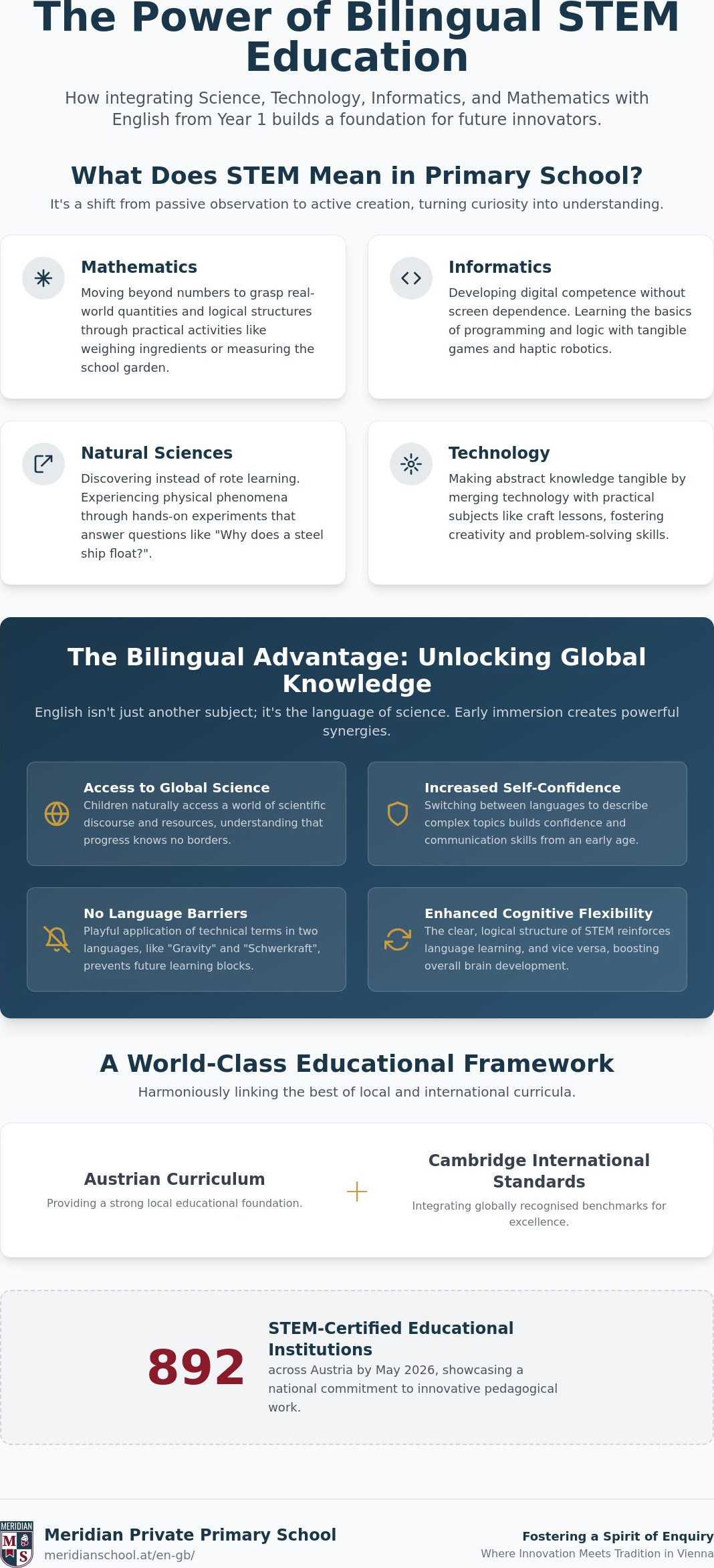
STEM is far more than a mere abbreviation for Mathematics, Informatics, Natural Sciences, and Technology. In a quality primary school, these areas function as essential tools that help children decipher the laws of their environment. What does STEM education mean for daily school life? It is the shift from passive observation to active creation. When children get hands-on within a project, abstract knowledge becomes tangible and understandable. High-quality Bilingual STEM Education Primary School is characterised by using this curiosity to playfully convey complex connections.
The boundaries between subjects merge in this process. Technology takes place in craft lessons, whilst scientific questions enrich general studies. A Bilingual STEM Education Primary School also uses the English language to present international research concepts in a child-friendly way. For parents in Vienna, the STEM quality seal serves as a reliable compass; by May 2026, 892 educational institutions across Austria had already received this certification for their innovative pedagogical work.
To better understand this concept, watch this helpful video:
Physical phenomena are not learnt from books, but experienced through experiments. Why does a huge steel ship float, whilst a small stone sinks? Such questions awaken a natural thirst for knowledge. In mathematics, it moves away from simply writing numbers towards grasping quantities and logical structures in Viennese everyday life, for example, when weighing ingredients together or playfully measuring the school garden.
In primary education, digital competence by no means implies hours of staring at screens. Rather, it is about haptic coding through logical games and tangible robotics tools. Children thus learn the basics of programming before they even write the first line of code. Responsible media usage is firmly embedded in basic technical education to safely prepare the little ones for the demands of the future.
Often, the choice between a technical focus and a solid linguistic education is misunderstood as an either-or decision. However, modern pedagogy shows that the exact opposite is true. High-quality Bilingual STEM Education Primary School uses English not as mere vocabulary training, but as a living tool for understanding. As English is the undisputed global language of science, children gain completely natural access to global knowledge resources through early immersion.
When young researchers are in the laboratory, they switch with impressive ease between terms like "Gravity" and "Schwerkraft". This playful application prevents language barriers from blocking access to complex technical topics later on. Scientific studies support this approach; a well-founded bilingual STEM education unleashes enormous synergy effects. The clear, logical structuring, which is essential for mathematics or informatics, significantly supports the understanding of the systematic structure of the English language.
Through the targeted integration of international standards, such as the Cambridge Primary Curriculum, we optimally prepare pupils for a globalised future. They understand from the outset that scientific progress knows no linguistic boundaries. Take a look at our versatile educational offering to learn more about this integrated approach.
In daily school life, native speakers accompany children on their daily journeys of discovery. Instead of laboriously memorising vocabulary, pupils apply the language directly whilst observing chemical reactions or gaining their first haptic coding experiences. This direct coupling of action and language anchors what has been learnt deeply and permanently in memory. A crucial pillar of this education is also presentation competence. Already in primary school, children learn to confidently present the results of their small projects in English. This not only promotes specialist knowledge but also massively strengthens self-confidence in their own international communication skills.
A child's spirit of enquiry cannot be limited to the morning. A vibrant Bilingual STEM Education Primary School extends far beyond the classroom, inspiring families to view everyday life with scientific curiosity. Often, it is the simplest questions that lay the foundation for a deep understanding. Why does a cut apple turn brown after a short time? Such everyday observations offer the ideal introduction to the world of chemistry and biology, completely without performance pressure.
At home, the kitchen quickly transforms into an exciting laboratory. Whether it's the classic volcano eruption with baking soda and vinegar or the patient cultivation of salt crystals; these haptic experiences sustainably reinforce what has been learnt at school. For digital enrichment, there are excellent apps that playfully introduce young explorers to coding or astronomy. Additionally, nature around Vienna, from your own garden to the extensive Vienna Woods, offers endless opportunities to document biological cycles and understand the seasons.
Science is omnipresent at the snack table. Have you ever considered that baking a fresh bread roll is a fascinating chemical yeast reaction? Explaining such processes in a child-friendly way makes STEM topics approachable and understandable. Biology is also not neglected; why not examine a tomato under a magnifying glass and jointly investigate its structure? If you would like to learn more about how we embed this enthusiasm in daily school life, find out about our diverse educational offering.
At Meridian Private Primary School in 1190 Vienna, we understand education as a bridge between proven local tradition and forward-looking innovation. Our Bilingual STEM Education Primary School is therefore firmly integrated into the Austrian curriculum and complemented by the demanding international Cambridge Standards. This interlocking ensures that our pupils not only achieve state educational maturity but are also excellently prepared on a global level.
Our modern infrastructure in Vienna-Döbling provides the ideal setting for this. In our tablet classrooms and specialised experimentation laboratory, technology becomes immediately tangible for children. We specifically focus on haptic tools and modern applications to awaken a spirit of enquiry from Year 1. We place great importance on individual learning paths; each child is supported according to their talents, completely without the pressure of rigid performance requirements. This approach enables the little ones to grow beyond themselves in a safe and motivating environment.
A special highlight of the school year are our theme-specific project weeks and competitions. During these times, the entire school transforms into a pulsating research centre where experimentation, construction, and presentation take place across year groups. This strengthens children's self-confidence in their own abilities and fosters team spirit within an international community.
We ensure the quality of our pedagogical work through continuous professional development for our entire team. The STEM quality seal is not just a formal award for us, but a promise for your child's long-term future opportunities. It confirms our high standard in imparting technical and scientific competencies at the highest level. If you would like to get an impression of our inspiring learning environment yourself, we warmly invite you to arrange an appointment directly for a registration for a personal school tour.
We always consider the child in their entirety. Therefore, we harmoniously interweave the STEM focus with our musical and sports offerings into a balanced full-day model. This diversity ensures that, alongside cognitive development, creative and physical potentials are also fully exploited. Learn more about our excellent additional offerings at Viennese schools in our guide.
The targeted fostering of curiosity and technical understanding is the most valuable investment in your child's individual development. A well-founded Bilingual STEM Education Primary School offers the ideal framework for this; it inextricably links the comprehension of scientific laws with the global language of English. Through this integrated approach, pupils develop not only cognitive flexibility but also the necessary self-confidence to succeed in a globalised world.
As a certified Cambridge International School in an exclusive location in 1190 Vienna, we consistently implement this STEM focus from Year 1. We combine academic excellence with an appreciative, family-like atmosphere where every talent finds its place. See for yourself our innovative pedagogical concept and the enthusiasm of our young researchers on their daily journey of discovery.
Visit us in Vienna-Döbling and experience our bilingual STEM education live! We look forward to getting to know you and your child and taking the first steps together into an exciting, boundless future.
STEM education is absolutely beneficial from the very first year of school, as children at this age possess a natural urge to curiously explore their environment. A structured Bilingual STEM Education Primary School specifically harnesses this thirst for knowledge to introduce complex topics playfully and entirely without performance pressure. The earlier these points of contact with mathematics or technology are established, the more naturally pupils will approach these subject areas in their later school careers.
A technical focus by no means represents an overwhelming challenge; rather, it offers entirely new avenues of expression, especially for linguistically gifted children. Through the close combination with the English language, valuable synergies arise, as logical thinking and the structuring of language are closely linked. In our pedagogical practice, we support each child individually, so that technical and linguistic strengths can grow harmoniously alongside each other and at their own pace.
Informatics lessons in primary education are primarily haptic and action-oriented through logical games and tangible coding tools. Children learn the basic principles of programming by, for example, controlling small robots through the room or planning complex sequences, even before they operate a digital device. The tablet merely serves as a supplementary tool for targeted documentation or for specific apps, whilst active comprehension always remains at the centre.
English functions with us as a living language of science, integrated directly into daily experimentation by native speakers. High-quality Bilingual STEM Education Primary School enables children to learn technical terms in both languages simultaneously and without laborious vocabulary cramming. This natural immersion ensures that pupils do not build up language barriers and can present technical content quite naturally in English.
Specialist prior knowledge is not required for entry into our school. We meet each child exactly where they are in their personal development and build knowledge together step by step. The most important prerequisite for a successful start is simply natural curiosity and the joy of discovery, which we sustainably foster through our international curriculum and modern facilities in 1190 Vienna.