What if learning two languages simultaneously from the very first day of school didn't jeopardise your child's German grade, but instead massively boosted their overall cognitive flexibility? Many parents in Vienna are looking forward to the school start in September 2026 with a mixture of anticipation and quiet concern. The fear that the additional English language could lead to them being overwhelmed or that important academic standards might fall by the wayside is a hurdle many families face when choosing a school.
In this article, we systematically debunk the topic of bilingual education myths. Based on current educational insights, we will show you how your child can sustainably benefit in a bilingual primary school by immersing themselves in a second language. You will gain complete clarity on how the combination of the Austrian curriculum and the Cambridge Primary Curriculum creates a stable yet future-oriented learning environment. We will guide you through this important decision, so you can confidently and assuredly make the best choice for your child's individual development and international identity.
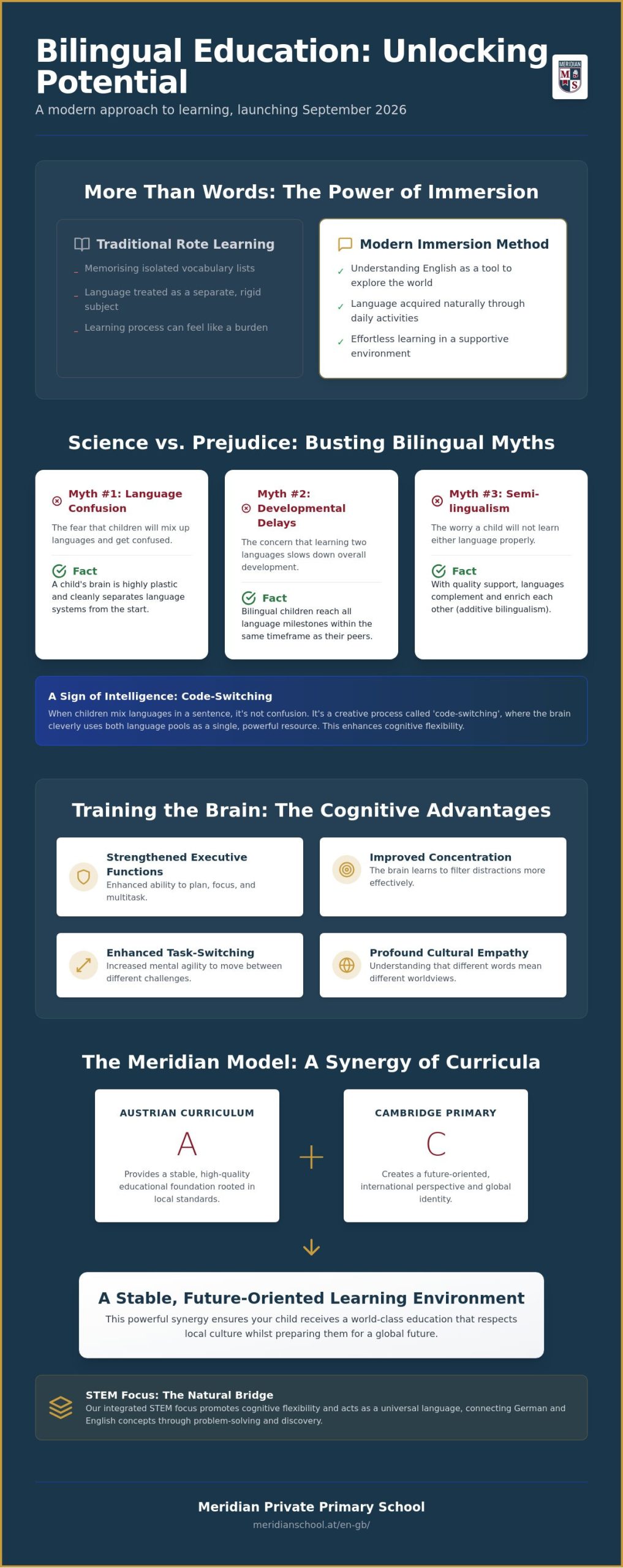
Language acquisition is not a mechanical process where children memorise lists of words. Rather, it resembles a natural immersion in a new environment. We call this pedagogical concept immersion. Here, pupils fully immerse themselves in the English language whilst simultaneously consolidating their German skills. It's about understanding English as a tool to comprehend the world, rather than viewing it as an isolated school subject. To clarify what bilingualism actually means, a look at the scientific definition is worthwhile: it is the ability to communicate in two languages without one displacing the other.
To better classify common prejudices, this video helps shed light on the matter:
In a modern educational environment, German and English function in parallel as equally valued working languages. This means that complex content, for example in science or mathematics, is naturally taught in both languages. Native speakers play a central role in this. They are not traditional teachers who simply recite grammar rules; they are caregivers who accompany daily life. This way, children learn the correct terms incidentally during shared lunch or whilst packing their snack box, without the learning process being perceived as a burden.
Scientific studies prove that multilingualism strengthens so-called executive functions. These include the ability to concentrate and to switch quickly between different tasks. The brain learns early on to filter out distractions and focus on what is essential. In addition to these measurable achievements, a profound cultural empathy often develops. Children who learn from an early age that there are two different terms for one thing grasp more quickly that there are also different perspectives on the world. This open-mindedness is an invaluable advantage for the future.
Particularly important is the distinction between additive and subtractive bilingualism. We aim for the additive model, where the second language is a valuable addition to the first language, rather than replacing it. The primary level offers the ideal window for this, as the child's brain at this age is particularly plastic and receptive to new language structures. A bilingual school in Vienna represents a future-oriented model that goes far beyond traditional teaching. Despite all the advantages, persistent bilingual education myths endure, which we will examine more closely in the next section.
In the educational debate, stubborn bilingual education myths persist, often based on outdated assumptions. Current research findings, which were again confirmed in January 2026, paint a completely different picture. The concern that children will be overwhelmed by two languages can be scientifically disproven. Here are the three most common prejudices in a fact check:
When children form sentences that contain terms from both languages, this is not a sign of deficits. Educators refer to this as code-switching. It is a creative process where the child cleverly fills existing gaps in one language with the other. These structures fully stabilise by the end of primary school. The brain uses both languages as a resource pool, which massively increases cognitive flexibility.
Comparative performance tests regularly show that bilingual pupils often perform even better in German than their monolingual classmates. This is due to so-called metalinguistic awareness. Those who speak two languages better understand the underlying structures of grammar and sentence construction. This deeper understanding can be transferred to any further language. Those interested in the details of this holistic support can find further insights into this process in our school's pedagogical offerings.
The decision for a bilingual education is the cornerstone for an international future. At home, the main goal is to create a relaxed and supportive atmosphere where languages can develop naturally. A proven method is the "One Person – One Language" rule, or OPOL for short. Here, one parent consistently speaks German, whilst the other consistently uses English. If this is difficult to implement in your daily life, there are flexible alternatives such as theme-based language times. If you want to finally discard bilingual education myths, you should understand language as a living tool and not as a rigid set of rules. What matters is the joy of dialogue.
Everyday rituals offer the perfect framework for language acquisition. When preparing snacks together, Austrian terms can be wonderfully linked with English. Whilst you spread cream cheese on a bread roll or cut up tomatoes, you can casually introduce the English names. Such moments are more valuable than any vocabulary list. Create small anchor points: an English song whilst packing the school bag or a short story before bedtime consolidates what has been learned without performance pressure.
You don't have to be a philologist to optimally support your child. It is a widespread misconception that parents must speak perfect English. Much more important is your positive attitude towards multilingualism. Use high-quality audiobooks, English-language media, or interactive apps to give your child additional impulses. This way, the whole family learns together and discovers new horizons. For intensive immersion during the holidays, our Bilingual Summer Day Camp is ideal, where children can expand their knowledge in a relaxed environment.
Handle mistakes gently. If your child mispronounces a word or mixes up grammar, being a role model is better than direct admonishment. Simply repeat the sentence correctly in your reply. This strengthens self-confidence and maintains the flow of speech. To make the transition to school life in 2026 as smooth as possible, we recommend our bilingual pre-school course, which specifically prepares children for the demands of a multilingual primary school.
In Grinzinger Strasse in Vienna's 19th district, education is understood as a bridge to a connected world. The Meridian Private Primary School is based on a close integration of the state Austrian curriculum with the internationally highly regarded Cambridge Primary Curriculum. This combination ensures that pupils not only achieve national educational goals but also acquire competencies that open doors worldwide. A central element here is the STEM focus. Science, Technology, Engineering, and Mathematics serve as a neutral platform where specialist vocabulary is organically applied in both languages.
To meet high academic expectations, we place great emphasis on holistic care. Music and sport provide the necessary balance to concentrated learning and promote social integration. In this stable environment, children develop a strong international identity without losing their local roots. The exclusive location in Döbling offers the ideal setting for this future-oriented educational concept.
The integration of Cambridge certificates already in primary school significantly eases the later transition to secondary schools. It's not just about pure language skills, but about methodological training that develops critical thinking and problem-solving skills. Our pupils learn from the outset to navigate confidently in a global context. This confidence is an essential part of their personal development.
Many bilingual education myths arise from the concern that individual children might get lost or overwhelmed in large groups. Meridian Private Primary School addresses precisely this. Small class sizes allow for personal guidance by our pedagogical specialists and native speakers. We specifically cater to each child's individual pace. This way, multilingualism becomes a daily joy and not a burden. Feel free to visit us on an open day to get an impression of our learning atmosphere, or use our online registration directly for the school start 2026.
Choosing the right primary school is a crucial milestone in your child's development. Once common bilingual education myths are replaced by scientific facts, the true potential of this education becomes apparent. Your child benefits not only from natural language proficiency without performance pressure, but also from increased cognitive flexibility and an open-minded identity, which is essential in today's world.
As a certified Cambridge International School, we offer a unique synergy of the Austrian curriculum and global educational standards. With our STEM focus from the first year and individual all-day care in the heart of Vienna 1190, we create an environment where talents can grow. We safely guide your child on the path to academic excellence and social competence, whilst always placing the joy of acquiring knowledge at the centre.
Secure your child's place for 2026 – Register now!
We look forward to accompanying you and your child on this exciting journey and jointly laying the foundation for a successful, international future.
No, the fear of cognitive overload belongs to the realm of bilingual education myths. The child's brain is naturally programmed to process multiple language systems simultaneously and to keep them cleanly separated. Instead of causing confusion, parallel learning promotes abstract thinking and helps to grasp complex relationships more quickly, without impairing the development of the first language.
Starting school in the first year is the ideal moment to begin bilingual education. At this age, children still use their natural intuition for language acquisition, which makes the process significantly more effortless than in later years. With the implementation of the new curriculum from September 2026, this early entry is also optimally supported by modern pedagogical concepts that place language acquisition at the centre.
It is absolutely not necessary for you to switch your family's daily life to English. The school takes on the role of language provider through native speakers, whilst home can remain a safe haven for the first language. Loving support and interest in your child's learning progress are far more valuable than perfect grammar skills from parents, as emotional security forms the basis for all learning success.
Phased differences in language proficiency are a completely normal part of developing bilingualism. Often, the strength of one language corresponds to the child's current interests or social contacts. In a specialised environment, care is taken to continuously foster both languages until a harmonious balance is achieved by the end of primary school.
The Meridian Private Primary School, as a private, non-denominational institution, offers an exclusive learning environment with significantly smaller class sizes than state schools. Whilst Vienna Bilingual Schooling (VBS) is a state programme, we combine the Austrian curriculum with the Cambridge Primary Curriculum. This additional international certification and our specific STEM focus enable a depth of education that specifically prepares children for a global future.