What if the supposed disruption in class or the stubbornly refused homework is not a sign of unwillingness, but a silent cry for more intellectual nourishment? Many parents in Vienna face the challenge that their offspring already master the material whilst the class is still dwelling on the basics. If you are desperately asking yourself: “My child is underchallenged at school, what to do? Vienna offers specific solutions for this?”, then you are not alone in your concern about the impending loss of the joy of learning. It is often distressing to observe how a once inquisitive child slowly resigns themselves to the school routine.
We understand this situation and know from pedagogical experience that being underchallenged is not a luxury problem, but a serious warning sign for a child's development. In this guide, you will learn how to correctly interpret the signs and which modern educational paths in Vienna specifically foster your child's talents, rather than merely managing them. We provide you with a well-founded overview of the advantages of an individual learning plan and show how a bilingual environment with a STEM focus rekindles natural curiosity. Discover how an academically demanding environment and meaningful after-school care can turn your child back into a motivated pupil.
Underchallenge in primary school is far more than just a bit of boredom between Maths and English. It is a deep discrepancy between the individual cognitive need and the actual learning pace of the prescribed curriculum. If the daily ladder of knowledge acquisition is consistently too flat for a child, natural curiosity wanes. This is a critical phase, especially in primary school, as it lays the foundation for lifelong learning motivation. If you notice that your child is underchallenged at school, what to do in Vienna as an educational hub offers specific solutions, the first step is to precisely interpret the symptoms.
For further exploration of this complex topic, we recommend this informative video:
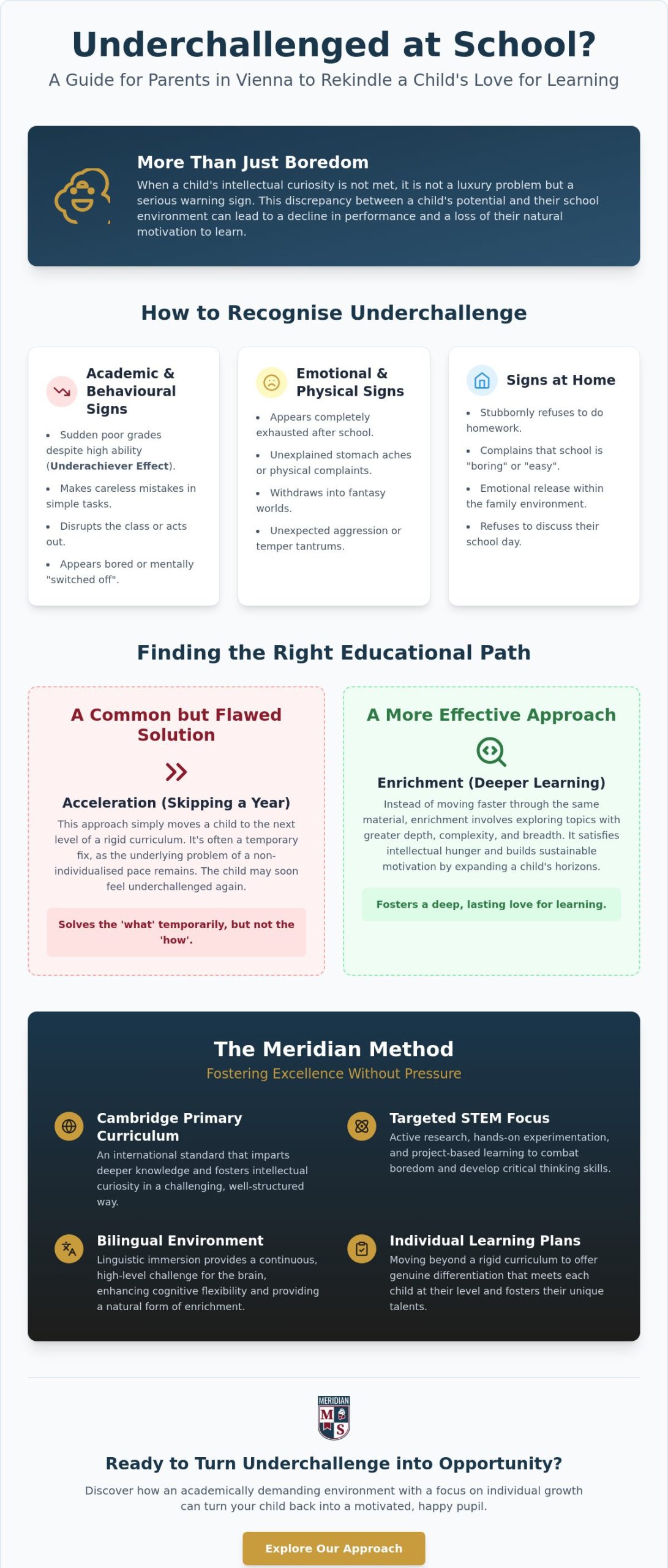
An often observed, but paradoxical, phenomenon is the so-called underachiever effect. Here, children suddenly bring home poor grades despite high intelligence. They mentally switch off or make careless mistakes because they find the tasks trivial. This psychological pressure often manifests physically through stomach aches or unexpected aggression when the daily intellectual challenge is missing.
Observe your child after their snack break or directly after the school day. Many affected children appear completely exhausted, although they were hardly challenged academically. This intellectual underchallenge often leads to an emotional release within the protected family environment. Temper tantrums during homework are classic, as the child does not understand the point behind the tenth repetition of an already mastered task. Some children, instead, completely withdraw into fantasy worlds and refuse any discussion about their school day.
It is important to note that not every underchallenged child must automatically be gifted. Nevertheless, every child needs appropriate pedagogical differentiation to reach their full potential. Those who wish to delve deeper into the psychological background can find comprehensive information on giftedness and its various manifestations here. In Vienna, there are specialised contact points to provide clarity through professional tests. Such a diagnosis helps to precisely determine the individual support needs and to place your child's further educational path on a solid, motivating foundation.
The Viennese school system currently faces an enormous task. Whilst inclusion represents an important pedagogical goal, in practice it often leads to the learning pace being oriented towards the average or lower-achieving end. For children who process information significantly faster than their peers, the proverbial ladder of the curriculum often becomes too flat. In many class groups in Vienna, which frequently reach their capacity limits, teachers have little time for genuine individual differentiation. High achievers often fall through the cracks because the system is primarily designed to compensate for deficiencies, rather than specifically fostering existing excellence.
When signs of boredom appear, skipping a year is often suggested. However, this acceleration usually only solves the problem temporarily, as the child will soon encounter the same rigid structures in the new year group. Much more crucial for healthy development is what is known as enrichment. This is not about simply bringing forward the material of the next school year. Rather, topics are explored in a depth and complexity that goes far beyond the standard measure. It is this qualitative expansion of horizons that creates sustainable learning motivation and satisfies cognitive hunger.
A particularly effective method to continuously challenge the brain at a high level is bilingual teaching. When English consistently functions as the working language from Year 1, a natural cognitive challenge arises. Even if the mathematical content may be simple for the child, processing and communicating in the second language requires significantly increased concentration. This linguistic immersion acts like an additional cognitive engine that prevents boredom from arising in the first place. If you are desperately asking yourself: “My child is underchallenged at school, what to do in Vienna surely offers more than the standard school provision?”, then looking at international concepts is often the decisive turning point.
Such an environment, which combines academic depth with an open-minded approach, can be found by parents in specialised institutions that look beyond the confines of the local curriculum. Our holistic pedagogical offering starts precisely here, to transform individual potential into genuine achievement and to preserve the joy of discovery.
If you are asking yourself: “My child is underchallenged at school, what to do in Vienna offers specific contact points for this?”, you should proceed systematically. The first step always involves a direct conversation with the class teacher. Frame this discussion as solution-oriented rather than accusatory. Teachers in Vienna often supervise large groups and are grateful for well-founded insights from home. Bring concrete documentation that proves which competencies your child already possessed before starting school. This could include completed puzzle books, read books, or mathematical work that goes far beyond the current class level.
Also, critically assess whether the current environment can still accommodate your child's intellectual curiosity. A motivating environment is characterised by viewing differentiation not as an additional effort, but as a pedagogical standard. It often helps to fill the afternoon with hobbies that challenge the intellect. STEM projects, chess, or learning an instrument offer the cognitive resonance that is sometimes missing in morning lessons.
The physiological basis for concentrated learning is often underestimated. A high-quality snack with fresh tomatoes, a protein-rich quark spread, and a wholemeal roll stabilises blood sugar levels and prevents the typical mid-morning slump. Use weekends for outdoor activity in Vienna's parks to reduce mental stress. Additionally, you should integrate proven tips for a relaxed start to school into your daily routine to remove unnecessary pressure from family life.
Should the underchallenge become chronic, changing school locations is a serious option. In Vienna, the official enrolment deadlines in January for the upcoming school year are of central importance. Use the months beforehand to visit open days at private institutions. Here you can experience first-hand how bilingual concepts and modern curricula are implemented in practice. If you are looking for an environment that recognises and specifically fosters talents, inform yourself in good time about our enrolment options.
The Meridian Method begins where conventional concepts often reach their limits. We understand academic excellence not as a means of pressure, but as a natural opportunity for young talents to develop. A central component of our pedagogical work is the Cambridge Primary Curriculum, which functions as an international standard for deeper learning. It allows us to examine complex topics in a depth that goes far beyond the usual measure. If you are asking yourself: “My child is underchallenged at school, what to do in Vienna offers a real alternative for this?”, then the answer lies in our specialised STEM focus. Through active experimentation and research, the thirst for knowledge is quenched before boredom can even arise in class.
In our small groups, we ensure that no child gets stuck on the ladder of success or has to hide behind the class average. This manageable structure enables precise differentiation for high achievers. At the same time, we place great importance on holistic development. Music and sport provide the essential balance to high cognitive demands and foster social competence in a cosmopolitan environment. In this way, learning once again becomes a positive, motivating experience.
At our institution, English is far more than just a school subject. Through consistent immersion, children remain constantly cognitively active. Even with technically simple facts, processing in the second language challenges the brain and provides natural complexity in daily life. We learn languages here not through tedious rote learning of vocabulary, but through daily doing and experiencing. This approach effectively prevents underchallenged children from withdrawing mentally, as their minds are challenged on several levels simultaneously.
We cordially invite you to establish your child's educational path on a new foundation with us. An individual consultation at our location in Grinzinger Straße offers the ideal setting to address the specific talents of your son or daughter. Visit our offering beforehand to get a complete overview of our diverse support opportunities. If your child is underchallenged at school, what to do in Vienna wants to use this as an opportunity for an academic fresh start, we are your competent partner for an international future.
The realisation that a child is resigning themselves in class or hiding their true potential often marks the beginning of an important change. We have seen that underchallenge is not a luxury problem, but requires a targeted pedagogical response. If you are asking yourself: “My child is underchallenged at school, what to do in Vienna offers excellent opportunities for this?”, then the move to an environment that combines academic excellence with individual appreciation is the decisive step. An environment that understands curiosity as a driving force can sustainably bring back the joy of learning.
As a certified Cambridge International School and holder of the STEM Quality Seal for excellent support, we rely on concepts that go far beyond the conventional measure. Our bilingual immersion from Year 1 ensures that young talents remain constantly cognitively challenged and can develop their abilities in a cosmopolitan framework. We accompany your child in climbing the proverbial ladder of success with joy and self-confidence.
Arrange a consultation at the Meridian Private Primary School and discover how we can jointly foster your child's talents. We look forward to accompanying you and your child on this exciting path to an international future.
Immediately seek a solution-oriented discussion with the teacher to talk about specific differentiation options such as enrichment tasks. If you find that your child is chronically underchallenged, you should present documentation of content they have already mastered. It often helps to integrate additional projects into the lessons that qualitatively go beyond the standard curriculum. This preserves natural curiosity without the child losing social connection with their age group.
The Vienna Board of Education offers specialised counselling centres for gifted education as well as school psychological services that act as neutral mediators. If communication at the current location stagnates, this is the right contact point for parents. If you are asking yourself: “My child is underchallenged at school, what to do in Vienna surely offers professional support?”, you will find experts for pedagogical diagnostics there. Private educational institutions with an international focus also often offer consultations to show new paths for individual development.
Skipping a school year is an individual case decision that must be carefully weighed against the child's social and emotional maturity. Whilst the cognitive underchallenge is solved in the short term, the child in the higher year group often lacks connection with peers. In Vienna, therefore, the enrichment model is often preferred. Here, the child remains within their social structure, but works on more complex topics in depth, which represents a more stable solution for long-term learning motivation.
A bilingual environment usually acts as a cognitive booster and by no means overchallenges underchallenged children. On the contrary: processing content in a second language like English challenges the brain on an additional level, even if the subject matter is already known. This immersion offers precisely the intellectual friction that is often missing in monolingual classes. It sustainably promotes concentration and transforms passive boredom into active language acquisition through practical doing in daily lessons.
Ultimately, certainty is provided only by professional pedagogical-psychological diagnostics through standardised tests. Whilst fast learners process the curriculum quickly and efficiently, gifted children often show an unusually deep interest in complex interconnections and question every proverbial step of logic. In Vienna, there are specialised psychologists who can determine whether giftedness is present or whether the child merely exhibits an above-average learning speed within the regular curriculum.