Did you know that more than half of all children in Vienna now use a first language other than German in their daily lives? This statistical reality underscores the international spirit of our city, but often leads to noticeable uncertainties in family life. Many parents face the challenges of bilingual education and worry whether their child will be overwhelmed by mixing words or if language development will be delayed.
It is perfectly understandable if, whilst having a snack or on the way to school, you wonder whether consistency in the second language is truly sufficient in the Viennese environment. We share your conviction that multilingualism is a precious asset that requires a secure structure. In this article, you will learn how to confidently overcome linguistic hurdles and optimally utilise the advantages of bilingualism for your child's future. We will give you concrete tips for everyday life between Prater and Döbling; furthermore, we will show how an academic environment sustainably strengthens a multilingual identity.
In January 2026, multilingualism is a lived reality in Viennese households. Nevertheless, many parents worry when their child cheerfully mixes terms whilst talking about their school day. Contrary to outdated opinions, this so-called code-switching is not a sign of being overwhelmed, but rather proof of cognitive flexibility. Children instinctively use all available resources to express themselves precisely. Anyone who understands the fundamentals of multilingualism quickly realises: the brain selects the term that best captures the desired nuance in a fraction of a second.
To understand this concept even better, watch this helpful video:
In primary school, mixing terms is completely natural and often situational. The dominant language changes during different phases of a child's life. Whilst English might dominate emotional closeness at home, German becomes the leading language for STEM subjects or social interaction during break time. The scientific consensus here is clear: the challenges of bilingual education do not cause permanent language development disorders. Rather, the child builds a complex neural network that goes far beyond mere vocabulary knowledge.
The myth of so-called semi-lingualism persists stubbornly, but it is unfounded. Children's brains are far more plastic than those of adults. A temporary delay in one of the languages is often just a phase of consolidation, in which the brain organises structures. In the long term, this process secures a cognitive advantage in areas such as problem-solving skills. It is not about the sheer quantity of words, but about the ability to grasp complex concepts in two worlds simultaneously.
Despite all the composure, it is important to distinguish between natural development and genuine speech therapy needs. If a child has significant difficulties grasping fundamental concepts in both languages, clarification is advisable. The first language always serves as the foundation for every subsequent language. If this is stably anchored, building further competencies becomes significantly easier. In Vienna, specialised educational experts are available to help families master the challenges of bilingual education.
Many parents notice that their child effortlessly switches between languages in the playground or whilst having a snack. This everyday competence is valuable, but often not sufficient for long-term academic success. Here lies one of the central challenges of bilingual education: the transition from social communication to academic specialist language, also known as CALP (Cognitive Academic Language Proficiency). Whilst the child speaks about „tomatoes“ or „bread rolls“ in everyday life, STEM subjects like mathematics or general studies require precise vocabulary in both languages simultaneously.
Without targeted promotion of written language, „fossilised“ errors are also a risk. These are grammatical inaccuracies that become entrenched in language use if a language is only applied orally. Current facts on individual multilingualism prove that cognitive development benefits immensely when children learn to read and write in both languages. This process sharpens abstract thinking and paves the way for an international career, as the brain learns to store complex concepts independently of language.
To overcome these academic hurdles, international standards such as the Cambridge Primary Curriculum offer a valuable framework. It enables pupils to grasp complex facts in mathematics or science in English, whilst simultaneously completing the Austrian curriculum for primary schools. This dual structure effectively prevents a language from being relegated to a mere „home language“ without academic depth. It creates an environment where academic excellence and multilingualism are experienced as a single entity.
Sometimes, despite the best intentions, parents encounter resistance. The child suddenly only replies in German, even though they perfectly master the second language. Often, this is due to a desire for social conformity in Viennese school life or simple peer pressure. In such phases, it is essential to immediately remove emotional pressure. Instead, link the second language with positive experiences and your child's interests. Those who playfully persevere, for example through a bilingual pre-school course, preserve the natural joy of language learning and strengthen their identity as a global citizen.
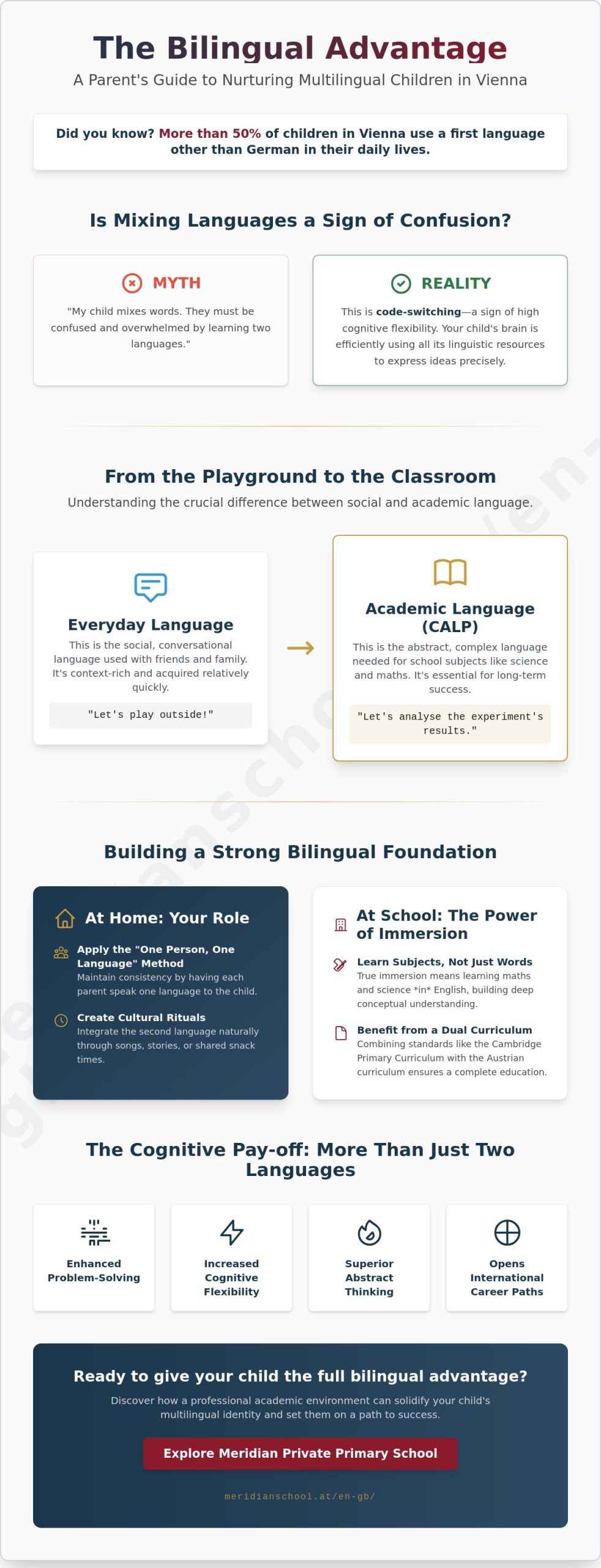
Viennese everyday life offers ideal conditions for keeping languages alive. One of the most proven strategies against the challenges of bilingual education is the „One Person, One Language“ (OPOL) method. Here, each parent consistently speaks to the child in their native language. This creates clear structures and prevents language mixing in the mind. But theory isn't everything; language needs a soul.
Link the second language with emotional moments such as shared snack time. When the bread roll or quark strudel becomes an occasion for an English conversation, the vocabulary becomes more deeply embedded. Utilise the city's rich offerings. The Büchereien Wien (Vienna Libraries) offer a wealth of foreign language literature, and institutions like Vienna's English Theatre bring the language directly to the stage. Visiting relatives or meeting international peers also creates natural speaking opportunities that no textbook can replace.
Evening rituals are the key to success. Read stories daily in the language that is less prevalent in the Viennese environment. This enormously expands vocabulary outside of school. For media consumption, quality over quantity applies. A short, high-quality English audio play is more valuable than hours of passive listening. Your own role model effect is the strongest instrument; your linguistic consistency signals to the child the value of both worlds.
Especially in the 1190th district, excellent opportunities for social integration can be found. Playgroups foster exchange at eye level and allow friendships to develop. During the holidays, Bilingual Summer Day Camps offer the chance to immerse oneself in the language without performance pressure. Sport and music at school often act as icebreakers. When children play football together or sing in a choir, the challenges of bilingual education recede into the background, and communication flows naturally.
Would you like to enable your child to have this playful access? Secure a place in our Bilingual Summer Day Camp now and foster language proficiency in an inspiring environment.
Whilst parents lay the emotional foundation for multilingualism at home, the school acts as the crucial academic anchor. Here, language transforms from a mere means of communication into a precise tool for acquiring knowledge. The principle of immersion goes far beyond traditional rote vocabulary learning; it means a genuine „diving into“ the language. In a private primary school, English is not taught as an isolated subject, but used as a natural working language in all areas of life.
This approach offers enormous relief for families. They no longer have to bear the sole responsibility for grammatical correctness or specialist vocabulary. The school takes over the structured development of academic language, which removes pressure from family life. To sustainably master the challenges of bilingual education, this professional guidance is essential. Furthermore, international certificates, such as those from the Cambridge Primary Curriculum, prepare children for a global career already in primary school.
A modern all-day school offers the ideal timeframe to consolidate both languages without time pressure. When children make music, play sports, or experiment in the STEM focus after lessons, language learning happens incidentally. This integration of music, sport, and natural sciences into bilingual everyday life ensures that the foreign language is not experienced as an additional burden, but as an enriching part of one's own identity. A space is created where multilingualism is the social norm, not the exception.
The ideal time to start in a bilingual environment is at school entry, as the brain is particularly receptive to new language structures during this phase. For the 2026/27 school year, official enrolment for Viennese primary schools takes place between 10th November and 21st November 2025. All children born between 2nd September 2019 and 1st September 2020 are of compulsory school age. Inform yourself in good time about school registration and the requirements to enable your child the best possible start to an international future.
The decision for a multilingual path is a valuable gift for your child's overall development. As we have discussed, initial language mixing, with the right support, transforms into precise academic competence that extends far beyond everyday life. However, to successfully master the challenges of bilingual education, a stable environment is required that professionally complements the family setting.
Meridian Private Primary School offers precisely this framework as a certified Cambridge International School in the heart of the 19th district. With native speaker teachers in every class and a clear STEM focus, we ensure that your child masters both languages at the highest level. Our holistic all-day care relieves you in everyday life and creates the necessary space for individual development in an international environment.
Visit Meridian Private Primary School and discover our bilingual concept! We look forward to accompanying you and your child on this exciting journey towards a cosmopolitan future.
Yes, so-called code-switching is a completely natural part of language development and a sign of cognitive flexibility. Your child instinctively uses the term that is more present to them at that moment or better captures the desired nuance. In primary school, this phenomenon usually disappears on its own once the separation of language systems in the brain is consolidated. It is no cause for concern, but rather proof of the active networking of both languages.
The ideal time to begin multilingual education is as early as possible, ideally from birth or in infancy. The human brain is particularly plastic during the first six years of life and absorbs language structures almost effortlessly. An early start helps to playfully master the challenges of bilingual education before academic pressure increases. Targeted support should begin at the latest with entry into nursery school or pre-school.
It is advisable for each parent to communicate in the language in which they feel most confident and authentic. Children need a correct linguistic role model to internalise grammatical structures properly. If you do not perfectly master a language, you should leave it to your partner or professional native speakers at school. This way, you avoid errors becoming entrenched, whilst simultaneously preserving emotional authenticity in daily interaction with your child.
No, scientific findings show that children growing up bilingual do not have long-term disadvantages in learning to read. Whilst there may be a short temporary shift in the first year of school as the brain processes two writing systems simultaneously, this process actually promotes abstract thinking. In the long term, children benefit from a deeper understanding of language structures, which also gives them a significant cognitive advantage when learning further foreign languages or in complex STEM subjects.
When choosing a school, look for international accreditations such as the Cambridge certificate, native speakers in every class, and a holistic educational concept. In Vienna 1190, private primary schools often offer the advantage of smaller groups and an enhanced STEM focus. An on-site visit will help you to sense the atmosphere and ensure that the school meets both the Austrian curriculum and global educational goals. This way, you will find an environment that competently supports the individual challenges of bilingual education.