A little boy in the 19th district observes with fascination how a self-built water wheel turns, while explaining the physical principles quite naturally in English. It is precisely this moment when passive listening transforms into true understanding. You are probably familiar with the concern that your child's individual talents might remain undiscovered in traditional teacher-led instruction, or that a lack of high-quality bilingual provisions in Vienna could restrict their future career path. Research in primary school today is far more than an educational trend; it is the foundation for critical thinking and a strong international identity.
We understand that you are looking for a learning environment for your child that combines academic excellence with a warm, nurturing atmosphere. Discover in this article how inquiry-based learning awakens natural curiosity and lays the groundwork for a global future in 2026. We provide you with a precise insight into how the integration of the Austrian curriculum with the Cambridge Primary Curriculum makes complex STEM topics understandable through experimentation and confidently prepares your child for an international career.
Inquiry-based learning is far more than just an educational buzzword. It refers to a principle of active knowledge acquisition, where children don't just consume facts, but rather discover the world through their own questions. When we talk about research in primary school, we mean the transition from traditional rote learning in general studies to a profound understanding of interrelationships. While in the past the correct result was often prioritised, today the process counts. Children are natural little scientists; they possess an unbridled curiosity that we specifically address in the school day.
To better understand this concept, watch this helpful video:
An essential aspect of this is the establishment of a positive error culture. In a modern STEM-oriented environment, an unsuccessful experiment is not a failure, but often the best teacher. If the experiment does not yield the expected result, the real thinking begins: Why didn't it work? This analytical approach massively distinguishes inquiry-based learning from conventional teaching, where answers are often predetermined.
The research process follows a clear logic: observing, asking questions, formulating hypotheses, and finally testing them. In this cycle, the role of teachers fundamentally changes. They no longer act as purely instructive knowledge transmitters, but as learning facilitators. They provide impulses, make high-quality materials available, and support pupils in finding their own solutions. This strengthens self-efficacy and confidence in their own cognitive abilities from the outset.
In 2026, we face global challenges that demand innovative approaches. The promotion of future skills ideally begins in the first year. Critical thinking and problem-solving skills are the core competencies of the future. Through research in primary school, we prepare children for a technological world. It's no longer enough to merely possess knowledge; one must be capable of applying it in new contexts and critically questioning it. This forms the foundation for a successful international career.
STEM is not an isolated subject at our institution, but an integral part of the entire school life. We consistently integrate Mathematics, Informatics, Natural Sciences, and Technology with our bilingual concept. Research in primary school thus gains an additional dimension: children acquire technical terms quite naturally in two languages. The Cambridge Primary Curriculum serves as a global quality standard, ensuring that our pupils learn at an international level. We aim to awaken the spirit of inquiry early on to train the problem-solvers of tomorrow.
Language proficiency benefits massively from this approach. In regular presentations, the children explain their experimental setups and results alternately in German and English. This process fosters self-confidence and rhetorical skills. The current iKM PLUS educational study from 2026 shows that this focus bears fruit: in Austria, 84% of Year 4 pupils achieve the educational standards in Mathematics. Our goal is to further consolidate this rate through innovative methods.
Through the immersion method, English becomes the working language in the lab. Natural sciences offer the ideal context to consolidate the second language without rote vocabulary learning. Pupils intuitively grasp the concept of 'Gravity' (Schwerkraft) while observing the free fall of various objects and documenting their measurements. Thus, language becomes a tool to explain the world. Take a look at our versatile educational offer to learn more about this approach.
Mathematics loses its intimidation when it becomes tangible. When building models, geometry and statics become an exciting challenge instead of an abstract formula. This practical link with our STEM focus helps to alleviate mathematical anxieties early on. When children calculate how much weight a self-constructed paper bridge can bear, they experience the relevance of numbers directly in their everyday lives.
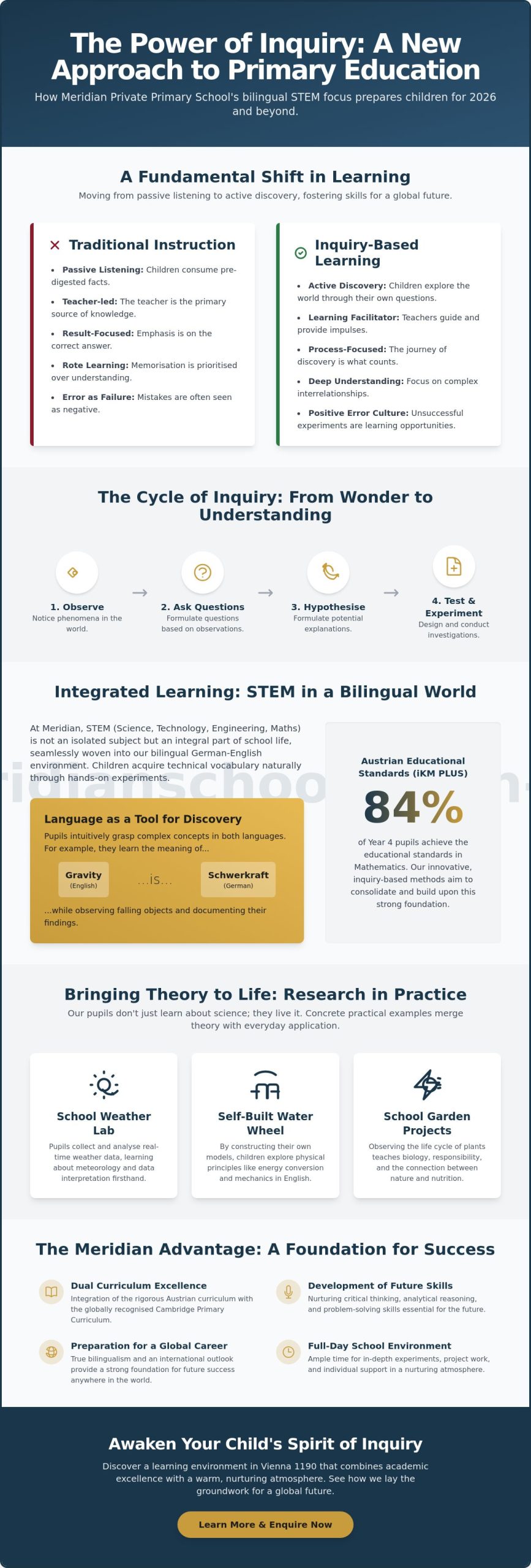
Theory only comes alive when it is tangible. In our school day in the 19th district, classrooms regularly transform into small research laboratories. A highlight is the school's own weather lab. Here, children independently create clouds in a glass to understand condensation processes. The collected weather data is then professionally analysed on tablets, providing the perfect bridge to the digital primary school. We base the conception of these units on internationally recognised standards, as recommended by the Stiftung Kinder forschen, to ensure consistently high quality of experiments.
Current figures prove that this practical approach works: by June 2024, approximately one in ten schools in Austria had already been awarded the STEM quality seal. However, research in primary school with us encompasses far more than digital analysis:
Science often happens where you least expect it. During the snack break, we investigate the density of foods. Why does an apple float in the water basin while a Euro coin immediately sinks to the bottom? Such everyday phenomena awaken enthusiasm for fundamental physical laws. The surface tension of water, which we make visible with a little pepper and a drop of washing-up liquid, regularly causes astonished faces and lively discussions in German and English.
Vienna offers unique opportunities as a research location. We utilise collaboration with renowned Viennese museums and institutes to enable real encounters with scientists for the children. When an astronomer in the planetarium or a biologist in the Technical Museum talks about their daily work, it often shapes future career aspirations early on. These excursions are an integral part of our curriculum and broaden horizons beyond the classroom. Would you like to learn more about our innovative approach? Discover our entire educational offer now for a future-oriented education.
Meridian Private Primary School in Vienna Döbling positions itself as an exclusive educational partner for families who value holistic and future-oriented education. In the heart of the 19th district, we offer an environment where research in primary school is not just a side note on the timetable, but forms the core of our educational approach. Small class sizes are not a luxury here, but the necessary prerequisite to professionally accompany each child on their individual journeys of discovery. This structure gives us the assurance that no talent remains undiscovered.
A crucial advantage of our private full-day school is the factor of time. While traditional models are often dominated by time pressure, with us, after the communal snack, there is ample space for in-depth experiments. We know that true insights don't emerge in a rush. Only through quiet experimentation in the afternoon are the theoretical concepts learned in the morning consolidated. Our first-class facilities enable a seamless transition from theory to practical application in the school's own laboratory or in our extensive outdoor areas.
We enrich the official Austrian curriculum with an international flair that goes far beyond the standard. The learning of the global language English takes place through immersion, meaning natural immersion in the language throughout the school day. For a gentle start into this multilingual world, we offer our bilingual pre-school course. Here, the foundations for a successful career are laid even before actual school entry, by children playfully making their first contact with basic scientific concepts in both languages.
The choice of the right primary school is a fundamental decision for your child's future. We cordially invite you to get an impression of our innovative learning environment on site. Visit us on one of our open days in Grinzinger Straße and personally experience how we rekindle the spirit of inquiry in our pupils daily. All details regarding registration as well as information on the specific admission procedure for the academic year 2026 can be found on our website. We look forward to welcoming you and your little researcher in Döbling.
The decision for the right education lays the foundation for your child's entire future career path. Research in primary school is far more than a mere pastime; it is the targeted promotion of critical thinking and problem-solving skills in a bilingual environment. As a certified Cambridge International School, we offer a unique integration of local recognition and global quality standards. Our STEM focus consistently starts from Year 1 to identify and individually foster talents early on.
In our excellent location in Vienna 1190, we create the protected space that inquisitive minds need for their development. We combine academic professionalism with a warm atmosphere, where every child is encouraged to ask questions and actively understand the world. Transform your child's natural curiosity into a solid foundation for an international career and a lifelong joy of learning.
Discover our holistic offer for young researchers!
We look forward to meeting you and your little explorer in person and together laying the groundwork for a successful, globally-minded future.
Research in primary school begins with us on the first day of school in Year 1. In accordance with the new Austrian curriculum, which has been gradually implemented since the academic year 2023/24, we firmly integrate discovery lessons into the weekly timetable. This way, the natural curiosity of school beginners is immediately addressed and systematically fostered to create a solid foundation for the entire primary school period and beyond.
No, prior knowledge of English is not a prerequisite for participation in our STEM projects. We use the immersion method, where children learn the language quite naturally through active doing. Technical terms are introduced in parallel in German and English. This playful approach allows even beginners to understand complex experiments and simultaneously expand their vocabulary in a real context without performance pressure.
All materials for the experiments are provided by the school. Our laboratory is equipped with modern measuring devices, microscopes, and tablets for data analysis. For many experiments, we also use high-quality everyday materials to show that science happens everywhere. Parents do not need to purchase any special utensils; we place importance on the infrastructure for research in primary school being professionally and fully available on site.
Safety is paramount in every experiment and is ensured through small group sizes and continuous pedagogical supervision. All experiments are designed to be age-appropriate and use only non-toxic substances. Before a new project starts, the teachers conduct a detailed safety briefing. Children thus learn from the outset how to handle laboratory equipment and materials responsibly within a protected, professionally managed framework.
Yes, inquiry-based learning is an excellent tool for overcoming mathematical hurdles. Through practical experimentation, abstract numbers and formulas become tangible. When a child calculates the statics of a bridge or measures data in the weather lab, they immediately recognise the utility of Mathematics. This action-oriented approach increases motivation and helps children develop a deeper understanding of logic and set theory that goes far beyond mere calculation.