Wie erkennen Sie, ob Deutsch und Englisch im Schulalltag wirklich gelebt werden und ein internationales Curriculum den österreichischen Lehrplan ergänzt? Bei der Wahl einer bilingualen Ganztagsschule in Wien zählen nicht nur die Unterrichtssprachen, sondern auch die Verbindung von Lernen, Betreuung und Aktivitäten über den ganzen Tag.
Bei MERIDIAN in Wien-Grinzing gehören Deutsch und Englisch ab dem ersten Schultag zum Unterricht. Das Cambridge Primary Curriculum ergänzt den österreichischen Lehrplan für Volksschulen. Zum Ganztagsangebot gehören außerdem ein MINT-Schwerpunkt, Sport, Schwimmunterricht und eine tägliche Gartenstunde. In diesem Beitrag erfahren Sie, woran Sie ein stimmiges Ganztagsangebot erkennen, wie die beiden Curricula zusammenspielen und welche Rolle Klassengröße und Tagesgestaltung spielen. So können Sie Ihre Fragen für einen Schulbesuch und die Anmeldung gezielt vorbereiten.
Eine bilinguale Volksschule setzt Deutsch und Englisch nicht nur in einzelnen Sprachstunden ein. Beide Sprachen begleiten den Unterricht und können auch in weiteren Situationen des Schulalltags präsent sein. Ein Ganztagsangebot verbindet Unterricht mit Mittagessen, Lern- und Betreuungszeiten sowie zusätzlichen Aktivitäten. Für Eltern, die eine bilinguale Ganztagsschule in Wien suchen, ist daher entscheidend, wie diese Bestandteile den Tag tatsächlich strukturieren.
Betrachten Sie das Angebot als Ganzes: In welchen Situationen begegnet Ihr Kind den beiden Sprachen? Wie ergänzen einander die Lehrpläne? Welche Lern-, Bewegungs- und Ruhephasen sind vorgesehen? Bei MERIDIAN lernen maximal 20 Kinder pro Klasse, mindestens zwei Lehrkräfte begleiten jede Klasse. Diese konkreten Rahmenbedingungen helfen Ihnen, die Lernumgebung einzuschätzen.
Bei einzelnen Englischstunden steht die Sprache meist in einer eigenen Unterrichtseinheit im Mittelpunkt. bilingual immersion bedeutet, dass Englisch regelmäßig im Alltag verwendet wird und dadurch in unterschiedlichen Situationen präsent ist. Einen internationalen Überblick bietet Wikipedia unter Bilingual education worldwide. Bei MERIDIAN sind Deutsch und Englisch ab dem ersten Schultag Unterrichtssprachen.
Ein privates bilinguales Ganztagsangebot ist nicht automatisch mit dem öffentlichen Vienna Bilingual Schooling (VBS) gleichzusetzen. Entscheidend sind das konkrete Schulmodell und das Zusammenspiel von Unterricht, Lehrplan und Tagesgestaltung. MERIDIAN verbindet das Cambridge Primary Curriculum mit dem österreichischen Lehrplan für Volksschulen. Damit stehen internationale Lerninhalte neben den Vorgaben des österreichischen Volksschulwesens.
Wenn Sie eine bilinguale Ganztagsschule in Wien vergleichen, achten Sie darauf, wie die Sprachen im Unterricht und im übrigen Schultag eingesetzt werden. Einen Überblick über MERIDIAN und die Unterrichts- und Bildungsangebote finden Sie online.
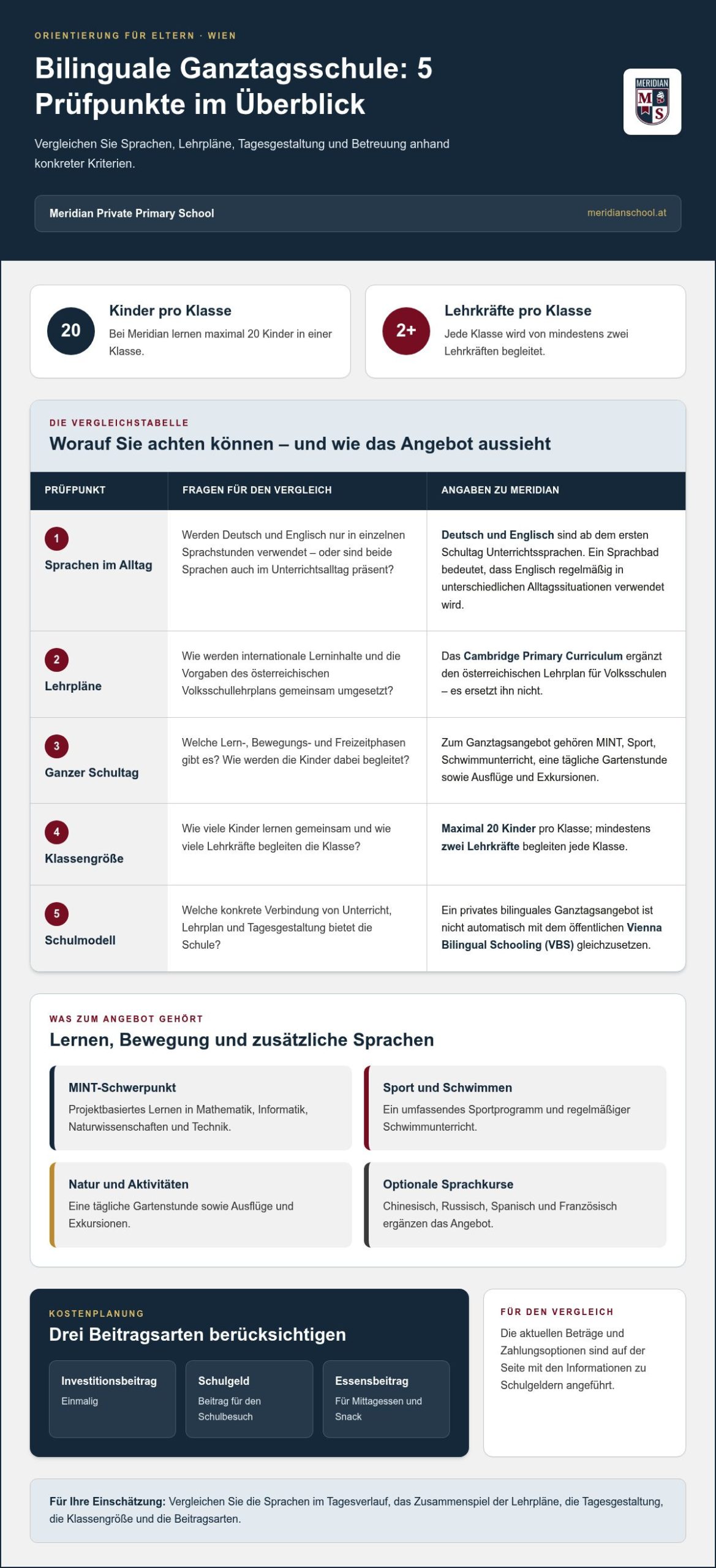
Ein stimmiges Angebot zeigt sich nicht allein an den Unterrichtssprachen. Achten Sie auch darauf, wie der Schultag gestaltet ist und wie die Lehrpläne zusammenspielen. Bei MERIDIAN ergänzt das Cambridge Primary Curriculum den österreichischen Lehrplan für Volksschulen. Die internationale Ausrichtung tritt also neben den österreichischen Lehrplan, sie ersetzt ihn nicht.
Drei Prüfpunkte helfen Ihnen beim Vergleich:
Fragen Sie nach den konkreten Bestandteilen des Schultags: Welche MINT-Projekte bearbeiten die Kinder? Welche Sportangebote gibt es, und wie ist der regelmäßige Schwimmunterricht in den Tagesablauf eingebunden? Auch die tägliche Gartenstunde, Ausflüge und Exkursionen geben Ihnen ein genaueres Bild davon, wie Lernen und Aktivitäten über den Tag verteilt sind.
Beziehen Sie auch die Klassengröße in Ihre Einschätzung ein. Bei MERIDIAN lernen maximal 20 Kinder in einer Klasse, mindestens zwei Lehrkräfte begleiten jede Klasse. Bei einem persönlichen Besuch können Sie sich ein Bild davon machen, wie Unterricht und Aktivitäten gestaltet sind. Eine Übersicht über die Angebote für Unterricht und Aktivitäten finden Sie online.
Vergleichen Sie diese Punkte mit den Bedürfnissen Ihres Kindes. So können Sie den persönlichen Eindruck vor Ort gezielt einordnen.
MERIDIAN ist eine private Ganztagsvolksschule in Wien-Grinzing. Deutsch und Englisch sind ab dem ersten Schultag Unterrichtssprachen. Das Cambridge Primary Curriculum ergänzt den österreichischen Lehrplan für Volksschulen. So kommen internationale Lerninhalte und der österreichische Volksschulrahmen im Unterricht zusammen.
Zum Ganztagsangebot gehören ein MINT-Schwerpunkt mit projektbasiertem Lernen, ein umfassendes Sportprogramm und regelmäßiger Schwimmunterricht. Dazu kommen eine tägliche Gartenstunde sowie Ausflüge und Exkursionen. Optionale Sprachkurse in Chinesisch, Russisch, Spanisch und Französisch ergänzen das Angebot. Diese Bestandteile helfen Ihnen, bei der Schulwahl neben dem Unterricht auch Bewegung, Natur und zusätzliche Sprachen mitzudenken.
Ein persönlicher Besuch gibt Ihnen die Möglichkeit, den Standort und die Tagesgestaltung kennenzulernen. Überlegen Sie vorab, was für Ihr Kind besonders wichtig ist: etwa die Verwendung von Deutsch und Englisch im Schulalltag, der MINT-Schwerpunkt oder die Sport- und Schwimmangebote. Die Anmeldeschritte für die Volksschule finden Sie online.
Für die Kostenplanung sind die einzelnen Beitragsarten und die Zahlungsweise wichtig. Zu berücksichtigen sind der einmalige Investitionsbeitrag, das Schulgeld und der Essensbeitrag. Die aktuellen Beträge und Zahlungsoptionen sind auf der Seite mit den Informationen zu Schulgeldern angeführt. Beziehen Sie diese Kosten ebenso in Ihre Überlegungen ein wie das pädagogische Angebot.
Wenn Sie eine bilinguale Ganztagsschule in Wien beurteilen, vergleichen Sie Unterricht, Tagesgestaltung und Kosten mit den Bedürfnissen Ihrer Familie. Ein Besuch bei MERIDIAN in Grinzing hilft Ihnen, das Angebot vor Ort kennenzulernen.
Mit der Wahl einer bilingualen Ganztagsschule in Wien entscheiden Sie auch, in welchem Umfeld Ihr Kind lernt und seinen Schultag verbringt. Neben dem Konzept zählt daher Ihr persönlicher Eindruck: Passt die Atmosphäre zu Ihrem Kind? Können Sie sich den Tagesablauf für Ihre Familie gut vorstellen?
MERIDIAN ist die erste Schule in Wien mit Cambridge Primary School-Zertifizierung. Die Schule verfügt über das Öffentlichkeitsrecht für das Schuljahr 2021/22. Diese Eckpunkte geben Orientierung. Ein Besuch vor Ort und ein Gespräch helfen Ihnen zusätzlich, Ihre Fragen zur Schule und zum Alltag Ihres Kindes zu klären.
Lernen Sie das bilinguale Ganztagsangebot in Grinzing persönlich kennen und vereinbaren Sie einen persönlichen Termin. So können Sie sich vor Ort ein Bild machen und Ihre Fragen zu Anmeldung und Schulalltag besprechen.
Nein. MERIDIAN heißt Kinder unabhängig von ihrem bisherigen Sprachniveau willkommen. Deutsch und Englisch sind ab dem ersten Schultag Unterrichtssprachen. Bei einem persönlichen Besuch können Sie besprechen, wie beide Sprachen im Schulalltag eingesetzt werden und welche Begleitung Ihr Kind erhält.
Die Gesamtkosten setzen sich aus den einzelnen Beiträgen und der gewählten Zahlungsweise zusammen. Bei MERIDIAN gehören Schulgeld, der einmalige Investitionsbeitrag und der Essensbeitrag dazu. Die aktuellen Beträge und Zahlungsoptionen finden Sie in der Gebührenübersicht auf der Website.
Nein. MERIDIAN ist eine private Ganztagsvolksschule und konzentriert sich auf die Primarstufe. Eine Sekundarstufe oder ein Gymnasium gehört nicht zum Angebot. Die Anmeldeinformationen für die Volksschule finden Sie online.
Zusätzlich zu Deutsch und Englisch gibt es optionale Sprachkurse in Chinesisch, Russisch, Spanisch und Französisch. Diese Kurse ergänzen den bilingualen Unterricht, ersetzen die beiden Unterrichtssprachen aber nicht.
Woran erkennen Sie, ob Ihr Kind Englisch wirklich im Schulalltag erlebt oder nur einzelne Englischstunden besucht? Bei der Wahl einer englisch volksschule wien macht genau dieser Unterschied viel aus. Ebenso wichtig ist die Frage, ob ein internationales Curriculum den österreichischen Lehrplan ergänzt oder ersetzt.
In diesem Beitrag erfahren Sie, woran Sie bilingualen Unterricht und ein durchdachtes Schulprofil erkennen. Mit konkreten Kriterien können Sie Lehrplan, Ganztagsangebot, MINT-Schwerpunkt und Zusatzangebote vergleichen. Als Beispiel stellen wir die Meridian Private Primary School in Wien-Grinzing vor: Die Schule verbindet den österreichischen Lehrplan mit dem Cambridge Primary Curriculum und verwendet Deutsch und Englisch ab dem ersten Schultag im Unterricht und im Alltag. Auch kleine Klassen, inklusives und ganzheitliches Lernen sowie die nächsten Schritte zu persönlicher Information und Anmeldung kommen zur Sprache.
Bilingualer Unterricht bedeutet, dass Deutsch und Englisch nicht nur als getrennte Unterrichtsfächer vorkommen. Beide Sprachen werden im Unterricht und im Alltag verwendet. Wenn Sie eine englisch Volksschule in Wien suchen, achten Sie deshalb darauf, wie regelmäßig Englisch im Schulleben präsent ist und welche Rolle es neben Deutsch spielt.
Ein internationales Angebot muss den österreichischen Bildungsweg nicht ersetzen. Bilingualer Unterricht beschreibt zunächst die Sprachen im Lernalltag, nicht automatisch einen bestimmten Lehrplan. Bei MERIDIAN in Wien-Grinzing bilden der österreichische Lehrplan für Volksschulen und das Cambridge Primary Curriculum gemeinsam die Grundlage. Weitere Informationen zu Sprachpraxis und Schulangebot finden Sie im Überblick zum bilingualen Unterricht.
Bei einer einzelnen Englischstunde steht die Sprache als eigenes Fach im Mittelpunkt. Ein Sprachbad, auch bilingual immersion genannt, bringt Englisch regelmäßig in Alltagssituationen ein. Kinder begegnen der Sprache etwa beim gemeinsamen Arbeiten, in Gesprächen oder bei Aktivitäten, nicht nur während einer Englischlektion. Das beschreibt die Unterrichtsform, nicht ein garantiertes Lernergebnis oder einen bestimmten Sprachstand.
Die bilingual education umfasst unterschiedliche Modelle des Unterrichts mit zwei Sprachen. Vergleichen Sie deshalb konkret, wie Englisch im Schulalltag eingesetzt wird und auf welcher Lehrplangrundlage der Unterricht beruht. Wird Englisch auch außerhalb eigener Sprachstunden verwendet? Bleibt der österreichische Lehrplan Teil des Bildungswegs? Diese Fragen helfen Ihnen, die tatsächliche Unterrichtspraxis hinter der Bezeichnung „bilingual“ einzuordnen.
Ein aussagekräftiger Vergleich geht über die Frage hinaus, ob Englisch am Stundenplan steht. Achten Sie darauf, wie die Sprache im Unterricht und im Alltag vorkommt und welche Bildungsgrundlage die Schule nennt. So erkennen Sie, ob das Angebot zu Ihren Vorstellungen vom österreichischen Bildungsweg und einer internationalen Ausrichtung passt.
Diese Punkte machen Schulprofile besser vergleichbar, ohne dass Sie sich allein auf Bezeichnungen wie „bilingual“ oder „international“ verlassen müssen. Beim Curriculum zählt, welche Lerninhalte es abdeckt und wie es zum österreichischen Lehrplan steht. Das Cambridge Primary Curriculum ist ein international anerkanntes Curriculum für die Grundschule. Bei MERIDIAN wird es mit dem österreichischen Lehrplan für Volksschulen verbunden.
Beziehen Sie auch den Tagesablauf in Ihren Vergleich ein. Ein MINT-Schwerpunkt umfasst Mathematik, Informatik, Naturwissenschaften und Technik. Musik und Sport ergänzen das Angebot um weitere Lern- und Erfahrungsbereiche. Details zum Cambridge Primary Curriculum und zum Schulangebot von MERIDIAN finden Sie online. Bei einem Schulbesuch oder persönlichen Gespräch können Sie sich zusätzlich ein Bild vom Alltag und der pädagogischen Ausrichtung machen.
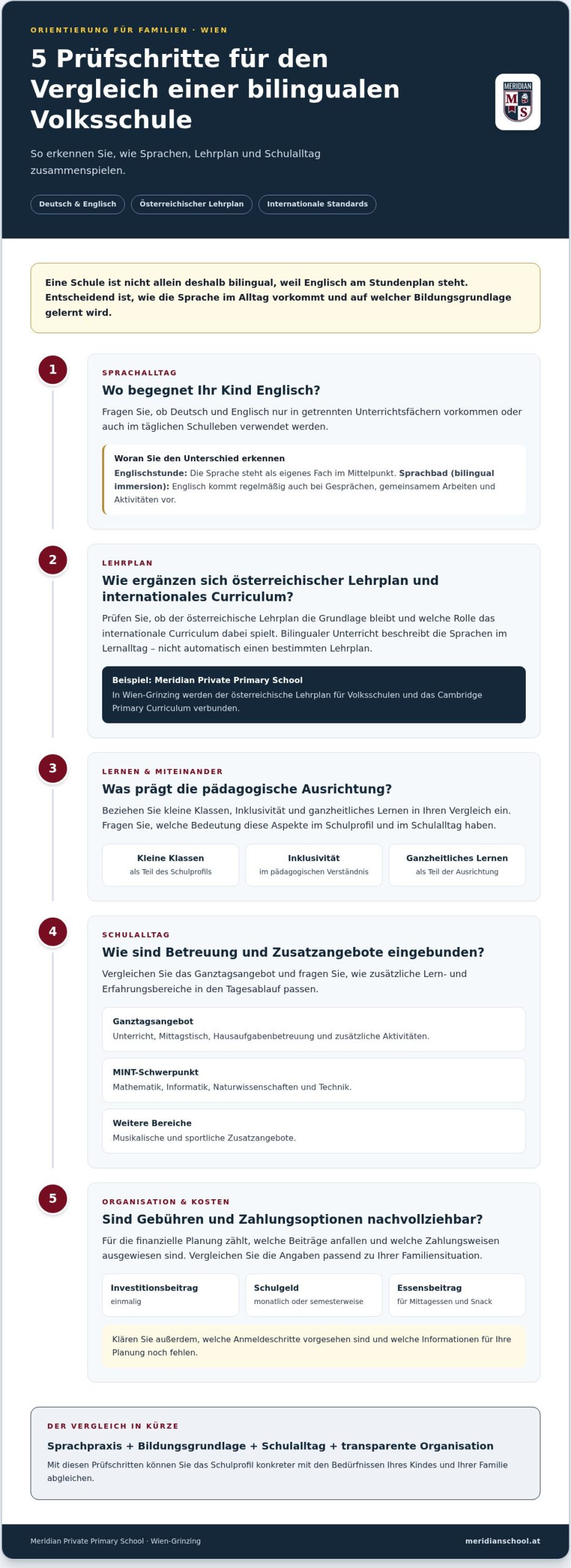
MERIDIAN ist eine bilinguale Privatschule in 1190 Wien. Deutsch und Englisch kommen ab dem ersten Schultag im Unterricht und im Alltag vor. Für Familien, die eine englisch Volksschule in Wien suchen, verbindet dieses Sprachkonzept eine klare österreichische Bildungsgrundlage mit internationalen Standards: Der österreichische Lehrplan für Volksschulen wird mit dem Cambridge Primary Curriculum kombiniert. So ergänzen einander der österreichische Bildungsweg und das internationale Curriculum.
Zum Schulprofil gehört auch ein Ganztagsangebot mit Unterricht, Mittagstisch, Hausaufgabenbetreuung und zusätzlichen Aktivitäten. Der MINT-Schwerpunkt umfasst Mathematik, Informatik, Naturwissenschaften und Technik. Musikalische und sportliche Zusatzangebote erweitern die Lern- und Erfahrungsbereiche. Kleine Klassen sowie ein inklusives und ganzheitliches pädagogisches Verständnis sind weitere Aspekte des Schulprofils, die Sie bei einem persönlichen Eindruck in den Schulalltag einbeziehen können.
Bei einem Schulbesuch oder persönlichen Gespräch können Sie Ihre Fragen zum Sprachalltag, zum Curriculum und zum Ganztagsangebot direkt besprechen. Überlegen Sie vorher, welche Aspekte für Ihr Kind besonders wichtig sind. So können Sie das Schulprofil gezielt mit den Bedürfnissen Ihrer Familie abgleichen.
Die Anmeldeschritte an der MERIDIAN finden Sie online. Für die finanzielle Planung können Sie die ausgewiesenen Schulgelder und Zahlungsoptionen heranziehen. Berücksichtigen Sie dabei den einmaligen Investitionsbeitrag, das Schulgeld sowie den Essensbeitrag. Das Schulgeld ist monatlich oder semesterweise ausgewiesen. So vergleichen Sie die für Ihre Familie relevanten Zahlungsoptionen übersichtlich.
Eine Schulwahl wird greifbarer, wenn Sie Ihre Erwartungen mit dem tatsächlichen Umfeld abgleichen. Überlegen Sie vor einem Besuch, was Ihrem Kind im Lernalltag wichtig ist und welche Fragen Sie noch klären möchten. Achten Sie darauf, wie die Atmosphäre auf Sie und Ihr Kind wirkt und ob Sie sich einen guten Austausch mit der Schule vorstellen können.
Ein persönliches Gespräch bietet Raum, individuelle Anliegen anzusprechen und die nächsten Schritte in Ruhe zu besprechen. So können Sie Ihre Eindrücke ordnen und entscheiden, ob MERIDIAN zu den Vorstellungen Ihrer Familie passt.
Lernen Sie MERIDIAN kennen und vereinbaren Sie einen persönlichen Besuch. Gewinnen Sie vor Ort einen Eindruck vom bilingualen Schulalltag in Wien-Grinzing und besprechen Sie Ihre Fragen direkt mit der Schule.
Aus dem bilingualen Konzept allein lässt sich nicht ableiten, dass Ihr Kind vor dem Schuleintritt Englisch sprechen muss. Aufnahme und individuelle Sprachsituation sind davon getrennte Fragen. Bei MERIDIAN begegnet Ihr Kind Deutsch und Englisch ab dem ersten Schultag. Im persönlichen Gespräch können Sie schildern, welche Sprachen Ihr Kind bisher erlebt, und besprechen, wie das Schulkonzept zu Ihrer Familie passt.
Nein. Eine bilinguale Volksschule ist nicht automatisch eine reine Englischschule. Bei MERIDIAN gehört der österreichische Lehrplan zur Bildungsgrundlage, das Cambridge Primary Curriculum ergänzt ihn. Wenn Sie eine englisch Volksschule in Wien vergleichen, achten Sie darauf, welchen Stellenwert Deutsch im Unterricht hat und wie die Schule ihre internationale Ausrichtung mit dem österreichischen Bildungsweg verbindet.
Eine Cambridge International School ist berechtigt, Cambridge-Curricula und die dazugehörigen Angebote umzusetzen. Für Eltern ist der Titel ein Hinweis auf eine internationale Bildungsgrundlage, nicht darauf, dass der österreichische Lehrplan entfällt. Beurteilen Sie das konkrete Schulprofil danach, wie beide Grundlagen zusammenwirken und welche weiteren Schwerpunkte, etwa MINT, den Unterricht ergänzen.
Die MERIDIAN Privatschule liegt in Wien-Grinzing im 19. Bezirk. Für die Alltagstauglichkeit zählt neben dem Standort auch, wie der Schulweg zu Ihrer Wohn- und Arbeitssituation passt. Planen Sie die Strecke zu den üblichen Bring- und Abholzeiten und beziehen Sie das Ganztagsangebot in Ihre Überlegungen ein. Ein Besuch vermittelt Ihnen einen persönlichen Eindruck von der Lernumgebung.
Wenn Sie nach „zweisprachige Volksschule Wien“ suchen, vergleichen Sie nicht nur die Zahl der Englischstunden. Entscheidend ist auch, wie Deutsch und Englisch im Unterricht und im Schulalltag eingesetzt werden. Öffentliche VBS-Angebote und private bilinguale Schulen unterscheiden sich unter anderem bei Lehrplan, Sprachpraxis, Betreuung und Schulgeldern.
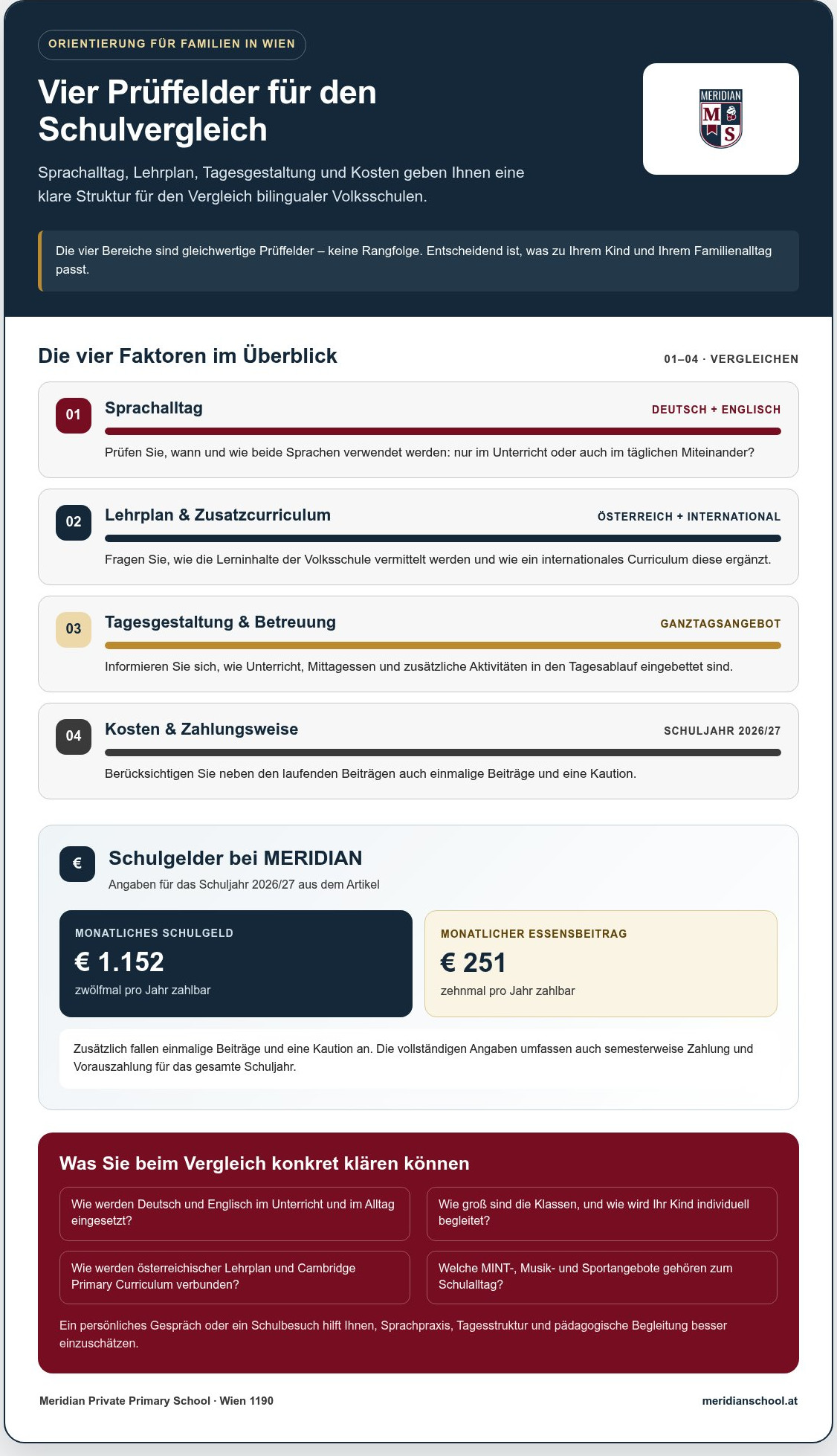
Für einen konkreten Vergleich sind vier Punkte hilfreich: Sprachalltag, Lehrplan, Tagesgestaltung und Kosten. Das öffentliche VBS-Modell arbeitet mit dem österreichischen Lehrplan. Die Meridian Private Primary School in 1190 Wien verbindet diesen mit dem Cambridge Primary Curriculum. Deutsch und Englisch sind dort ab dem ersten Schultag Unterrichts- und Alltagssprachen. Auch Klassengröße, Ganztagsangebot, MINT-Schwerpunkt sowie musikalische und sportliche Zusatzangebote prägen das Schulmodell. Im Folgenden finden Sie Orientierung zu diesen Kriterien, zu Schulgeldern und zur Anmeldung.
Für den Vergleich bilingualer Schulmodelle ist wichtig, wie Ihr Kind Deutsch und Englisch erlebt. Prüfen Sie nicht nur, ob beide Sprachen im Stundenplan stehen, sondern auch, ob sie im Unterricht und im täglichen Miteinander verwendet werden. Einen Überblick über unterschiedliche Formen gibt Was ist bilinguale Bildung?
Vienna Bilingual Schooling (VBS) ist ein öffentliches Angebot der Bildungsdirektion für Wien. Der Unterricht orientiert sich am österreichischen Lehrplan. Deutsch und Englisch werden im Team-Teaching als Unterrichtssprachen eingesetzt. Die Bildungsdirektion weist die Schulplätze zentral zu. Private Schulen gestalten ihr bilinguales Angebot im Rahmen ihres Schulkonzepts. An der privaten Volksschule MERIDIAN sind Deutsch und Englisch ab dem ersten Schultag Unterrichts- und Alltagssprachen. Dazu verbindet die Schule den österreichischen Lehrplan mit dem Cambridge Primary Curriculum.
Die Unterschiede lassen sich anhand konkreter Merkmale vergleichen, ohne daraus eine pauschale Rangfolge abzuleiten. Achten Sie besonders auf Sprachpraxis, Lehrplan, Trägerschaft und Schulstufen:
| Merkmal | Öffentliches VBS | Private bilinguale Volksschule MERIDIAN |
|---|---|---|
| Trägerschaft | Öffentliches Angebot der Bildungsdirektion für Wien | Private Schule mit Öffentlichkeitsrecht |
| Lehrplan | Österreichischer Lehrplan | Österreichischer Lehrplan und Cambridge Primary Curriculum |
| Sprachalltag | Deutsch und Englisch im Team-Teaching | Deutsch und Englisch im Unterricht und im Alltag ab dem ersten Schultag |
| Schulstufen | Volksschule | Primarstufe |
Welche zweisprachige Volksschule in Wien zu Ihrer Familie passt, hängt davon ab, welches Lernumfeld und welche organisatorischen Rahmenbedingungen Sie suchen. Vergleichen Sie im nächsten Schritt Sprachalltag, Zusatzangebote und Betreuung im Detail.
Ein Vergleich wird übersichtlicher, wenn Sie vier Bereiche einzeln betrachten: Sprachalltag, österreichischer Lehrplan, zusätzliches Curriculum und Ganztagsangebot. Überlegen Sie bei der Suche nach einer zweisprachigen Volksschule in Wien, wie diese Punkte zu den Bedürfnissen Ihres Kindes und zum Familienalltag passen.
Besprechen Sie im persönlichen Gespräch den Einsatz beider Unterrichtssprachen, die Klassengröße und die individuelle Begleitung. Fragen Sie auch nach konkreten Beispielen für MINT-Themen, musikalische und sportliche Angebote sowie Inklusion im Schulalltag. So können Sie besser einschätzen, wie das pädagogische Konzept umgesetzt wird und welche Angebote zu den Interessen Ihres Kindes passen.
Beziehen Sie auch die Kosten in Ihren Vergleich ein. Für das Schuljahr 2026/27 beträgt das monatliche Schulgeld bei MERIDIAN € 1.152, zahlbar zwölfmal pro Jahr. Der Essensbeitrag beträgt € 251 monatlich, zahlbar zehnmal pro Jahr. Dazu kommen einmalige Beiträge und eine Kaution. Die Seite zu Schulgeldern und Zahlungsweisen führt die vollständigen aktuellen Angaben auf, einschließlich der semesterweisen Zahlung und der Vorauszahlung für das gesamte Schuljahr.
Für Ihre Entscheidung zählt, welches Modell die Anforderungen Ihrer Familie erfüllt. Ein persönliches Gespräch oder ein Schulbesuch hilft Ihnen, Sprachpraxis, Tagesstruktur und pädagogische Begleitung besser einzuschätzen. Die Anmeldeschritte und Informationen zum Kennenlernen zeigen Ihnen, wie Sie weiter vorgehen können.
Wenn Sie eine zweisprachige Volksschule in Wien suchen, lohnt sich ein genauer Blick auf den gelebten Sprachalltag. Bei MERIDIAN sind Deutsch und Englisch ab dem ersten Schultag Unterrichts- und Alltagssprachen. Die kleine Klassengröße schafft einen überschaubaren Lernrahmen, in dem die individuelle Entwicklung der Kinder berücksichtigt wird. Bei einem Schulbesuch können Sie beobachten, wie beide Sprachen im Unterricht und im Miteinander vorkommen.
Das Schulkonzept verbindet den österreichischen Volksschullehrplan mit dem Cambridge Primary Curriculum. Damit treffen die Lerninhalte der österreichischen Volksschule auf ein international ausgerichtetes Curriculum. MERIDIAN ist eine zertifizierte Cambridge International School. Im persönlichen Gespräch können Sie erfahren, wie beide Ansätze im Unterricht zusammenspielen und den Lernalltag prägen.
Zum Schulalltag gehören außerdem ein Ganztagsangebot, ein MINT-Schwerpunkt sowie musikalische und sportliche Zusatzangebote. Fragen Sie, wie diese Bereiche in den Tagesablauf eingebunden sind und welche Möglichkeiten Ihr Kind hat, eigene Interessen zu entwickeln. So können Sie das pädagogische Umfeld mit den Bedürfnissen Ihrer Familie abgleichen.
Die aktuellen Anmeldeinformationen und Schritte helfen Ihnen, Ablauf und Termine zu planen. Die geltenden Schulgelder und Zahlungsweisen finden Sie auf der Schulgeldseite. Berücksichtigen Sie diese Kosten frühzeitig bei Ihrer Entscheidung.
MERIDIAN bietet eine Primarstufe als Ganztagsschule. In einem persönlichen Gespräch und bei einem Schulbesuch können Sie Fragen zu Lehrplan, Betreuung und Zusatzangeboten besprechen. So erhalten Sie einen konkreten Eindruck davon, ob das Schulmodell zu den Erwartungen Ihrer Familie passt.
Die Entscheidung für eine zweisprachige Volksschule in Wien wird konkreter, wenn Sie das Schulkonzept mit den Bedürfnissen Ihres Kindes und Ihrem Familienalltag abgleichen. Notieren Sie vor einem persönlichen Gespräch, welche Punkte Ihnen besonders wichtig sind: Wie erleben die Kinder Deutsch und Englisch im Alltag? Wie ergänzt das internationale Curriculum den österreichischen Lehrplan? Und welche pädagogische Umgebung unterstützt die fachliche und soziale Entwicklung Ihres Kindes?
Bei MERIDIAN können Sie diese Fragen anhand des Schulkonzepts besprechen. Die Schule ist eine zertifizierte Cambridge International School, verbindet den österreichischen Lehrplan mit dem Cambridge Primary Curriculum und setzt Deutsch und Englisch ab dem ersten Schultag im Unterricht und im Alltag ein. Auch Ganztagsangebot, MINT-Schwerpunkt sowie musikalische und sportliche Zusatzangebote gehören zum Schulalltag.
Lernen Sie das bilinguale Schulangebot in Wien kennen, vereinbaren Sie ein persönliches Gespräch und besuchen Sie die Schule. So können Sie sich selbst ein Bild machen und prüfen, ob das Modell zu Ihrer Familie passt.
Vienna Bilingual Schooling (VBS) ist ein öffentliches Angebot. Die Bildungsdirektion für Wien weist die Schulplätze zu. Private Schulen organisieren Aufnahme und Schulalltag im Rahmen ihres eigenen Schulkonzepts und verrechnen Schulgelder. Für Ihre Entscheidung zählen daher auch Aufnahmeweg und Finanzierung. Lehrplan, zusätzliche Schwerpunkte und Tagesgestaltung können sich je nach Schule unterscheiden.
Ja. Wenn Ihre Familie zu Hause Deutsch spricht, schließt das bilinguales Lernen nicht grundsätzlich aus. Ihr Kind kann Englisch auch im Schulalltag erleben, selbst wenn die Sprache bisher nicht zu Hause verwendet wurde. Für die Schulreife ist Deutschkenntnis laut den geltenden Kriterien nicht automatisch Voraussetzung, wenn eine altersgemäße Kompetenz in einer anderen Sprache vorliegt. Die konkrete Lernbegleitung besprechen Sie am besten im persönlichen Gespräch.
Der Anmeldeweg hängt davon ab, ob Sie eine öffentliche VBS-Schule oder eine private Volksschule wählen. Für das Schuljahr 2027/28 findet der erste Teil der öffentlichen Einschreibung vom 9. bis 20. November 2026 statt. Die Anmeldung ist dabei nur an einem Schulstandort möglich. Bei einer privaten Schule richten Sie sich nach den jeweiligen Anmeldeschritten und Terminen und planen dafür ausreichend Zeit ein.
Bei MERIDIAN beträgt das Schulgeld im Schuljahr 2026/27 monatlich 1.152 € (12 Mal pro Jahr), der Essensbeitrag 251 € (10 Mal pro Jahr). Einmalig fallen 1.750 € Investitionsbeitrag und 250 € Bearbeitungsgebühr an. Bei der Aufnahme wird eine Kaution von 500 € hinterlegt. Die semesterweise Zahlung beträgt 6.705 €, die Vorauszahlung für das Schuljahr 13.341 €. Berücksichtigen Sie diese Beträge bei Ihrer Budgetplanung.
Was macht eine bilinguale Privatschule in Wien für Ihr Kind passend: möglichst viel Englisch oder ein ausgewogenes Konzept, das auch Deutsch verlässlich fördert? Wenn Sie eine bilinguale privatschule wien suchen, zählen nicht nur die Unterrichtssprachen. Wichtig ist auch, wie sie mit dem österreichischen Lehrplan und dem Schulalltag verbunden sind.
Wie passt ein internationaler Bildungsansatz zu österreichischen Standards? Woran erkennen Sie die Deutschförderung, und was ergänzt den Unterricht im Tagesablauf? Hier erfahren Sie, wie die Meridian Private Primary School Deutsch und Englisch ab der ersten Schulstufe einsetzt und das Cambridge Primary Curriculum mit dem österreichischen Lehrplan verbindet. Außerdem geht es um kleine Klassen, MINT-, Musik- und Sportangebote, Ganztagsbetreuung, Schulgelder und Anmeldung. So können Sie das Konzept anhand konkreter Kriterien beurteilen und Ihre nächsten Schritte planen.
Bei der Wahl einer bilingualen Volksschule zählt nicht allein, wie oft Englisch unterrichtet wird. Entscheidend ist, wie Deutsch und Englisch in Unterricht und Schulalltag eingesetzt werden und ob das Sprachkonzept zur Primarstufe Ihres Kindes passt. Achten Sie darauf, ob beide Sprachen als Lern- und Unterrichtssprachen vorgesehen sind und wie sie im Tagesablauf vorkommen. Eine bilinguale Volksschule ist außerdem von einer weiterführenden Schule zu unterscheiden.
Öffentliche VBS-Angebote und private Schulen unterscheiden sich durch ihre Trägerschaft und das jeweilige Schulkonzept. Vergleichen Sie daher nicht nur die Unterrichtssprachen, sondern auch den Aufbau des Unterrichts und die Einbindung der Sprachen in den Alltag. MERIDIAN ist eine private Volksschule in Wien und konzentriert sich auf die Primarstufe. Auf der Seite zum bilingualen Schulkonzept erhalten Sie einen Überblick über das Angebot. Hintergrundinformationen zum öffentlichen Modell bietet der Beitrag zu Vienna Bilingual Schooling (VBS).
bilingual immersion, auch Sprachbad genannt, bedeutet, dass Kinder eine Sprache durch ihre regelmäßige Verwendung aufnehmen und nicht nur in einzelnen Sprachstunden damit arbeiten. Bei MERIDIAN sind Deutsch und Englisch ab der ersten Schulstufe Unterrichtssprachen. Die Kinder begegnen beiden Sprachen beim Lernen und im schulischen Alltag.
Beim Vergleich öffentlicher und privater Modelle hilft ein Blick darauf, wie die Sprachpraxis mit dem pädagogischen Konzept verbunden ist. Achten Sie darauf, ob die Primarstufe im Mittelpunkt steht und in welchen Situationen beide Sprachen verwendet werden. So können Sie besser einschätzen, welche bilinguale Schulform zu den Bedürfnissen Ihrer Familie passt.
Für Ihre Entscheidung ist wichtig, ob Deutsch neben Englisch im Schulalltag sichtbar bleibt. Fragen Sie sich, in welchen Situationen beide Sprachen verwendet werden und wie Kinder lernen, Inhalte zu verstehen und auszudrücken. Aufgaben, Lernmaterialien und Rückmeldungen geben Ihnen konkrete Hinweise darauf, wie die Sprachen im Unterricht berücksichtigt werden. Diese Prüfpunkte helfen Ihnen, ein Angebot unter dem Stichwort „bilinguale privatschule wien“ einzuordnen.
Ein bilingualer Ansatz ersetzt Deutsch nicht durch Englisch. Bei MERIDIAN sind beide Sprachen ab der ersten Schulstufe Unterrichtssprachen. Die Schule verbindet diese Ausrichtung mit dem österreichischen Lehrplan für Volksschulen und dem Cambridge Primary Curriculum. Als zertifizierte Cambridge International School verknüpft MERIDIAN internationale Bildungsstandards mit der Verankerung im österreichischen Schulsystem. Eine Untersuchung des UCLA Civil Rights Project beleuchtet mögliche Vorteile bilingualer Bildung. Für Ihre Wahl bleibt ausschlaggebend, wie das Schulkonzept die sprachliche und individuelle Entwicklung im Alltag begleitet.
Das Cambridge Primary Curriculum ist ein international anerkannter Bildungsrahmen für die Grundschule. Der österreichische Lehrplan bildet die Grundlage für die Volksschule in Österreich. Bei MERIDIAN werden beide Rahmen miteinander verbunden: Das Cambridge Primary Curriculum ergänzt den österreichischen Lehrplan, statt ihn zu ersetzen. Als zertifizierte Cambridge International School verbindet MERIDIAN damit eine internationale Perspektive mit dem österreichischen Schulsystem.
Bei einem Schulbesuch können Sie darauf achten, wie diese Verbindung im Unterricht erkennbar wird und wie Lernfortschritte begleitet werden. Kleine Klassen können Raum für individuelle Entwicklung bieten. Ebenso lohnt sich ein Blick darauf, wie Inklusion und ganzheitliches Lernen im pädagogischen Alltag berücksichtigt werden. Diese Kriterien helfen Ihnen, ein Konzept zum Thema „bilinguale privatschule wien“ an Ihren Erwartungen zu messen. Weitere Informationen zum bilingualen Bildungsangebot finden Sie online.
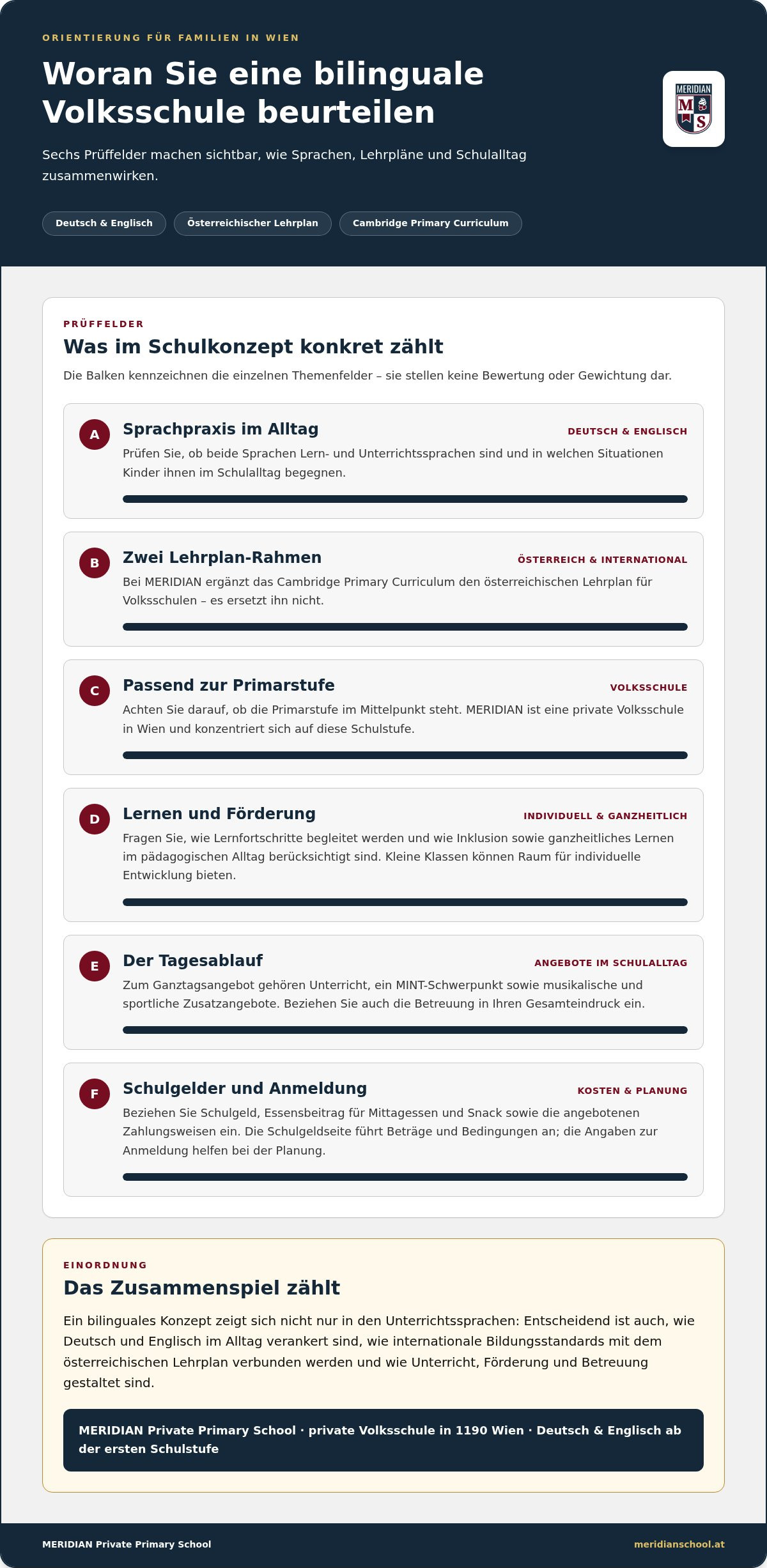
Wie sich ein bilinguales Konzept im Tagesablauf zeigt, lässt sich bei einem Besuch vor Ort gut nachvollziehen. MERIDIAN ist eine private Volksschule in 1190 Wien. Das Ganztagsangebot umfasst neben dem Unterricht einen MINT-Schwerpunkt sowie musikalische und sportliche Zusatzangebote. Kleine Klassen und eine ganzheitliche Ausrichtung prägen den pädagogischen Rahmen. Auf der Seite zum Schulangebot in Wien können Sie sich näher informieren.
Bei den Schulgeldern ist ein genauer Blick auf die einzelnen Bestandteile hilfreich. Berücksichtigen Sie das Schulgeld, den Essensbeitrag für Mittagessen und Snack sowie die angebotenen Zahlungsweisen. Die Schulgeldseite führt die aktuellen Beträge und Bedingungen an. So können Sie die Kosten nachvollziehen und die ausgewiesenen Positionen in Ihre Planung einbeziehen.
Informieren Sie sich über die Schulanmeldung und die vorgesehenen Schritte. Die dort angeführten Angaben und Termine helfen Ihnen, Ihre Planung darauf abzustimmen.
Ein persönliches Gespräch und ein Besuch in der Schule geben Ihnen die Möglichkeit, MERIDIAN kennenzulernen. Besprechen Sie dabei Ihre Fragen zu Unterricht, Betreuung und individueller Förderung. So erhalten Sie einen direkten Eindruck vom Schulalltag und können beurteilen, ob das Konzept zu den Erwartungen Ihrer Familie passt.
Eine passende bilinguale privatschule wien erkennen Sie daran, dass Deutsch und Englisch in Unterricht und Schulalltag verankert sind und der österreichische Lehrplan mit einem internationalen Bildungsrahmen zusammenspielt. Beziehen Sie auch die Ausrichtung auf die Primarstufe, die pädagogische Begleitung und den gesamten Tagesablauf in Ihre Entscheidung ein. Kleine Klassen können individuelle Entwicklung unterstützen.
MERIDIAN verbindet als zertifizierte Cambridge International School das Cambridge Primary Curriculum mit dem österreichischen Lehrplan. Der Unterricht findet ab der ersten Schulstufe auf Deutsch und Englisch statt. Das Ganztagsangebot umfasst außerdem einen MINT-Schwerpunkt sowie musikalische und sportliche Angebote. Die Informationen zu Schulgeldern und Anmeldung helfen Ihnen, auch die organisatorischen Aspekte zu berücksichtigen.
Ein persönlicher Eindruck hilft Ihnen, das Konzept mit Ihren Erwartungen abzugleichen. Vereinbaren Sie einen Schulbesuch und lernen Sie das bilinguale Schulkonzept von MERIDIAN in Wien kennen.
Eine VBS-Schule ist Teil des öffentlichen Vienna Bilingual Schooling-Angebots. Eine bilinguale Privatschule wird von einem privaten Träger geführt und setzt ein eigenes Schulkonzept um. Beide Ansätze können Deutsch und Englisch im Unterricht verbinden. MERIDIAN ist eine private Volksschule in Wien, die sich auf die Primarstufe konzentriert und das Cambridge Primary Curriculum mit dem österreichischen Lehrplan verbindet.
Ja. Bei MERIDIAN ist Deutsch neben Englisch ab der ersten Schulstufe eine Unterrichtssprache. Die Schule verankert den Unterricht im österreichischen Lehrplan und ergänzt ihn durch das Cambridge Primary Curriculum. Achten Sie bei der Wahl einer bilingualen Privatschule in Wien darauf, wie beide Sprachen im Unterricht und im Schulalltag eingesetzt werden und wie Lernfortschritte begleitet werden.
Die Kosten hängen von der Schule und ihrer Gebührenstruktur ab. Bei MERIDIAN finden Sie auf der Schulgeldseite die Angaben zu Schulgeld, Zahlungsweisen und zusätzlichen Beiträgen wie dem Essensbeitrag. Vergleichen Sie die ausgewiesenen Kostenpositionen und beziehen Sie sie in Ihre Planung ein.
Informieren Sie sich zuerst über das Schulkonzept und den Standort und vereinbaren Sie einen persönlichen Schulbesuch oder ein Gespräch. So erhalten Sie einen unmittelbaren Eindruck vom Alltag und können Ihre Fragen zur bilingualen Förderung stellen. Die aktuellen Schritte und Informationen zur Anmeldung bei MERIDIAN finden Sie online. Nutzen Sie diese Angaben für Ihre Planung und Vorbereitung.
Die entscheidende Frage ist nicht nur, ob Ihr Kind Deutsch und Englisch lernen soll, sondern wie beide Sprachen Teil des Schulalltags werden. Wer eine bilinguale Volksschule in Wien sucht, vergleicht oft das öffentliche VBS-Modell mit einer privaten Cambridge International School. Dabei stellt sich auch die Frage, wie Kinder beim Lernen in zwei Sprachen begleitet werden. Ein gut gestaltetes Sprachbad nutzt beide Sprachen im Alltag und führt Schritt für Schritt an neue Inhalte heran.
In diesem Wegweiser erfahren Sie, worin sich die Modelle unterscheiden und wie die Meridian Private Primary School in Grinzing den österreichischen Lehrplan mit dem Cambridge Primary Curriculum, bilingualem Unterricht und einem MINT-Schwerpunkt verbindet. Sie erhalten außerdem Orientierung zu Schulreife, Aufnahme, Anmeldeplanung, Schulgeldern und Ganztagsbetreuung. So können Sie die Lernumgebung anhand konkreter Kriterien mit den Bedürfnissen Ihres Kindes abgleichen.
Eine bilinguale Volksschule verbindet Lernen in Deutsch und Englisch. Bei bilingual immersion begegnet Ihr Kind beiden Sprachen nicht nur in einzelnen Sprachstunden, sondern verwendet sie regelmäßig im Schulalltag. Dieses Sprachbad schafft natürliche Anlässe zum Zuhören, Sprechen und Verstehen. Was Zweisprachigkeit bedeutet und welche Formen es gibt, erläutert der Überblick zu Bilingualismus.
Wenn Sie sich fragen, ob zwei Unterrichtssprachen Ihr Kind überfordern könnten, achten Sie darauf, wie die Schule neue Inhalte einführt und Kinder beim Mitlernen unterstützt. Ein klar strukturierter Unterricht gibt Orientierung, während wiederkehrende Alltagssituationen Gelegenheit bieten, Wörter und Zusammenhänge in beiden Sprachen zu erfassen. Beim Wechsel zwischen Sprachen kann Ihr Kind üben, Themen aus verschiedenen Blickwinkeln zu betrachten und Lösungswege zu vergleichen. Kinder entwickeln sich dabei individuell und müssen nicht alle gleich schnell vorankommen.
Ein Einblick in den Schulalltag zeigt, wie Englisch in Aktivitäten und Begegnungen Platz findet:
Im klassischen Sprachunterricht stehen oft einzelne Wörter und Übungen im Mittelpunkt. Im Sprachbad ist Englisch in sinnvolle Situationen eingebettet, etwa beim Lesen, Erklären oder gemeinsamen Arbeiten. Native Speaker können Aussprache und alltägliche Wendungen vermitteln. Wichtig ist zugleich, dass Kinder Fragen stellen und sich in beiden Sprachen ausdrücken können.
Englisch als Alltagssprache ab dem ersten Schultag schafft eine frühe Grundlage für internationale Begegnungen und weitere Bildungswege. An der Meridian Private Primary School in Grinzing lernen Kinder auf Basis des österreichischen Lehrplans und des Cambridge Primary Curriculum. So verbindet die Schule lokale Lehrplaninhalte mit einem internationalen Bildungsrahmen und hält Deutsch im Lernalltag fest verankert.
In Wien gibt es unterschiedliche Wege zu bilingualer Bildung. Das öffentliche Vienna Bilingual Schooling (VBS) verankert Deutsch und Englisch im Unterricht. Eine private Cambridge International School verbindet ein internationales Curriculum mit dem österreichischen Lehrplan. Wenn Sie eine bilinguale Volksschule in Wien auswählen, vergleichen Sie daher nicht nur die Unterrichtssprachen. Prüfen Sie auch, wie die Lehrpläne zusammenspielen, wie der Schulalltag gestaltet ist und ob das Angebot zum österreichischen Bildungsweg Ihres Kindes passt.
Ein internationaler Standard kann für Familien mit internationalem Hintergrund interessant sein. Auch für Kinder, die in Wien aufwachsen, bietet ein strukturierter Zugang zu englischsprachigen Inhalten zusätzliche Perspektiven. Das Niedersächsische Institut für frühkindliche Bildung und Entwicklung beschreibt in seinem Beitrag die Vorteile der Mehrsprachigkeit. Entscheidend für Ihre Wahl ist, ob Lernkonzept, Tagesablauf und Entwicklungsstand Ihres Kindes zusammenpassen.
Das Cambridge Primary Curriculum richtet sich an Kinder von fünf bis elf Jahren. Es umfasst Englisch, Mathematik und Naturwissenschaften sowie ergänzende Bereiche wie Global Perspectives, Musik und digitale Kompetenz. In Verbindung mit dem österreichischen Lehrplan entsteht ein Bildungsrahmen, der lokale Anforderungen und internationale Inhalte zusammenführt. Das Cambridge-Zertifikat ist die offizielle Anerkennung durch Cambridge Assessment International Education für den Abschluss des Curriculums. Der Cambridge-Ansatz lässt sich zudem mit einem MINT-Schwerpunkt in Mathematik, Informatik, Naturwissenschaften und Technik verbinden.
Die Meridian Private Primary School in Grinzing ist eine zertifizierte Cambridge International School mit Öffentlichkeitsrecht. Ihr bilinguales Schulangebot verbindet den österreichischen Lehrplan mit dem Cambridge Primary Curriculum.
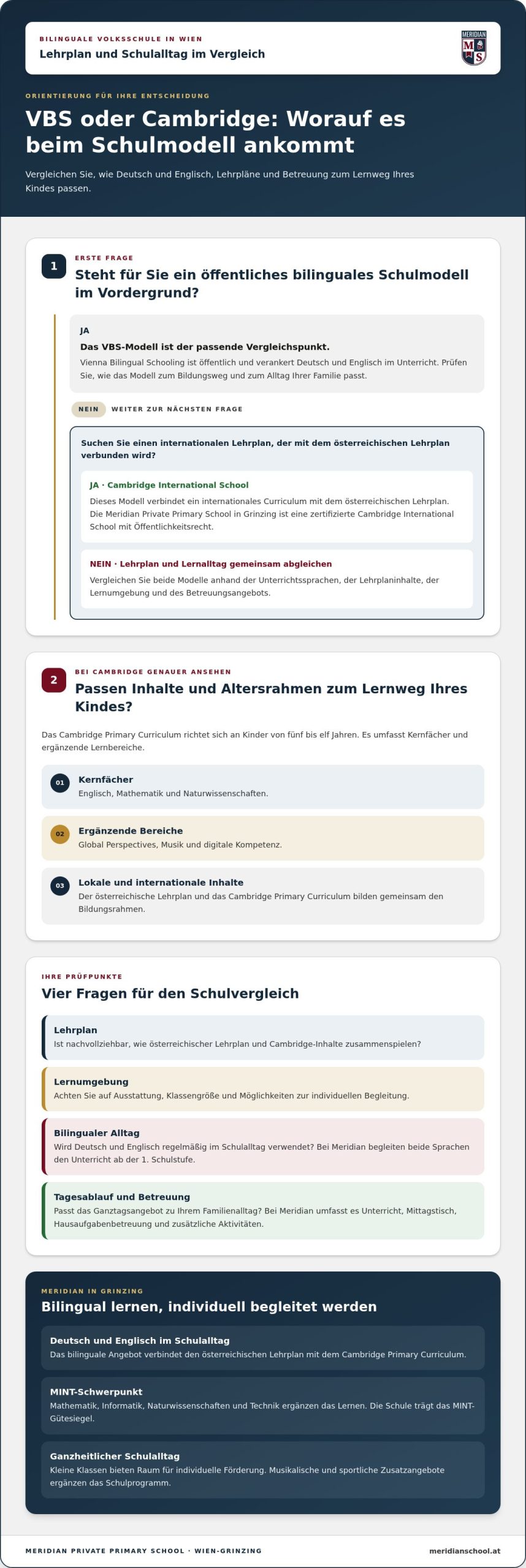
In Grinzing verbindet die Meridian Private Primary School den österreichischen Lehrplan mit dem Cambridge Primary Curriculum. Deutsch und Englisch begleiten den Unterricht ab der 1. Schulstufe. Der MINT-Schwerpunkt umfasst Mathematik, Informatik, Naturwissenschaften und Technik. Musikalische und sportliche Zusatzangebote ergänzen den Schulalltag. Die Schule verfügt über Öffentlichkeitsrecht und trägt das MINT-Gütesiegel. Kleine Klassen bieten Raum für individuelle Förderung.
Wenn Sie eine bilinguale Volksschule in Wien suchen, beziehen Sie auch die Betreuung in Ihre Entscheidung ein. Bei Meridian umfasst das Ganztagsangebot Unterricht, Mittagstisch, Hausaufgabenbetreuung und zusätzliche Aktivitäten. Achten Sie beim Vergleich darauf, wie sich Unterricht und Betreuung über den Tag verteilen und welche Angebote Ihr Kind besonders ansprechen.
Der erste Schritt ist die Anmeldung. In einem persönlichen Austausch können Sie Fragen zum Schulkonzept und zum Einstieg Ihres Kindes besprechen. Die Schulreife wird pädagogisch festgestellt. Informationen zu den Anmeldeschritten und Unterlagen finden Sie auf der Anmeldungsseite der Meridian Schule. Das Bilingual Summer Day Camp bietet eine weitere Gelegenheit, Englisch spielerisch zu erleben.
Beziehen Sie auch die Schulgelder in Ihre Entscheidung ein. Relevant sind das monatliche Schulgeld, der Essensbeitrag und der einmalige Investitionsbeitrag. Für das Schulgeld gibt es monatliche und semesterweise Zahlungsoptionen. Vergleichen Sie die einzelnen Beiträge mit Ihrem geplanten Betreuungsbedarf und prüfen Sie die aktuellen Zahlungsdetails in der Gebührenübersicht. So können Sie Lernkonzept, Betreuung und Kosten gemeinsam abwägen und persönlich kennenlernen, ob diese bilinguale Volksschule in Wien zu Ihrem Kind passt.
Bei der Wahl einer bilingualen Volksschule in Wien zählen mehr als zwei Unterrichtssprachen. Achten Sie darauf, wie das Sprachbad im Alltag umgesetzt wird, wie österreichischer Lehrplan und Cambridge Primary Curriculum zusammenspielen und ob das pädagogische Konzept zu Ihrem Kind passt. Der Vergleich zwischen öffentlichem VBS-Modell und privater Cambridge International School hilft Ihnen, diese Kriterien einzuordnen.
Die Meridian Private Primary School in Grinzing verbindet Deutsch und Englisch im Schulalltag mit dem österreichischen Lehrplan und einem internationalen Curriculum. Als zertifizierte Cambridge International School mit MINT-Gütesiegel setzt sie außerdem einen Schwerpunkt auf Mathematik, Informatik, Naturwissenschaften und Technik. Kleine Klassen schaffen Raum für individuelle Förderung. Informieren Sie sich über Anmeldung, Ganztagsangebot und Schulgelder, damit Sie die wichtigsten Rahmenbedingungen für Ihre Entscheidung kennen.
Lernen Sie das Konzept persönlich kennen und besprechen Sie Ihre Fragen zur Schulwahl. Vereinbaren Sie jetzt einen persönlichen Beratungstermin und lernen Sie die Meridian Schule in Wien kennen. So können Sie in Ruhe einschätzen, ob dieser Bildungsweg zu den Bedürfnissen und Zukunftsplänen Ihres Kindes passt.
Ja. Die Meridian Private Primary School ist eine private Volksschule in Wien mit Öffentlichkeitsrecht und bietet bilingualen Unterricht in Deutsch und Englisch ab der ersten Schulstufe. Zusätzlich ist sie eine zertifizierte Cambridge International School. Damit verbindet sie den österreichischen Lehrplan für Volksschulen mit dem Cambridge Primary Curriculum.
Das Cambridge Primary Curriculum ersetzt den österreichischen Lehrplan nicht, sondern ergänzt ihn um einen internationalen Bildungsrahmen. Es umfasst unter anderem Englisch, Mathematik und Naturwissenschaften sowie weitere Lernbereiche. Für Ihr Kind verbindet sich dadurch das Lernen nach österreichischem Lehrplan mit internationalen Inhalten und einem MINT-Schwerpunkt.
Im Schuljahr 2026/2027 beträgt das monatliche Schulgeld EUR 1.152,-, der Essensbeitrag für Mittagessen und Snack EUR 251,- pro Zahlung. Der einmalige Investitionsbeitrag beträgt EUR 1.750,-. Das Schulgeld wird monatlich oder semesterweise verrechnet; der Essensbeitrag fällt zehn Mal pro Jahr an. Die aktuellen Zahlungsdetails finden Sie in der Gebührenübersicht der Schule.
Der bilinguale Unterricht beginnt ab der ersten Schulstufe und ist auf Lernen in Deutsch und Englisch im Unterricht und im Alltag ausgerichtet. Ihr Kind muss Englisch daher nicht bereits als Schulfach beherrschen, um mit dem Spracherwerb zu beginnen. Das Sprachbad ermöglicht tägliche Begegnungen mit der Sprache. Dabei bleiben die individuelle Entwicklung und der Lernstand Ihres Kindes wichtig.
Kann eine internationale Volksschule Ihrem Kind einen globalen Bildungsweg eröffnen und zugleich im österreichischen Schulsystem verankert bleiben? Wer nach „internationale volksschule wien“ sucht, merkt rasch: Die Bezeichnung kann für unterschiedliche Lehrpläne, Unterrichtssprachen und Betreuungsmodelle stehen.
Deshalb lohnt es sich, Angebote nicht allein am Etikett zu vergleichen. Entscheidend ist, wie österreichischer Lehrplan und internationale Standards zusammenspielen und ob Sprachen und Schulalltag zu Ihrem Kind passen. Die Meridian Private Primary School in 1190 Wien verbindet den österreichischen Lehrplan mit dem Cambridge Primary Curriculum und unterrichtet ab der ersten Schulstufe auf Deutsch und Englisch.
Dieser Überblick zeigt Ihnen, worauf Sie bei Curriculum, bilingualem Unterricht, MINT-Schwerpunkt und Ganztagsangebot achten können. Sie erfahren außerdem, wie Sie Schulgelder und Anmeldung einordnen und welche nächsten Schritte, vom Schulbesuch bis zum persönlichen Gespräch, bei der Schulwahl helfen.
Der Begriff „internationale Volksschule“ bezeichnet kein einheitliches Schulmodell. Schulen unterscheiden sich bei Unterrichtssprachen, Lehrplänen und deren Umsetzung. Wenn Sie nach „internationale volksschule wien“ suchen, vergleichen Sie daher nicht nur Schulnamen oder Werbeaussagen, sondern auch konkrete Unterrichtsinhalte und den Schulalltag.
Drei Kriterien helfen bei der Einordnung: Der österreichische Lehrplan schafft den lokalen Bezug, ein internationales Curriculum setzt zusätzliche Bildungsstandards und Mehrsprachigkeit zeigt sich darin, wie Sprachen tatsächlich verwendet werden. Diese Aspekte hängen zusammen, sind aber nicht dasselbe. Ein Überblick über das österreichische Bildungssystem kann helfen, die Volksschule im nationalen Bildungsweg einzuordnen.
Eine internationale Volksschule verbindet ein nachvollziehbares Sprachen- und Bildungskonzept mit dem Schulalltag. Entscheidend ist, ob die Schule erklären kann, welche Inhalte Ihr Kind in welcher Sprache lernt und wie ein internationales Curriculum mit dem österreichischen Lehrplan zusammenspielt.
Bitten Sie um konkrete Beispiele aus dem Unterricht und klären Sie, was für Ihr Kind im Alltag gilt. Diese Fragen schaffen eine bessere Vergleichsbasis:
Fragen Sie auch nach dem Begriff bilingual immersion. Gemeint ist, dass eine Sprache durch regelmäßige Nutzung im Alltag und nicht nur im Sprachunterricht erlernt wird. Lassen Sie sich erklären, woran sich dieser Ansatz im konkreten Schulprofil erkennen lässt. So beurteilen Sie die internationale Ausrichtung anhand des Unterrichts und nicht allein anhand des Schulnamens.
Ein einheitliches Raster erleichtert den Vergleich. Notieren Sie für jede Schule, was tatsächlich angeboten wird, und fragen Sie bei unklaren Angaben nach konkreten Beispielen aus dem Unterricht. Neben dem Schulprofil zählen auch die Rahmenbedingungen. Der Überblick des österreichischen Regierungsportals zu Bildung und Schulpflicht in Österreich bietet Familien mit internationalem Hintergrund eine offizielle Orientierung.
Erkundigen Sie sich außerdem nach bilingual immersion. Bei diesem Ansatz nehmen Kinder eine Sprache durch regelmäßige Verwendung im Schulalltag auf, nicht nur in einer eigenen Sprachstunde. Fragen Sie, woran sich das im Tagesablauf erkennen lässt.
Wenn eine Schule den österreichischen Lehrplan mit dem Cambridge Primary Curriculum verbindet, fragen Sie, wie beide im Unterricht umgesetzt werden. Besprechen Sie auch Klassengröße, Inklusion und ganzheitliches Lernen: Welche Rahmenbedingungen und pädagogischen Ansätze kann die Schule konkret erläutern? So können Sie das tatsächliche Angebot besser einschätzen, statt sich auf Annahmen zu verlassen.
Für das Schuljahr 2026/27 beträgt das Schulgeld bei monatlicher Zahlung € 1.152,- pro Monat (12 Zahlungen), bei Semesterzahlung € 6.705,- pro Semester oder bei Vorauszahlung für das ganze Schuljahr € 13.341,-. Der Essensbeitrag für Mittagessen und Snack beträgt € 251,- pro Monat (10 Zahlungen); der einmalige Investitionsbeitrag beträgt € 1.750,-. Prüfen Sie die aktuellen Angaben unter Schulgelder und Beiträge und beziehen Sie auch die Zusatzangebote in Ihren Vergleich ein.
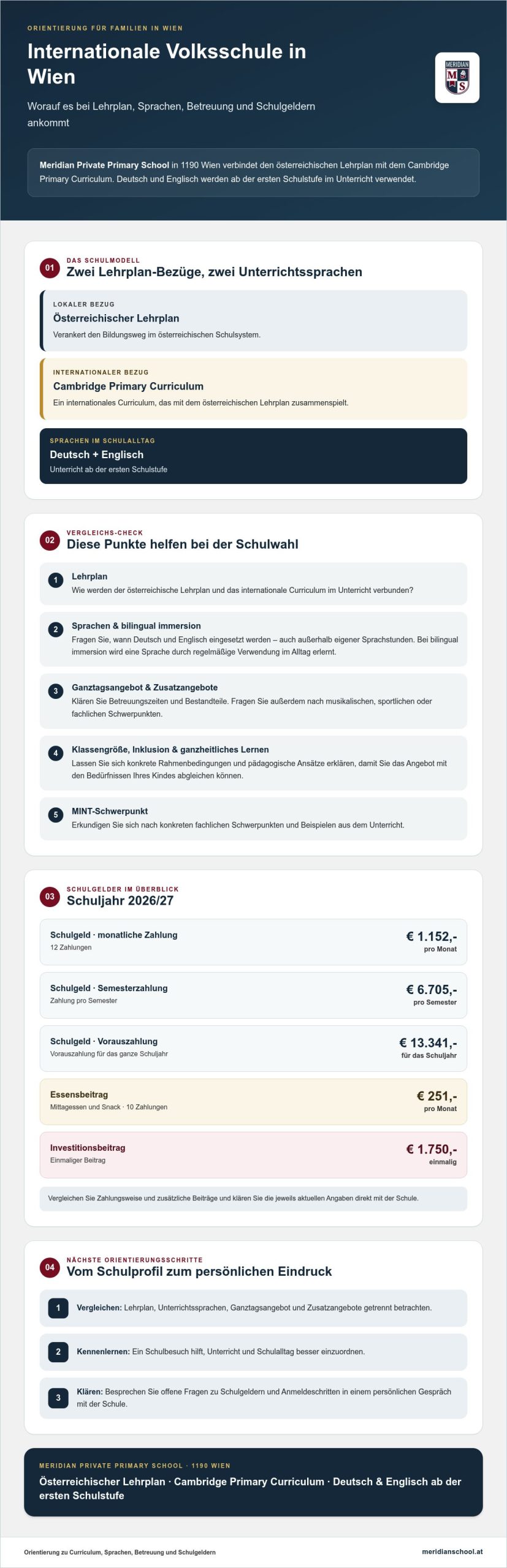
Die Meridian Private Primary School ist eine Ganztags-Volksschule in 1190 Wien. Deutsch und Englisch werden ab der ersten Schulstufe im Unterricht eingesetzt. Als Cambridge International School verbindet sie internationale Bildungsstandards mit dem österreichischen Lehrplan. Die Meridian Private Primary School verbindet in Wien das Cambridge Primary Curriculum mit dem österreichischen Volksschullehrplan.
Zum Schulprofil gehören außerdem ein MINT-Schwerpunkt sowie musikalische und sportliche Zusatzangebote. Fragen Sie, wie die beiden Lehrpläne im Unterricht zusammenspielen und wie Deutsch und Englisch im Schulalltag verwendet werden. Erkundigen Sie sich auch, welche Bestandteile das Ganztagsangebot umfasst und welche Zusatzangebote für Ihr Kind relevant sein könnten.
Ein persönliches Gespräch hilft, Fragen zum Unterrichtsmodell, zur Betreuung und zu inklusivem, ganzheitlichem Lernen zu klären. Fragen Sie dabei auch nach der aktuellen Klassengröße und danach, wie die Schule auf unterschiedliche Bedürfnisse eingeht. So können Sie das Schulprofil mit Ihren Vorstellungen und dem Alltag Ihres Kindes abgleichen.
Prüfen Sie die aktuellen Schulgelder und Beiträge vor einer Entscheidung direkt anhand der Gebühreninformation, da sich Beträge und Zahlungsweisen ändern können. Informationen zu den nächsten Schritten finden Sie unter Anmeldung an der Meridian Private Primary School. Wenn Sie eine internationale Volksschule in Wien in Betracht ziehen, fragen Sie bei der Schule nach, ob ein Besuch oder ein persönliches Gespräch möglich ist. So lernen Sie das Konzept näher kennen und können gezielt klären, ob es zu Ihrer Familie passt.
Eine passende internationale Volksschule in Wien erkennen Sie nicht allein am Namen. Vergleichen Sie, wie Unterrichtssprachen, Lehrplan und Betreuung im Schulalltag umgesetzt werden, und klären Sie offene Fragen im persönlichen Gespräch. Auch Zusatzangebote, Inklusion und die aktuelle Klassengröße können für Ihre Entscheidung wichtig sein.
Die Meridian Private Primary School in 1190 Wien unterrichtet ab der ersten Schulstufe auf Deutsch und Englisch. Als zertifizierte Cambridge International School verbindet sie das Cambridge Primary Curriculum mit dem österreichischen Lehrplan. So treffen internationale Standards und die Verankerung im österreichischen Volksschulwesen zusammen.
Wenn Sie herausfinden möchten, ob dieses Schulprofil zu Ihrem Kind und Ihrer Familie passt, lernen Sie das Schulangebot in einem persönlichen Gespräch kennen. Mit konkreten Fragen und einem persönlichen Eindruck können Sie die nächsten Schritte gut abwägen.
Eine internationale Volksschule bietet eine international ausgerichtete Bildung, doch der Begriff steht nicht für ein einheitliches Schulmodell. Prüfen Sie, welche Unterrichtssprachen tatsächlich verwendet werden, welchem Lehrplan die Schule folgt und ob internationale Standards mit dem österreichischen Volksschulweg verbunden sind. Mehrsprachigkeit kann auch im Schulalltag gelebt werden, nicht nur in eigenen Sprachstunden.
Ja. Die Meridian Private Primary School in 1190 Wien verbindet als zertifizierte Cambridge International School das Cambridge Primary Curriculum mit dem österreichischen Lehrplan für Volksschulen. Der Unterricht findet ab der ersten Schulstufe auf Deutsch und Englisch statt. Zum Profil gehören außerdem ein MINT-Schwerpunkt sowie musikalische und sportliche Zusatzangebote im Rahmen einer Ganztagsschule.
Vergleichen Sie Unterrichtssprachen, Lehrplan, Ganztagsangebot, Zusatzangebote und aktuelle Schulgelder. Fragen Sie nach, wie bilingual immersion im Alltag umgesetzt wird und wie österreichischer Lehrplan und internationales Curriculum zusammenspielen. Klären Sie im Gespräch außerdem Klassengröße, Inklusion und ganzheitliches Lernen. Konkrete Beispiele helfen Ihnen, Schulprofile sachlich gegenüberzustellen.
Bei einer Privatschule erkundigen Sie sich am besten direkt nach den aktuellen Anmeldeschritten, da der Ablauf von den Fristen öffentlicher Schulen abweichen kann. Bei der Meridian Private Primary School können Sie das Online-Anmeldeformular nutzen. Prüfen Sie die aktuellen Schulgelder und Beiträge anhand der Gebühreninformation und fragen Sie, ob ein Schulbesuch oder persönliches Gespräch möglich ist, um offene Fragen zu klären.
Was, wenn ein langer Schultag nicht einfach mehr Betreuungszeit bedeutet, sondern Lernen, Pausen und gemeinsame Aktivitäten sinnvoll verbindet? Wer nach „ganztag schule“ in Wien sucht, möchte meist wissen, wie der Alltag gestaltet ist, welche Förderung das eigene Kind erhält und ob das Angebot zum Familienalltag passt.
In diesem Artikel erfahren Sie, worin sich offene und verschränkte Ganztagsmodelle unterscheiden und welche Fragen bei der Schulwahl weiterhelfen. Am Beispiel der Meridian Private Primary School in Wien sehen Sie, wie Deutsch und Englisch ab der ersten Schulstufe, der österreichische Lehrplan und das Cambridge Primary Curriculum zusammenkommen. Außerdem erfahren Sie, worauf Sie bei MINT, Musik, Sport, Kosten und Anmeldung achten können.
Ein Ganztagsangebot umfasst mehr als Unterricht am Vormittag und Betreuung danach. Es ordnet Unterricht, Lernzeiten, Pausen und Freizeit innerhalb eines Schultags. Für Eltern, die nach „ganztag schule“ suchen, ist daher wichtig, wie diese Bereiche ineinandergreifen und welche konkreten Angebote für Kinder vorgesehen sind.
Ein erster Orientierungspunkt ist der Unterschied zwischen offener und verschränkter Form. Einen Überblick über die Modelle bietet die Definition der Ganztagsschule. In der offenen Form findet der Unterricht üblicherweise am Vormittag statt, die Nachmittagsbetreuung ist optional. In der verschränkten Form wechseln Unterrichts-, Lern- und Freizeitphasen über den Tag ab. Die Bezeichnung allein sagt jedoch noch nicht, wie der Stundenplan einer bestimmten Schule aussieht. Fragen Sie deshalb nach einem typischen Tagesablauf.
Ein kurzes Video stellt unterschiedliche Schulmodelle gegenüber:
Der österreichische Lehrplan bildet die Grundlage des Volksschulunterrichts. Schulen können ihr Angebot durch weitere Curricula oder Schwerpunkte ergänzen. Erkundigen Sie sich, welche Fächer und Inhalte davon betroffen sind und wie sich das im Stundenplan zeigt.
Beim Vergleich von Schulen hilft es, nicht nur nach der Zahl der Betreuungsstunden zu fragen. Bitten Sie um konkrete Beispiele: Wann ist Lernzeit vorgesehen? Gibt es fest eingeplante Pausen? Welche Freizeitangebote finden während des Schultags statt? Damit können Sie besser beurteilen, ob der Rhythmus für Ihr Kind passend wirkt.
Auch beim Sprachenlernen zählt der Schulalltag. Fragen Sie, ob Deutsch und Englisch nur in eigenen Unterrichtseinheiten vorkommen oder auch in weiteren Situationen verwendet werden. So erhalten Sie ein klareres Bild davon, wie die beiden Sprachen im Angebot verankert sind. Erkundigen Sie sich außerdem, welche Essenspausen vorgesehen sind und welche Betreuungsleistungen zum jeweiligen Angebot gehören.
Bei der Suche nach „ganztag schule“ zählt nicht nur die Dauer der Betreuung. Prüfen Sie, welche pädagogischen Schwerpunkte die Schule setzt und wie diese im Alltag umgesetzt werden. Fragen Sie beispielsweise nach den Lerninhalten im MINT-Bereich, nach den verwendeten Unterrichtssprachen und danach, welche musikalischen und sportlichen Angebote Teil des Schulalltags sind.
Wenn eine Schule mit einem zusätzlichen Curriculum arbeitet, ist die Verbindung zum österreichischen Lehrplan ein wichtiges Vergleichskriterium. Lassen Sie sich erklären, welche Inhalte das Curriculum ergänzt und wie die Umsetzung im Unterricht aussieht. Bei internationalen Programmen können Sie auch nachfragen, ob die Schule dafür zertifiziert ist und was diese Zertifizierung konkret für den Unterricht bedeutet.
Erkundigen Sie sich außerdem, wie Kinder mit unterschiedlichen Lernständen begleitet werden. Fragen Sie nach Beispielen für die Unterstützung im Unterricht und danach, an wen Sie sich bei Fragen zur Entwicklung Ihres Kindes wenden können. Bei Zusatzangeboten lohnt sich die Klärung, ob sie während des Schultags stattfinden oder eigene Wege außerhalb der Schule erfordern.
Bei bilingualem Unterricht erleben Kinder zwei Sprachen in unterschiedlichen Lern- und Alltagssituationen. Fragen Sie deshalb nicht nur, ob eine Schule bilingual ist, sondern auch, wann Deutsch und Englisch verwendet werden und wie der Unterricht in beiden Sprachen mit den Inhalten des österreichischen Lehrplans zusammenhängt. Ein bestimmtes Sprachniveau lässt sich daraus nicht automatisch ableiten.
Das Cambridge Primary Curriculum kann den österreichischen Lehrplan ergänzen. Für einen konkreten Vergleich ist entscheidend, wie die Schule beide Lehrpläne im Unterricht verbindet und welche Lernbereiche sie abdecken. Bei einem Schulbesuch können Sie zum Beispiel fragen:
Bitten Sie um eine schriftliche Aufstellung der Kosten, damit Sie Schulgeld und mögliche zusätzliche Beiträge getrennt vergleichen können. Erkundigen Sie sich bei der jeweiligen Schule nach den aktuellen Beträgen und Zahlungsoptionen.
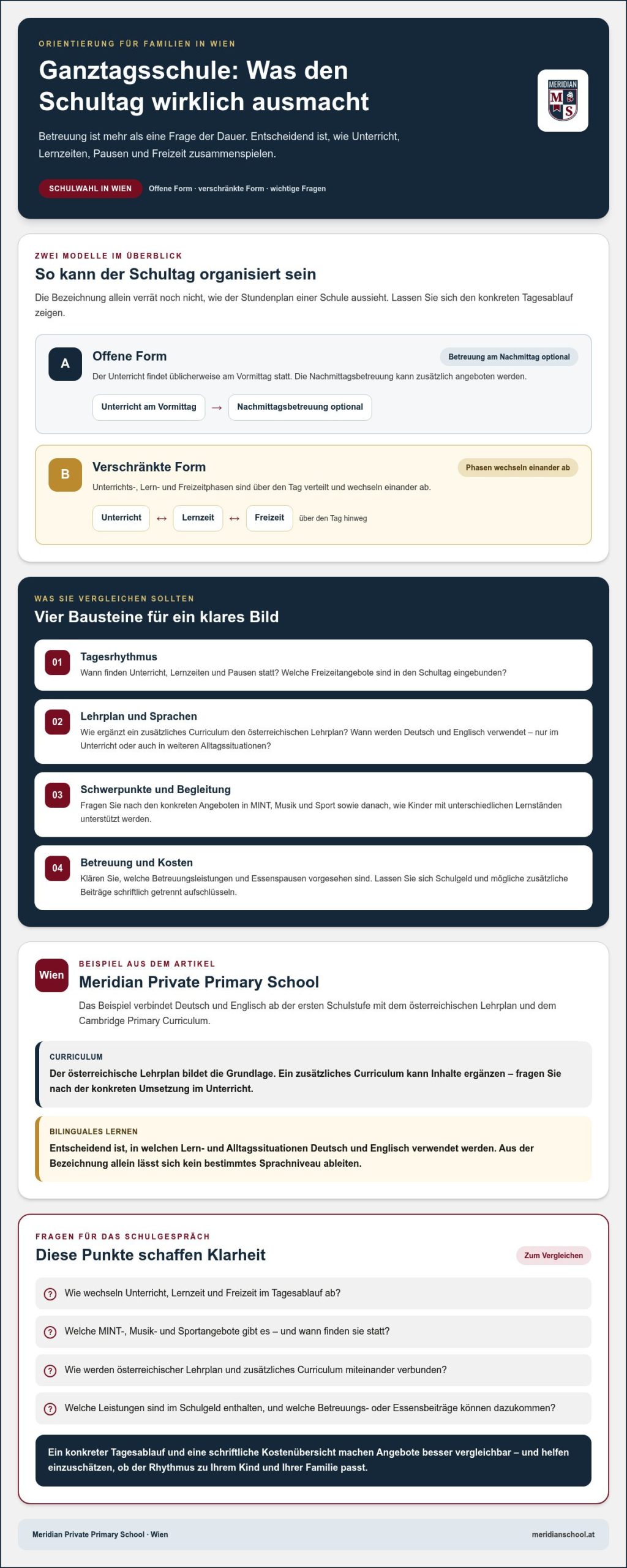
Die Meridian Private Primary School ist eine private Volksschule in 1190 Wien und bietet Ganztagsbetreuung in der Primarstufe. Im Unterricht verbindet die Schule den österreichischen Lehrplan mit dem Cambridge Primary Curriculum. Deutsch und Englisch sind ab der ersten Schulstufe Teil des Angebots. Meridian ist eine zertifizierte Cambridge International School.
Zum schulischen Profil gehört auch ein MINT-Schwerpunkt. Ergänzt wird das Angebot durch musikalische und sportliche Zusatzangebote. Wenn Sie die Schule mit anderen Ganztagsangeboten in Wien vergleichen, fragen Sie nach, wie diese Schwerpunkte im Tagesablauf berücksichtigt werden und welche Informationen zur Betreuung konkret verfügbar sind. So lässt sich besser einschätzen, ob das Angebot zu den Interessen und Bedürfnissen Ihres Kindes passt.
Fragen Sie bei einem persönlichen Gespräch auch nach den Lernzeiten und danach, wie Kinder bei ihren Aufgaben begleitet werden. So können Sie klären, welche Erwartungen an den Nachmittag realistisch sind und wie sich der Schultag mit dem Alltag Ihrer Familie vereinbaren lässt.
Ein persönliches Kennenlernen gibt Ihnen Gelegenheit, Fragen zum Schulstart, zum Unterricht und zum Tagesablauf zu stellen. Erkundigen Sie sich auch nach den einzelnen Schritten der Anmeldung und danach, welche Informationen die Schule dafür benötigt. Details finden Sie unter Anmeldung an der Meridian Schule.
Vergleichen Sie bei den Kosten die einzelnen Bestandteile und fragen Sie nach den aktuellen Beträgen und Zahlungsoptionen. Dazu können je nach Angebot unterschiedliche Beiträge gehören. Wenn Sie nach „ganztag schule“ in Wien suchen, kann ein Gespräch vor Ort zusätzlich helfen: Sie können direkt klären, wie Lehrplan, Sprachen und Zusatzangebote im Schulalltag zusammenwirken.
Wer nach „ganztag schule“ in Wien sucht, sollte nicht nur Betreuungszeiten vergleichen. Entscheidend ist auch, wie Unterricht, Erholung und Freizeit organisiert sind und welche pädagogischen Schwerpunkte den Alltag prägen. Fragen Sie, wie der österreichische Lehrplan mit zusätzlichen Bildungsangeboten und bilingualem Lernen zusammenspielt.
Die Meridian Private Primary School in 1190 Wien verbindet den österreichischen Lehrplan mit dem Cambridge Primary Curriculum und bietet Unterricht in Deutsch und Englisch ab der ersten Schulstufe. Zum Profil gehören außerdem ein MINT-Schwerpunkt sowie musikalische und sportliche Zusatzangebote. Erkundigen Sie sich vor Ihrer Entscheidung nach dem Tagesablauf, den Schulgeldern und den einzelnen Schritten der Anmeldung.
Ein persönliches Gespräch kann offene Fragen klären und Ihnen einen Eindruck vom Angebot vermitteln. Vereinbaren Sie ein persönliches Beratungsgespräch an der Meridian Privatschule, um zu prüfen, ob die Ganztagsschule zu Ihrem Kind und Ihrer Familie passt.
Nachmittagsbetreuung ergänzt den Vormittagsunterricht um Betreuung am Nachmittag. Ein Ganztagsangebot verbindet Unterricht, Lernphasen und Freizeit innerhalb des Schultags. Bei der offenen Form können Familien die Nachmittagsbetreuung nutzen, während sich in der verschränkten Form Unterrichts- und Freizeiteinheiten abwechseln. Fragen Sie bei der Schulwahl nach dem konkreten Tagesablauf und danach, wie Lernzeiten und Pausen gestaltet sind.
Die Kosten unterscheiden sich je nach Schule und Zahlungsmodell. Erkundigen Sie sich, welche Leistungen das Schulgeld abdeckt und ob zusätzliche Beiträge, etwa für Essen oder weitere Angebote, anfallen. Fragen Sie direkt bei der Schule nach einer aktuellen Kostenübersicht und den verfügbaren Zahlungsoptionen, damit Sie die Bestandteile nachvollziehbar vergleichen können.
Ob ein Kind für den Schulstart bereit ist, hängt nicht allein davon ab, ob es bereits Englisch spricht. Für die Einschätzung der Schulreife sind verschiedene soziale, emotionale und kognitive Voraussetzungen relevant. An der Meridian Private Primary School gehören Deutsch und Englisch ab der ersten Schulstufe zum Angebot; das Cambridge Primary Curriculum ist in den österreichischen Lehrplan integriert. Besprechen Sie individuelle Fragen zur Entwicklung und zum Schulstart am besten persönlich mit der Schule.
Das Ganztagsangebot während des Schuljahrs sagt für sich allein nichts über eine Betreuung in den Sommerferien aus. Fragen Sie Meridian direkt, ob für den gewünschten Zeitraum ein Angebot stattfindet und welche Informationen zu Anmeldung und Kosten gelten. So können Sie Ihre Ferienplanung auf aktuelle Angaben abstimmen.
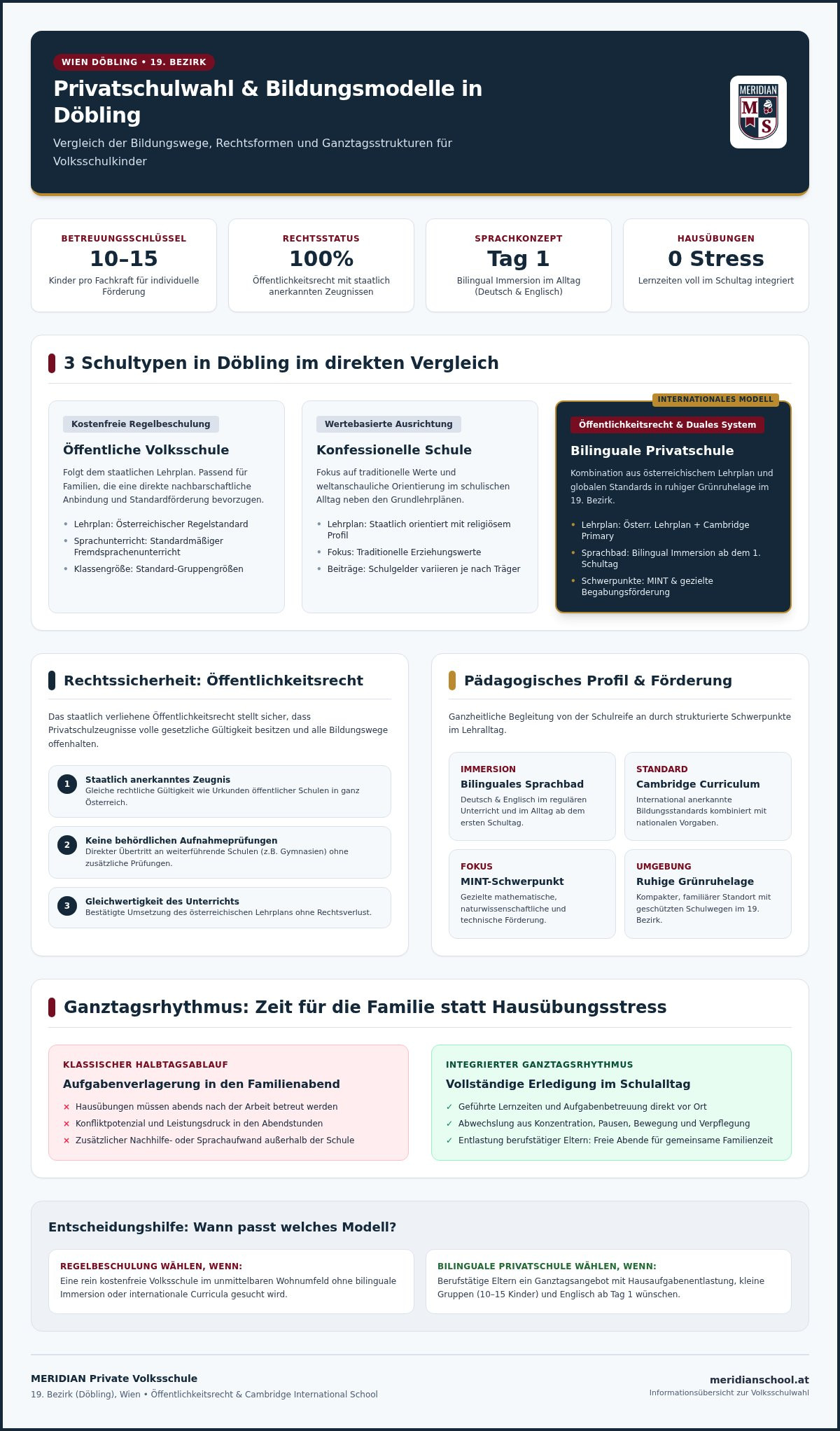
Die Entscheidung für eine Privatschule Döbling hängt von der angestrebten Bildungsqualität, der Rechtsform der Schule und der zeitlichen Entlastung für Familien ab. Wer neben dem österreichischen Lehrplan Wert auf bilinguale Standards legt, findet im 19. Wiener Gemeindebezirk passgenaue Bildungsmodelle.
Wichtigste Erkenntnisse: Eine Privatschule in Döbling mit Öffentlichkeitsrecht bietet staatlich anerkannte Zeugnisse, die den direkten Übertritt an weiterführende Gymnasien ohne zusätzliche behördliche Aufnahmeprüfungen ermöglichen.
Drei Ausgangslagen tauchen in Beratungsgesprächen besonders oft auf. Suchen Sie eine wohnortnahe Regelbeschulung ohne internationale Sonderlehrpläne, bleibt die öffentliche Volksschule der passende Rahmen. Wünschen Sie ab dem ersten Schultag ein Sprachbad (bilingual immersion) auf Deutsch und Englisch plus gezielte Begabungsförderung und MINT-Schwerpunkt, lohnt der Vergleich mit einer privaten Volksschule mit Öffentlichkeitsrecht. Steht ein rein religiöser Fokus im Vordergrund, entspricht eine konfessionelle Privatschule diesem Wunsch oft genauer.
Familien orientieren sich bei der Schulwahl häufig an öffentlichen Regelschulen, konfessionellen Privatschulen oder internationalen Ganztagsschulen. Der 19. Bezirk vereint ruhige Grünlagen mit gut erreichbaren Schulstandorten.
Öffentliche Volksschulen folgen dem staatlichen Lehrplan und eignen sich, wenn Sie eine nachbarschaftliche Anbindung suchen. Hinweise zur sicheren tägliche Schulweg in Döbling unterstützen den Start in die erste Klasse. Konfessionelle Häuser setzen oft auf traditionelle Werte. Internationale Modellschulen kombinieren den österreichischen Lehrplan mit globalen Standards.
Wir verbinden als MERIDIAN Private Volksschule das Sprachbad auf Deutsch und Englisch ab dem ersten Schultag mit kleinen Klassen. Eine gezielte Begabungsförderung sowie ein starker MINT-Schwerpunkt begleiten die Kinder durch den Tag. Unübersichtliche Straßenabschnitte erfordern besondere Aufmerksamkeit: körperlich geschützte Überquerungspunkte und geschulte Schülerlotsen sichern den Weg. Unsere Lage im Bezirk liegt in einer ruhigen Grünruhelage und stützt ein kompaktes, familiär geführtes Schulmodell.
Für ein umfassendes Ganztagsmodell lohnt der Blick auf die anfallenden Schulgebühren (Schulgelder). Zusätzliche Nachmittagsbetreuung (Ganztagsbetreuung) deckt Unterricht, Verpflegung und Nachmittagsaktivitäten ab. Welches Modell passt zu Ihnen? Wir heißen Sie an unserer Schule willkommen, wenn Sie Ihr Kind vor Ort anmelden möchten.
Ohne klare Rechtsform riskieren Sie später bürokratische Hürden beim Schulwechsel: genau hier setzt das Öffentlichkeitsrecht an. Ein Zeugnis einer Privatschule mit Öffentlichkeitsrecht besitzt dieselbe rechtliche Gültigkeit wie die Urkunde einer öffentlichen Schule.
Diese staatliche Konzession bedeutet für Sie volle Rechtssicherheit. Ihr Kind legt dadurch keine externe Aufnahmeprüfung ab, wenn es auf eine weiterführende Schule wechselt. Das Öffentlichkeitsrecht bestätigt die Gleichwertigkeit des Unterrichts nach dem österreichischen Lehrplan. Laut Erhebungen von Statistik Austria aus dem Jahr 2024 besuchen zunehmend mehr Kinder in Österreich eine Privatschule. Für Familien im 19. Bezirk bringt dieser Status spürbare Vorteile im Schulalltag.
Das Zeugnis einer öffentlich-rechtlichen Einrichtung ist staatlich anerkannt und berechtigt zum direkten Aufstieg in die nächste Schulstufe. Als qualifizierte Bildungsstätte verbinden wir den nationalen Lehrplan mit dem Cambridge Primary Curriculum. Sie sparen sich mühevolle Nachprüfungen an Behördenstellen. Wenn Sie eine stabile Basis für die spätere Laufbahn suchen, finden Sie hier den Ratgeber zur Anmeldung an einer bilingualen Volksschule in Döbling.
Ein staatliches Privatschulzeugnis öffnet den Zugang zu weiterführenden Schulen. Unabhängig davon, ob danach eine konfessionelle oder eine andere Schulform folgt, zählt die rechtliche Gleichstellung: Bildungswege bleiben damit offen.
Sie begleiten Ihr Kind von der ersten Schulreife an ohne bürokratische Hürden. Erfragen Sie Informationen zu Schulgeldern (Schulgebühren) direkt am Standort. Falls Sie befürchten, dass ein privates Zeugnis spätere Schulwechsel erschwert: Die behördliche Anerkennung stellt die Akzeptanz an weiterführenden Schulen sicher.
Berufstätige Eltern kennen den Abend mit Hausübungskämpfen: ein klar strukturierter Ganztagsrhythmus verlagert Unterricht, Erholungsphasen und geführte Lernzeiten in den Schulalltag und nimmt genau diesen Druck von zu Hause.
Stellen Sie sich vor, Sie kommen abends nach Hause und die gemeinsame Zeit gehört der Familie. Weil Aufgaben direkt in der Schule erledigt werden, entfällt der klassische Hausübungsstress. Die Pädagogen betreuen die Kinder bei den Aufgaben vor Ort und gehen auf individuelle Bedürfnisse ein. Gezielte Förderungen finden im Tagesablauf ihren festen Platz.
Situation, Lösung, Wirkung: Eine Familie mit zwei berufstätigen Elternteilen sucht Entlastung am Nachmittag. Sie wählt eine Ganztagsbetreuung, in der Lernzeiten und Pausen fest verankert sind. Ergebnis: Die Hausübungen bleiben in der Schule, abends bleibt Raum für gemeinsame Zeit, und das Sprachbad läuft ohne extra Nachhilfe weiter.
Wir sind der Überzeugung, dass ein strukturierter Tagesablauf ohne Schulaufgaben zu Hause die Beziehung zwischen Eltern und Kindern stärkt. Die Abwechslung aus Konzentration und Bewegung hält die Lernfreude bis in den Nachmittag. Pausen sichern dabei die Leistungsfähigkeit, vergleichbar mit einem sinnvoll getakteten Training.
Unser Schulmodell vereint den österreichischen Lehrplan mit dem Cambridge Primary Curriculum. Die integrative Nachmittagsbetreuung trägt hohe fachliche Ansprüche. Wie Ganztagsentlastung in Döbling im Alltag gelingt, beschreibt unser Überblick zum Standort 1190. Das verankerte Sprachbad fördert die Sprachkompetenz ohne zusätzlichen Nachhilfeaufwand. Die festen Schulgebühren geben Ihnen eine verlässliche Planungsgrundlage. Das Ganztagsmodell eignet sich für berufstätige Eltern, die eine fundierte Ausbildung ohne tägliche Nachmittagsarbeit suchen.
Bevor Sie Budget und Betreuungszeiten festlegen, hilft ein Blick darauf, welche Leistungen im Schulgeld stecken und welche Positionen separat laufen. Private Grundschulen finanzieren bilinguale Bildungsprogramme sowie kleinere Klassenstrukturen über Schulgelder. Als privat geführte Volksschule investieren wir diese Mittel direkt in eine hochwertige Betreuung. Unser Blog mit aktuellen Einblicken zeigt, wie dieser Rahmen den Schulalltag prägt. Mehr dazu: MERIDIAN Privatschule.
Für Familien ist die Tarifstruktur privater Bildungseinrichtungen gut kalkulierbar: Kernleistungen für Unterricht und Begleitung sind bereits abgedeckt.
| Beitragskategorie | Enthaltene Leistungen | Zahlungsmodell |
|---|---|---|
| Schulgeld | Unterricht nach Cambridge-Standard, bilinguales Sprachbad | Monatlich oder pro Semester |
| Betreuung | Nachmittagsbetreuung, Hausaufgabenbegleitung | Monatlicher Fixbetrag |
| Verpflegung | Mittagsmenü und frische Snacks | Monatliche Abrechnung |
Die genaue Höhe hängt von gewählten Zusatzleistungen ab. Bei einer Eröffnung ist für den Schulplatz meist ein einmaliger Investitionsbeitrag vorgesehen. Beträge für die Nachmittagsbetreuung variieren je nach zeitlichem Umfang.
Rechtlich gesehen ist die Schule staatlich anerkannt und besitzt das Öffentlichkeitsrecht. Eine Aufnahme setzt die Feststellung der Schulreife voraus. Weiterführende Gymnasien und vergleichbare Schulen stehen den Absolventen danach offen. Wir beraten Sie persönlich zu den Details der Beiträge.
Planungssicherheit entsteht, wenn Sie den Ablauf kennen, bevor Fristen drängen. Die Aufnahme an unserer privaten Volksschule folgt einem klaren, nachvollziehbaren Ablauf. Wir begleiten Sie persönlich durch jeden Schritt.
Dieser Ablauf gibt Ihnen Planungssicherheit, und die Anmeldephase verläuft ohne Hektik.
Seit unserer Eröffnung arbeiten wir als private Volksschule mit Öffentlichkeitsrecht. Wir stehen nicht unter konfessioneller Trägerschaft, sondern agieren als unabhängige Bildungseinrichtung für weiterführende Bildungswege: Das schafft Flexibilität bei späteren Schulentscheidungen. Sie erreichen uns am Standort in Grinzing (1190). Wir freuen uns auf Ihren Besuch.
Nicht jede Familie braucht denselben Rahmen: Manchmal ist die öffentliche Schule die klarere Antwort. Eine öffentliche Grundschule ist die bessere Entscheidung, wenn Sie eine rein kostenfreie, wohnortnahe Regelbeschulung ohne internationale Sonderlehrpläne bevorzugen.
Manche Eltern wünschen sich eine traditionelle Nachmittagsbetreuung ohne zusätzliche bilinguale Programme. Eine konfessionelle Privatschule passt oft besser, falls ein rein religiöser Fokus gesucht wird. Für manche Kinder ist der Wechsel an weiterführende Schulen einfacher, wenn sie das rein staatliche System gewohnt sind. Aufnahmeprüfung und Schulgelder entfallen an öffentlichen Standorten.
Die tägliche Anreise nach Wien-Döbling kostet Zeit. Eine Schule im eigenen Grätzel stärkt hingegen die sozialen Kontakte im unmittelbaren Wohnumfeld. Die öffentliche Volksschule funktioniert wie ein verlässlicher Nahversorger; unsere Einrichtung setzt dagegen auf ein spezialisiertes Profil mit Sprachbad und MINT-Schwerpunkt.
Für die breite Regelbildung ist das öffentliche Schulwesen geeignet. Wenn Sie jedoch Sprachbad suchen, ist unser Schulmodell die passende Wahl.
Details und Anfrage: Meridian Private Primary School.
Ja, dieser Wechsel gelingt nach der Absolvierung unserer privaten Grundschule.
Der Unterricht folgt dem österreichischen Lehrplan. Zusätzlich integrieren wir das bewährte Cambridge Primary Curriculum. Durch das staatliche Öffentlichkeitsrecht sind die Zeugnisse offiziell anerkannt. Kinder wechseln daher ohne Zusatzprüfungen an ein öffentliches Gymnasium.
Beim Sprachbad lernen die Kinder die Fremdsprache im normalen Schulalltag. Englisch wird ab dem ersten Schultag aktiv gesprochen.
Anders als beim reinen Vokabellernen begleiten Muttersprachler die Klassen durch den gesamten Tag. Fachunterricht findet auf Deutsch und Englisch statt und fördert ein tiefes Verständnis beider Sprachen.
Pädagogen bewerten die körperlichen, kognitiven, emotionalen und sozialen Fähigkeiten des Kindes. Es geht um die körperliche Entwicklung und die sprachliche Kompetenz.
Ebenso wichtig ist das Verhalten in der Gruppe. Bei der Einschulung achten wir auf eine ganzheitliche Entwicklung: Das Kind muss bereit für den strukturierten Schulalltag sein.
In privaten Nachmittagsbetreuungen betreuen Fachkräfte deutlich kleinere Gruppen als an öffentlichen Einrichtungen. Die Betreuungsschlüssel liegen nach aktuellen Marktdaten der Wiener Privatschulen meist bei einer Fachkraft für etwa zehn bis fünfzehn Kinder.
Kleine Gruppen ermöglichen eine individuelle Förderung. Pädagogen begleiten Lernzeiten und Freizeitaktivitäten intensiver und stützen so den schulischen Erfolg.
Ja, das österreichische Bildungssystem bildet das feste Fundament unserer täglichen Arbeit. Die vorgegebenen Bildungsstandards werden erfüllt.
Wir ergänzen diese Inhalte durch den internationalen Standard von Cambridge. Das MINT-Gütesiegel bestätigt unsere Qualität in Mathematik und Naturwissenschaften. Im Rahmen eines persönlichen Gesprächs händigen wir Ihnen Angaben zu den Schulgebühren aus.
Bildungsqualität, Rechtsform und zeitliche Entlastung: Dieselben Fragen, mit denen dieser Text beginnt, entscheiden auch am Ende über die passende Schulwahl. Unsere Schule verbindet den österreichischen Lehrplan mit den Qualitätsstandards der Cambridge International School. Im geschützten Lernumfeld erleben die Kinder ein natürliches Sprachbad.
Das Team der MERIDIAN Private Volksschule begleitet Ihr Kind im Jahr 2026 individuell auf seinem Bildungsweg. Verlässliche Angaben zu den monatlichen Schulgebühren erleichtern Ihnen die finanzielle Übersicht. Möchten Sie sich persönlich von unserem Konzept überzeugen? Vereinbaren Sie ein Beratungsgespräch für einen Besuch in Wien-Grinzing.
Haben Sie sich jemals gefragt, ob der herkömmliche Englischunterricht in einer großen Klasse wirklich ausreicht, damit Ihr Kind die Sprache später einmal so natürlich wie seine Muttersprache beherrscht? Viele Eltern in Wien teilen diese berechtigte Sorge und suchen nach einer Bildungseinrichtung, die weit über das Standardmaß hinausgeht. Eine zweisprachige Volksschule in Wien Englisch zu vermitteln, bedeutet heute nämlich weit mehr als nur Vokabeln zu pauken. Es geht darum, eine Umgebung zu schaffen, in der sich Kinder geborgen fühlen und Sprachen durch ein konstantes Sprachbad ganz ohne Leistungsdruck aufsaugen.
Wir verstehen, dass die Wahl der richtigen Schule eine fundamentale Entscheidung für den weiteren Lebensweg darstellt. In diesem Beitrag erfahren Sie, wie Ihr Kind durch bilingual immersion und internationale Cambridge-Standards optimal auf eine globale Zukunft vorbereitet wird. Wir geben Ihnen einen detaillierten Einblick in das Cambridge Primary Curriculum, erklären den innovativen MINT-Schwerpunkt und schaffen Klarheit über den Anmeldeprozess für das Jahr 2026. So gewinnen Sie die Sicherheit, die beste Wahl für die individuelle Entwicklung Ihres Kindes zu treffen.
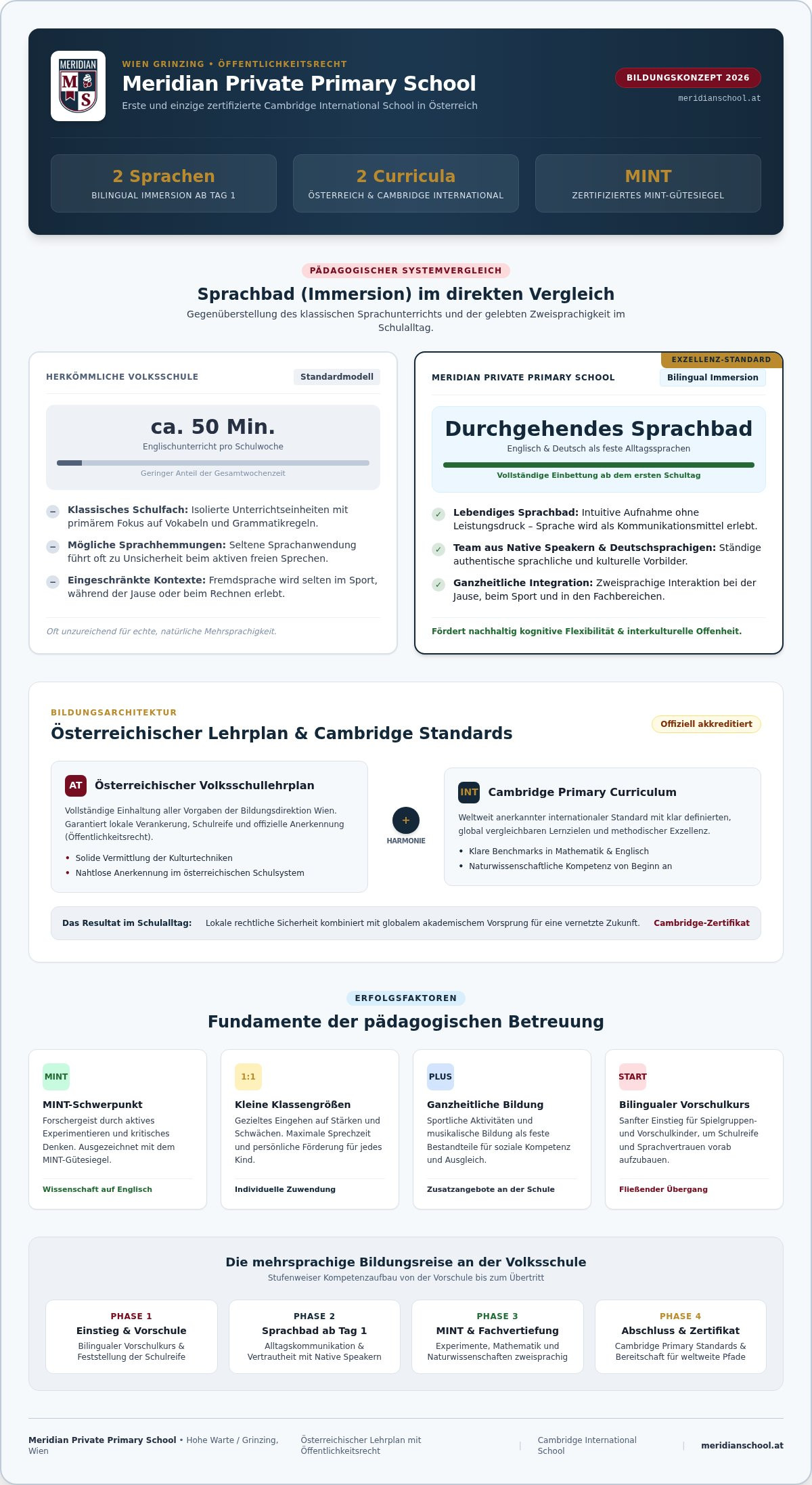
In einer zweisprachigen Volksschule in Wien Englisch als festes Element zu integrieren, bedeutet weit mehr als bloßes Vokabeltraining. Es ist ein lebendiger Bestandteil des gesamten Schultages, der alle Bereiche des Lernens durchdringt. Dieser pädagogische Ansatz, bekannt als bilingual immersion, ermöglicht es den Kindern, die Sprache durch ein konstantes Sprachbad ganz natürlich aufzusaugen. Anstatt mühsam Grammatikregeln auswendig zu lernen, kommunizieren die Schüler im Alltag ganz intuitiv. Das fördert die kognitive Flexibilität nachhaltig und schult das Gehör für feinste sprachliche Nuancen ab dem ersten Schultag.
Unser pädagogisches Team setzt sich aus qualifizierten Native Speakern und erfahrenen deutschsprachigen Lehrkräften zusammen. Sie agieren als authentische Vorbilder und begleiten die Kinder sowohl durch den Fachunterricht als auch durch die Freizeitphasen. Fundierte Erkenntnisse zur zweisprachigen Bildung belegen, dass diese frühe Form der Mehrsprachigkeit die soziale Kompetenz massiv stärkt. Wer früh lernt, in zwei Sprachen zu denken und zu fühlen, entwickelt eine natürliche Offenheit gegenüber anderen Kulturen. Dies bildet das Fundament für eine erfolgreiche internationale Laufbahn in einer global vernetzten Welt.
50 Minuten Englisch pro Woche in herkömmlichen Schulen reichen oft nicht aus, um echte Sprechsicherheit zu entwickeln. Indem unsere zweisprachige Volksschule in Wien Englisch als lebendige Alltagssprache nutzt, verschwinden Hemmungen hingegen fast wie von selbst. Ob beim Rechnen, beim Sport oder während der Jause: Englisch ist immer präsent. Die Kinder merken oft gar nicht, dass sie gerade eine Fremdsprache verwenden, da die Kommunikation zweckorientiert und spielerisch erfolgt. Um diesen Übergang für die Kleinsten noch fließender zu gestalten, empfehlen wir unseren bilingualen Vorschulkurs. So starten die Kinder bereits mit einer vertrauten Basis und viel Selbstvertrauen in die erste Klasse.
Die Meridian Private Primary School nimmt eine Vorreiterrolle in der Wiener Bildungslandschaft ein. Als erste zertifizierte Cambridge International School in Österreich verbinden wir lokale Verankerung mit globaler Exzellenz. Viele Eltern beschäftigt die Frage, wie internationale Standards mit den Vorgaben der Bildungsdirektion Wien harmonieren. In unserer täglichen Praxis greifen diese Systeme nahtlos ineinander. Das Cambridge Primary Curriculum dient als wertvolle Ergänzung zum österreichischen Lehrplan, indem es klare, weltweit vergleichbare Lernziele in Mathematik, Englisch und den Naturwissenschaften setzt.
Ein zentrales Element ist unser ausgezeichneter MINT-Schwerpunkt. Wir fördern den Forschergeist durch aktives Experimentieren und kritisches Denken. In einer zweisprachigen Volksschule in Wien Englisch nicht nur als Sprache, sondern als Werkzeug für wissenschaftliche Entdeckungen zu nutzen, verschafft den Kindern einen enormen Vorsprung. Sie lernen früh, komplexe Zusammenhänge in zwei Sprachen zu erfassen. Erfahren Sie mehr über diese einzigartige Kombination in unserem pädagogischen Angebot.
Damit jedes Kind sein volles Potenzial ausschöpfen kann, setzen wir konsequent auf kleine Klassengrößen. Diese ermöglichen eine persönliche Betreuung, die in großen staatlichen Klassen oft kaum realisierbar ist. Die Lehrkräfte haben den Raum, individuell auf Stärken und Schwächen einzugehen, was besonders beim Erwerb der Zweitsprache essenziell ist. Unser Konzept geht jedoch über das rein Akademische hinaus. Sportliche Aktivitäten und musikalische Bildung sind integrale Bestandteile unseres Alltags. Solche exklusiven Zusatzangebote an Schulen fördern die soziale Kompetenz und sorgen für einen ausgewogenen Ausgleich zum Unterricht in der zweisprachigen Volksschule in Wien Englisch.
Nachdem Sie die pädagogischen Vorteile abgewogen haben, steht die praktische Planung im Vordergrund. Der Prozess der Schulanmeldung in Wien 1190 ist bei uns bewusst persönlich und transparent gestaltet. Während staatliche Schulen oft starre Einschreibungsfristen im Jänner haben, nehmen wir uns Zeit für ein individuelles Kennenlernen. Wir laden Sie herzlich ein, unsere Räumlichkeiten in der Grinzinger Straße zu besichtigen und in einem persönlichen Gespräch alle offenen Fragen zu klären. So stellen wir sicher, dass unsere zweisprachige Volksschule in Wien Englisch und Deutsch optimal auf die Bedürfnisse Ihres Kindes abgestimmt ist.
Transparenz bei den Kosten ist für eine vertrauensvolle Partnerschaft essenziell. Die Schulgelder an der Meridian Private Primary School sind klar kalkuliert und decken ein umfassendes Ganztagsangebot ab. Neben dem bilingualen Unterricht nach internationalen Standards sind folgende Leistungen inkludiert:
Zusätzlich zum monatlichen Schulgeld wird ein einmaliger Investitionsbeitrag erhoben, der die stetige Weiterentwicklung unserer exklusiven Lernumgebung an der Meridian Private Primary School sichert.
Im Aufnahmegespräch liegt unser Fokus auf der ganzheitlichen Schulreife. Wir achten auf soziale Kompetenzen, kognitive Neugier und die emotionale Bereitschaft für den neuen Lebensabschnitt. Sprachliche Vorkenntnisse sind zwar vorteilhaft, aber keine zwingende Voraussetzung, da unser Sprachbad den Einstieg erleichtert. In unserer zweisprachigen Volksschule in Wien Englisch als natürliche Zweitsprache zu etablieren, gelingt an der Meridian Private Primary School am besten durch Freude am Entdecken. Zur gezielten Vorbereitung empfehlen wir unseren Ratgeber für den Schulstart in Wien, der wertvolle Tipps für einen entspannten Übergang vom Kindergarten bereithält.
Die Wahl der richtigen Schule ist eine Investition in die langfristige Entwicklung und die globalen Chancen Ihres Kindes. Wer für eine zweisprachige Volksschule in Wien Englisch als festen Bestandteil des Alltags wählt, entscheidet sich für ein pädagogisches Konzept, das weit über den Standard hinausgeht. Durch die einzigartige Verbindung von österreichischen Bildungszielen und dem weltweit anerkannten Cambridge Primary Curriculum schaffen wir eine Umgebung, in der Sprachen und Wissen ganz natürlich wachsen.
Als einzige zertifizierte Cambridge International School in Österreich und Träger des MINT-Gütesiegels legen wir besonderen Wert auf individuelle Förderung in Kleinklassen. Hier wird Forschergeist gefördert und soziale Kompetenz in einer weltoffenen Gemeinschaft gelebt. Vereinbaren Sie jetzt ein persönliches Beratungsgespräch an der Meridian Schule, um mehr über unseren innovativen Ansatz und die Anmeldung für 2026 zu erfahren. Wir freuen uns darauf, Sie und Ihr Kind auf diesem spannenden Weg zu begleiten und gemeinsam den Grundstein für eine erfolgreiche Zukunft zu legen.
Eine frühzeitige Anmeldung für unsere zweisprachige Volksschule in Wien Englisch ist bereits im Vorschulalter ratsam, um rechtzeitig einen Platz für das gewünschte Schuljahr zu sichern. Wir empfehlen den Besuch unseres bilingualen Vorschulkurses, der Kindern ab fünf Jahren den idealen Einstieg bietet. So gewöhnen sich die Kleinen spielerisch an das internationale Umfeld und die Sprachkombination, noch bevor der eigentliche Schulalltag beginnt.
Nein, Ihr Kind muss zum Zeitpunkt der Aufnahme kein fließendes Englisch beherrschen. Unser pädagogisches Konzept der bilingual immersion ist genau darauf ausgelegt, dass Kinder die Sprache ganz natürlich wie in einem Sprachbad aufsaugen. Durch die tägliche Interaktion mit Native Speakern und deutschsprachigen Lehrkräften entwickeln die Schüler ihre Sprachkompetenz intuitiv und ohne Leistungsdruck während des regulären Unterrichts und in den Pausen.
Die monatlichen Schulgelder decken den gesamten Ganztagsbetrieb inklusive des Cambridge Primary Curriculums ab. Zusätzlich fallen ein monatlicher Essensbeitrag für das reichhaltige Mittagessen und die Snacks sowie ein einmaliger Investitionsbeitrag bei der Anmeldung an. Wir legen großen Wert auf Transparenz und informieren Sie gerne in einem persönlichen Gespräch über die aktuelle Gebührenstruktur für das kommende Schuljahr 2026.
Ja, wir organisieren jährlich ein Summer Day Camp, das eine ideale Ergänzung zu unserem regulären Angebot darstellt. Eltern können zwischen einer zwei- oder dreiwöchigen Teilnahme für ihr Kind wählen, wobei die Verpflegung bereits inkludiert ist. Dieses Programm bietet eine wunderbare Gelegenheit, die Sprachkenntnisse in einer entspannten Atmosphäre zu vertiefen und neue Freundschaften zu schließen, während der MINT-Schwerpunkt auch hier spielerisch integriert wird.
Does a standardised curriculum truly prepare our children for a world that will have fundamentally changed by the time they finish school in 2038? As parents in Vienna today, you face the challenge of choosing a school that not only imparts knowledge but also fosters genuine future skills. We understand your concern that the regular primary school curriculum in Vienna alone may not be enough to fully develop your child's individual talents in a global context.
In this article, you will learn all about the current educational standards for Years 1 to 4 and how international programmes like the Cambridge Primary Curriculum significantly enrich education. We will show you how the combination of state-recognised public status and bilingual excellence from the very first day of school provides your child with security and a clear advantage. This comparison offers you a well-founded basis for choosing the ideal primary school in Vienna.
The statutory educational mandate for Viennese primary levels is laid down by the Federal Ministry of Education, Science and Research (BMBWF). This framework ensures that every child receives a balanced foundation in the core subjects of German, Mathematics, and General Studies. The Austrian education system places great emphasis on the integration of cognitive content and social skills. A modern Vienna primary school curriculum today functions as a dynamic instrument that not only imparts knowledge but also fosters personal development.
To better understand the pedagogical background and implementation of these standards, the following video offers a well-founded insight:
Primary education in Vienna is systematically divided into pre-school and Years 1 to 4. A central element for private educational institutions is their public status. This guarantees that private schools also adhere to the state framework and are permitted to issue certificates that are legally equivalent to those of state schools. This creates trust and security for parents seeking an excellent education with individual specialisations. Details of our pedagogical approach can be found in our offerings.
Since the introduction of the pedagogical package in September 2023, the focus has increasingly been on competence-based learning. Lessons are designed so that children can actively apply what they have learnt. Differentiation is the key word here; teachers adapt requirements to the individual learning progress of pupils. In a class, children often work on different tasks, which strengthens self-responsibility and avoids frustration.
The School Organisation Act forms the foundation for daily classroom practice. In Vienna, there are specific scopes for performance assessment that can go beyond traditional numerical grades. Especially in the first two school years, alternative forms of feedback are often used. This verbal assessment provides a detailed picture of the child's strengths. The Vienna primary school curriculum
The conventional Vienna primary school curriculum primarily focuses on imparting solid basic competencies in German and Mathematics, as well as social integration. This national foundational education forms a stable basis, but in a globalised world, many families seek an expanded perspective. This is where the international programme comes in. While state standards often pursue rigid learning objectives, the Cambridge Primary curriculum integrates active research and critical questioning from Year 1.
The synergistic combination of both curricula massively promotes the cognitive flexibility of children aged 6 to 10, as they learn to process complex issues simultaneously in two different language systems and cultural contexts. This dual focus not only prepares pupils for AHS readiness in Austria but also opens doors to worldwide educational pathways.
In Vienna, there is a clear difference between conventional English lessons, which often comprise only one hour per week, and true immersion. In the Cambridge model, English is not an isolated subject. The language serves as a tool to understand the world. In subjects such as General Studies or Mathematics, children immerse themselves deeply in the English language from the very first day of school.
This playful approach enables children to learn two languages to a level close to that of a native speaker. They switch effortlessly between German and English, without inhibitions or barriers. Choosing a high-quality bilingual primary school in Vienna means investing in language proficiency that goes far beyond the standard. It's not about rote vocabulary learning, but about experiencing the language in everyday life.
Adapting the Cambridge curriculum to the Austrian requirements of the Education Directorate ensures that no child loses connection with the local system. Meridian Private Primary School uses this hybrid model to combine the best of both worlds. International certificates and regular assessments provide parents with objective feedback on their child's learning progress according to global standards, even during primary school.
This dual certification is a crucial advantage for later transitions to secondary schools, be it a grammar school with a STEM focus or an International School. Children develop academic resilience and self-confidence that gives them a clear advantage in secondary education. If you would like to learn more about our pedagogical approach, our overview of our offerings provides detailed insights into daily school life.
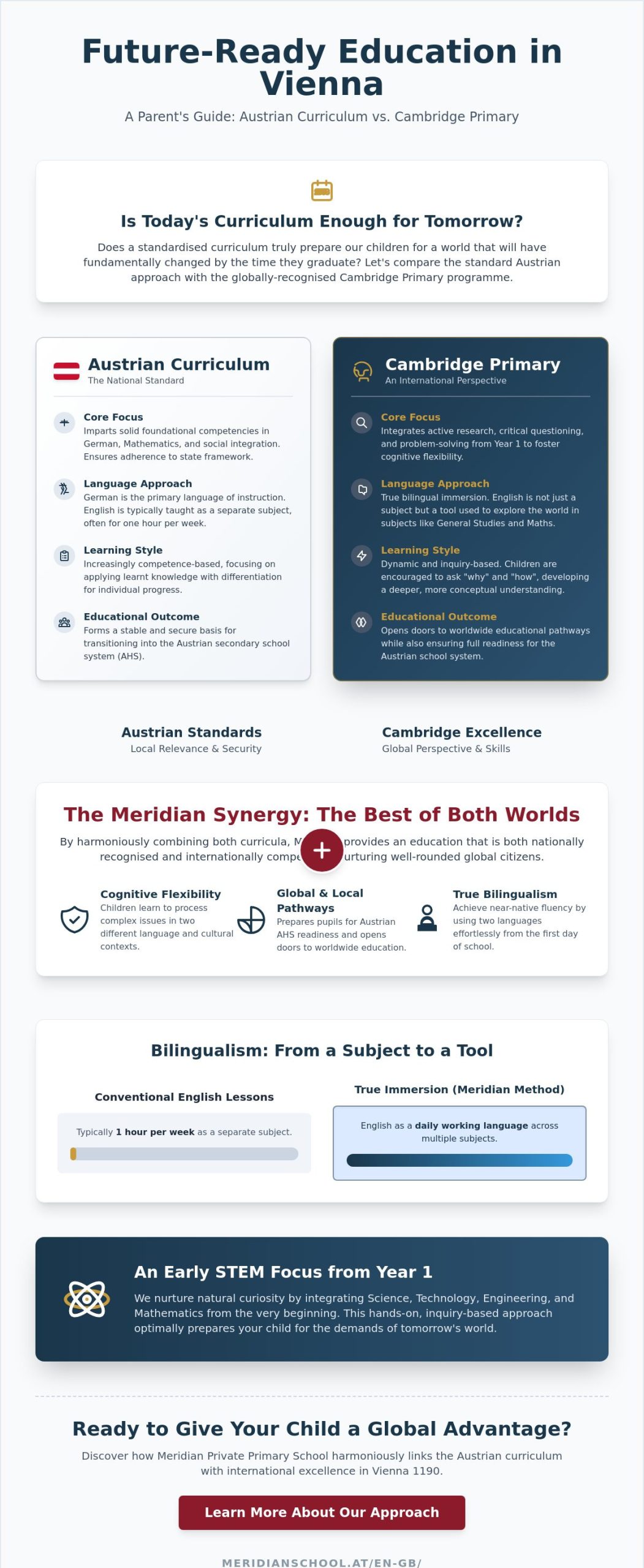
The decision for the right primary school profoundly shapes your child's entire educational path. While the state Vienna primary school curriculum forms the basis, a school's specific specialisations determine the depth of education. Parents should pay particular attention to how theory and practice merge in everyday life. A modern curriculum for 2026 must master the balance between academic rigour and child-friendly development.
Mathematics, Informatics, Natural Sciences, and Technology (STEM) are not subjects that should only begin in secondary school. In a globalised world, technological competence starts as early as 6 years old. We integrate tablets and IT skills directly into daily General Studies lessons, so that handling digital media becomes second nature. A spirit of inquiry is awakened through weekly experiments, firmly embedded in the timetable. This way, children learn not only from books but grasp the world through active doing.
An excellent school profile is characterised by offerings that extend beyond the classroom. Cognitive performance is closely linked to well-being. A healthy snack and planned outdoor activity breaks are essential to maintain concentration levels throughout the afternoon. Early musical education serves as a cognitive booster, promoting neural networking and strengthening social skills. Use the link to our additional offerings to learn more about these valuable additions.
When choosing a location, the organisation of the day also plays a role. In Vienna, a distinction is made between pure after-school care and integrated all-day schooling. In the integrated model, learning hours and leisure phases alternate rhythmically. This eases the burden on children and creates a relaxed learning atmosphere. Particularly in the Döbling district (1190 Vienna), first-class educational opportunities can be combined with a high quality of life. Short school commutes and a green environment ideally support learning success within the framework of the Vienna primary school curriculum.
Learn more about our holistic concept and discover our pedagogical offerings for Vienna.
As the first Cambridge International School in Vienna, we set new standards in primary education. Our concept is based on precise alignment: we fulfil all requirements stipulated by the Vienna primary school curriculum for state-recognised schools, and enhance these with the Cambridge Primary Curriculum. This dual qualification ensures that your child remains firmly rooted in the local education system while simultaneously developing an international identity. At Grinzinger Straße 95, we offer a learning environment that combines academic excellence with a family-like atmosphere.
Small class sizes with a maximum of 18 children allow for individual support, which is often not possible to this extent in large state institutions. Our educators dedicate the time each child needs for their personal development. We specifically foster strengths and closely monitor learning processes. Thanks to our public status, all certificates are officially recognised, which enables a smooth transition to secondary schools throughout Austria.
German and English are a lived reality with us from the very first day of school. In the team-teaching model, native speakers and German-speaking teachers guide children through their daily routine. Language is thus acquired naturally and without performance pressure. Our comprehensive pedagogical offerings also place emphasis on STEM subjects to sustainably awaken curiosity in natural sciences and technology already at primary school age.
The transition from kindergarten to primary school is a significant step for families. We support this transition through structured orientation discussions and clear planning. Transparent information on school fees and costs provides parents with the necessary security for their long-term budgeting.
The path to our school follows a clear process: it begins with a personal visit to our Döbling campus and leads through a pedagogical get-to-know-you session to the start of school in September. Places are limited due to the small groups. Secure your place in good time and arrange an appointment for school enrolment in Vienna now. We look forward to meeting you and your child in January or at one of our ongoing appointments.
The decision for the right primary school profoundly shapes your child's entire school career. While the standardised Vienna primary school curriculum secures fundamental competencies, Meridian Private Primary School, as the first Cambridge International School in Vienna, sets new standards in bilingual education. Our pupils benefit from an integrated concept in German and English from the very first day of school. The state-recognised public status guarantees full legal recognition of all qualifications; at the same time, our targeted STEM focus awakens an early interest in research and technology.
In Vienna 1190, we combine academic professionalism with a warm atmosphere that empowers every child in their individual development. Become part of an innovative educational community that links local stability with a global horizon. We look forward to competently supporting you and your child as they embark on this new chapter.
Arrange a consultation appointment for school enrolment 2026 now
Private schools with public status fully meet the legal requirements of the Federal Ministry of Education, Science and Research. The official Vienna primary school curriculum forms the binding foundation for the state recognition of certificates and learning content. However, innovative institutions like Meridian Private Primary School supplement this basis with the Cambridge Primary Curriculum. This provides children with an education that combines local educational standards with global competencies in German and English.
Bilingualism means the cross-curricular use of German and English as equally valued working languages from Year 1. In our school, we often teach General Studies or Mathematics in a team-teaching model together with native speakers. Pupils acquire language skills not in isolated language lessons; they apply them directly in practical learning situations. This approach fosters a natural feel for language and optimally prepares children for an international career.
The Vienna primary school curriculum sets clear educational objectives in the core subjects of German, Mathematics, and General Studies. These emphases form the necessary basis for transitioning to a secondary school such as the AHS lower secondary level or a Realgymnasium. We supplement these standards with targeted training in presentation techniques and independent work. According to current observations, over 90 per cent of graduates from private primary schools with an international focus successfully transition to a higher school.
Entry without specific English knowledge is easily possible in Year 1. We use the immersion method, where children playfully absorb the language by daily immersion in school life. Experienced educators individually guide this process. Usually, children can confidently follow lessons in English after just six months. The Cambridge Primary Curriculum supports this progress through structured learning paths precisely tailored to the pupils' respective developmental levels.
STEM subjects play a central role in strengthening logical thinking and problem-solving skills early on. At Meridian Private Primary School, we firmly integrate technology and natural sciences into the weekly timetable, often supplemented by digital media and practical experiments. Children explore environmental phenomena from the age of six in specialised lessons. This early promotion awakens curiosity about technical interrelationships and lays the foundation for a modern, future-oriented education.