Imagine your child coming home, full of enthusiasm, not talking about dry textbook pages, but about the flow rate of a stream in the Vienna Woods, which they measured in a team today and documented in English. Lively project-based learning in primary school makes exactly that possible, replacing rigid structures with a genuine understanding of the world. Many parents in Vienna are rightly concerned that outdated teaching methods and a lack of practical relevance in general studies could stifle their children's natural curiosity. Instead, they desire an environment where individual support and modern pedagogy go hand in hand.
In this article, you will discover how modern teaching harnesses children's natural curiosity to convey complex STEM topics in a playful and bilingual manner. We offer you an exclusive insight into daily school life following the Cambridge Primary Curriculum and demonstrate how the combination of local stability and global ambition optimally prepares your child for their future educational journey. This will give you the necessary confidence for your school choice for 2026 and help you understand why inquiry-based learning is the key to a strong, international identity.
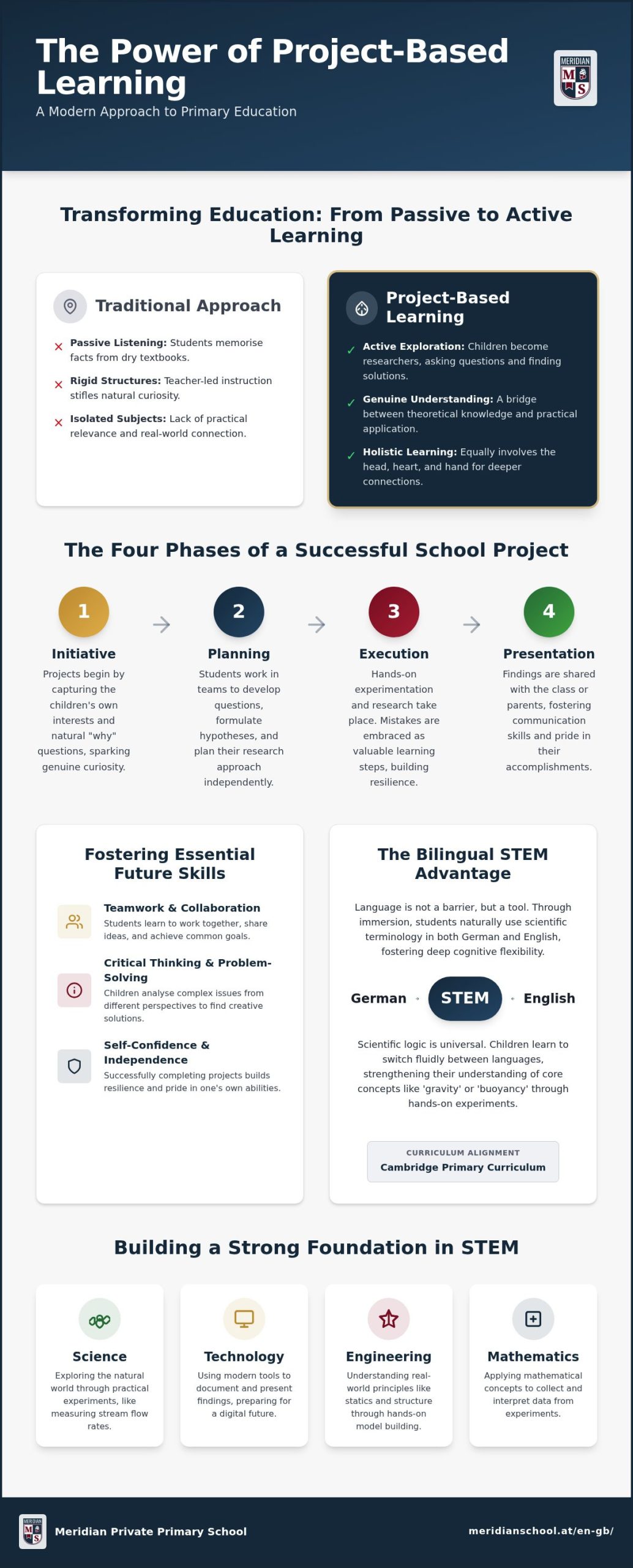
Project-based learning is far more than a mere change from daily school life. It acts as an essential bridge between theoretical knowledge and practical application in real life. While traditional general studies often focus on the teacher imparting facts, with project-based learning primary school, the child itself moves to the centre of the action. They step into the role of an active researcher, developing questions themselves and independently working out solutions. A well-founded definition of project-based learning describes this process as holistic learning that equally involves the head, heart, and hand. It's not about memorising for the next test, but about a deep understanding of connections.
A structured project always begins with the project initiative, where children's interests are taken up. This is followed by planning, execution, and finally, the presentation of the results to the class or parents. Particularly valuable is the realisation that mistakes made during experimentation are not failures. They are necessary learning steps that truly spur on the spirit of inquiry. This process sustainably fosters students' frustration tolerance and self-confidence. In the end, there is not just a finished poster or model, but the pride in the independently completed journey and what has been achieved together.
In our school, children experience language not as an isolated subject, but as a living tool for exploring the world. Through the proven method of immersion, they delve deeply into scientific matters whilst experimenting. Whether it's about the water cycle or the principles of statics, students naturally use technical terms in German and English in dialogue. This bilingual project-based learning primary school consistently aligns with the Cambridge Primary Curriculum in Vienna, which is recognised worldwide as the gold standard for modern primary education.
We link the Austrian curriculum with an ambitious, international outlook. The Ministry's fundamental decree on project-based learning provides the framework for innovative project-based learning primary school, whilst we create significant added value for the future through multilingualism. In the STEM disciplines – Mathematics, Informatics, Natural Sciences, and Technology – artificial language barriers almost completely disappear. Children quickly grasp that scientific logic is universal. This constant, fluid switching between languages trains the young brain and sustainably fosters cognitive flexibility. If you are interested in an education that combines local stability with a global identity, you can find details in our educational offer.
Inquiry-based learning doesn't end at the school gate. The spirit that characterises project-based learning primary school can be wonderfully integrated into family life. Often, it doesn't require expensive equipment, but merely a keen eye for the wonders of the immediate surroundings. Your own kitchen thus becomes a laboratory where physical laws become tangible whilst preparing snacks. Those living in Döbling will find ample material for botanical studies in the Vienna Woods or their own garden. To deepen the learning effect, little professionals keep a researcher's diary, in which they record sketches and observations.
For this experiment, you only need a glass of water, plenty of salt, and a small tomato. First, the fruit sinks to the bottom in fresh water, as its density is higher than that of the water. Now stir in salt, spoonful by spoonful. Children can observe how the tomato suddenly rises and dances on the surface. Ask your child: Why does the salt change the water so much? This way, they grasp the principle of density and buoyancy playfully and without pressure.
Everyday chemistry becomes visible when you stir a biological glue from simple quark and a pinch of baking powder. The chemical reaction creates casein glue, which holds surprisingly firmly after drying. This process helps to directly understand material changes. It is fascinating to see how everyday foodstuffs transform into technical aids. Such discoveries foster interconnected thinking and the courage to get to the bottom of things.
If you would like to experience how we professionalise this enthusiasm in daily school life, find out more about our educational offer in Vienna 1190. We support your child in discovering the world anew every day with scientific curiosity.
At Meridian Private Primary School in Vienna 1190, we live a philosophy that goes far beyond merely imparting curriculum content. We understand education as a holistic process, with bilingual discovery at its heart. Our specialised STEM focus in primary school is supported by particularly small class sizes. This allows our educators to intensively address each child's individual questions and to design project-based learning primary school at a high academic level. In this way, we ensure that no spirit of inquiry goes unnoticed and every talent receives the necessary attention.
The modern facilities in our premises in Döbling significantly support this approach. Tablets are specifically used as tools for research and documentation, whilst professionally equipped explorer corners offer young talents space for their own experiments. This structured yet free working method optimally prepares the pupils of Meridian Private Primary School for the transition to secondary schools. Project work specifically trains the self-organisation and analytical competence that paves the way to secondary school and gives children confidence in their own abilities. They learn early on to take responsibility for their learning processes.
Our concept does not end with the last lesson in the morning. The afternoon care consistently continues the focus on creativity and research, allowing children to deepen their interests without time pressure. Regular excursions in the Vienna area are an integral part of our active project-based learning and bridge the gap between the classroom and the city. Meridian Private Primary School sees itself as a partner for families who value pedagogical excellence and a warm atmosphere. Are you looking for a place for your child for the 2026 school year? Visit our offer and learn more about our vision of a cosmopolitan education in the heart of Grinzing.
Modern project-based learning primary school forms the foundation for lifelong curiosity and analytical thinking. We have seen how bilingual immersion and a strong STEM focus lay the groundwork for a global identity. Through actively grasping complex connections, children develop the competences that are crucial in an interconnected world. As a certified Cambridge International School, we offer an environment at our exclusive location in Vienna Döbling that combines academic professionalism with a warm atmosphere.
Bilingual teaching from Year 1 ensures that language naturally serves as a tool for exploring the world. Prepare your child optimally today for the transition to secondary school and secure them a place in a stable, future-oriented learning environment. Find out more about school registration in Vienna 1190 now and together lay the groundwork for a successful school career. We look forward to accompanying your child on their journey of discovery.
Project-oriented learning is extremely beneficial from Year 1 onwards, as children at this age bring a natural thirst for knowledge. We use this phase to introduce complex topics playfully. Through an early start in project-based learning primary school, pupils develop important self-organisation competences as early as Year 1. It's about grasping the "why" behind things, rather than just memorising facts.
No, bilingual STEM teaching by no means overwhelms children, as we consistently rely on the immersion method. Pupils immerse themselves in the English language whilst experimenting or solving mathematical puzzles. Since language is experienced as a tool and not as an isolated subject, they acquire technical terms entirely without pressure. Our educators sensitively guide this process, so that even children without prior knowledge quickly gain confidence.
In modern project-based learning primary school, learning success is measured not only through traditional tests but also through continuous process observation and documentation. Children create portfolios or present their results to the class. In doing so, we assess both subject-specific understanding and social competences such as teamwork and problem-solving ability. This holistic feedback gives parents a detailed picture of their child's individual development and progress.
Digital media serve as valuable tools for research and professional documentation of research results. For example, children use tablets to photograph plant growth phases or create short explanatory videos about their experiments. In this way, they learn early on to use technology responsibly and purposefully. Digital aids sensibly complement hands-on experimentation without distracting from the actual inquiry-based learning.
Thanks to our small class sizes in Vienna 1190, we can specifically address each child's individual learning pace. The Cambridge Primary Curriculum offers the necessary flexibility to provide both additional challenges for particularly fast learners and targeted support when needed. In the explorer corners, pupils work independently on tasks that match their current level of knowledge. In this way, we ensure that every child reaches their full potential.