What if your home kitchen became Vienna's most exciting research laboratory? Many parents worry that engaging experiments for primary school pupils are often neglected in regular school life or fail at home due to overly complicated instructions. You want to specifically foster your child's natural curiosity but understandably feel hindered by technical language barriers or elaborate experimental setups. It's completely normal to desire a clear and pedagogically valuable structure for STEM promotion here.
In this article, you'll discover how simple experiments playfully awaken an understanding of complex phenomena and how this spirit of discovery is supported bilingually at the highest level. We present easily implementable instructions for everyday life and thoroughly explain the educational benefits of this early scientific engagement. Furthermore, you'll learn how, at Meridian Private Primary School, we combine scientific excellence with language proficiency through the Cambridge Primary Curriculum to optimally prepare children for a global future.
STEM promotion doesn't just begin in a secondary school laboratory. In primary school, it primarily means one thing: seeing the world with wide-open eyes. When children conduct experiments for primary school pupils, they follow a clear process. They observe phenomena, form initial hypotheses, and test them playfully. This structured approach aligns exactly with the competence objectives of the Austrian curriculum for general studies. It massively promotes abstract thinking and problem-solving skills. Children thus learn to break down complex relationships into tangible units, which sustainably supports cognitive development.
Children's curiosity is the strongest driver for acquiring knowledge. Through targeted experiments for primary school pupils, children understand that even a "failed" experiment provides valuable insight. Mistakes here are not dead ends but necessary intermediate steps in the process of discovery. By learning scientific work early on, pupils develop remarkable resilience towards complex questions. This confidence in dealing with the unknown reduces pressure and effectively prevents the often-cited apprehension towards physics or chemistry in later secondary school.
Vienna is a significant technology hub that increasingly relies on highly qualified professionals. Given the current shortage of skilled workers in technical professions, these competencies are an indispensable global currency. According to a study by the Austrian Federal Economic Chamber, thousands of STEM professionals are missing in the country annually. The Meridian Private School in the 19th district has recognised this need and responded as a pioneer in the region. It firmly embeds the spirit of discovery into bilingual school life to foster the talents of tomorrow, today. Thus, a simple observation in the school garden becomes a well-founded scientific insight that lays the groundwork for an international identity and a successful academic future.
Science doesn't require expensive equipment. Often, everyday items from the pantry or fridge are enough to create fascinating experiments for primary school pupils. A classic is the density test: Why does a crispy bread roll float whilst a compact dough ball sinks in water? Here, children playfully learn the principle of density and the role of air pockets. The tomato battery also impressively demonstrates how measurable electricity can flow through chemical reactions in the fruit pulp. Such discoveries foster logical understanding and encourage further exploration.
The production of organic glue from quark is particularly exciting. To do this, warm a glass of milk and carefully add a splash of vinegar. The acid causes the milk protein (casein) to curdle. A solid mass forms, strongly resembling fresh quark. After straining and drying, this "glue" can be wonderfully used for crafting. Such simple experiments for home make chemical processes like acid-base reactions understandable without apprehension and sustainably foster interest in experiments for primary school pupils.
Use your home stairs for free-fall experiments. Drop various objects, such as a shuttlecock and an apricot, simultaneously and time them with your mobile phone. It's a great exercise for practising precise documentation. Always ensure safety and actively accompany your child on these journeys of discovery. If you'd like to see how we professionally integrate such concepts into our STEM focus, take a look at our educational offering. Thus, your living room becomes the first step towards an international research career.
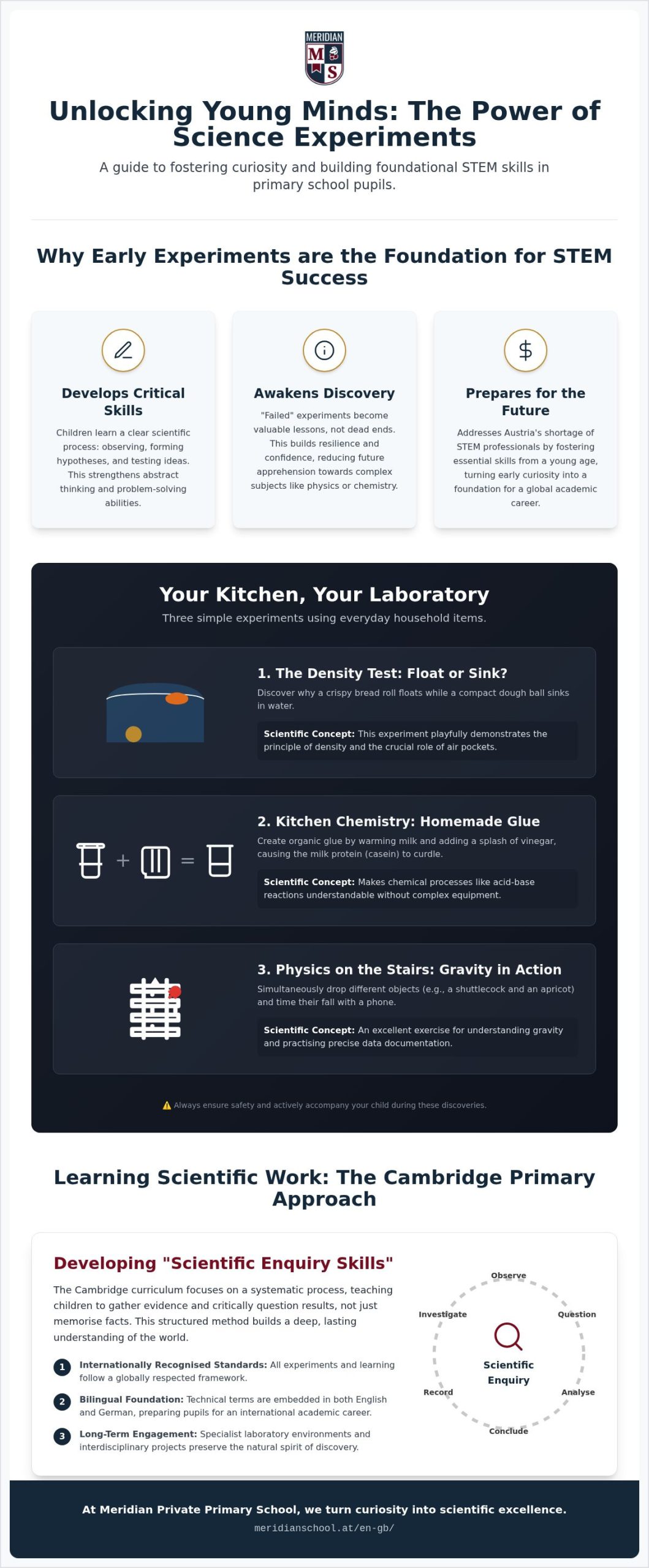
The Cambridge Primary Curriculum defines science far beyond merely memorising facts. At its core is the development of "Scientific Enquiry Skills". This is a systematic process where children learn to gather evidence and critically question results. When we conduct experiments for primary school pupils, this always happens according to internationally recognised standards. This structured approach helps children not only observe the world but understand it in depth. The targeted link with the Cambridge Primary Curriculum in Vienna guarantees a world-class education.
In our lessons, English becomes the working language of research. Whilst children are microscoping or observing chemical reactions, they playfully absorb technical vocabulary such as "gravity" or "solution". This immersion method is highly effective. It prevents technical language from being perceived as a barrier later on. Our pupils develop natural confidence in both languages. This is an invaluable advantage for their further academic career at international institutes or secondary schools. The aim is to actively break down language barriers through practical activity.
Research without numbers is hardly conceivable. That's why mathematics and technology are inextricably linked with science in our school. When weighing substances or measuring time intervals, children recognise the practical utility of mathematical formulae. This holistic STEM focus in primary school makes technology understandable. Experiments for primary school pupils serve as a bridge here to transform abstract logic into real results. We thus foster a deep understanding of the tools that drive our modern world.
Would you like to foster your child's spirit of discovery in an exclusive environment? Discover our comprehensive educational offering and learn how we combine academic excellence and international future visions in the 19th district.
At Meridian Private School in the 19th district, we transform the classroom into a vibrant research workshop. Our pupils use a modernly equipped school laboratory to experience scientific phenomena first-hand. Our native-speaking teachers accompany the children every step of the way. They foster curiosity and gently guide them from purely playful discovery towards a systematic way of working. Our interdisciplinary project weeks are particularly exciting. When art meets physics, innovative solutions emerge that sustainably shape an understanding of the world. Such experiments for primary school pupils are firmly integrated into our daily routine and make science tangible.
Our educational offering doesn't end with the last lesson. As part of our full-day care, we offer additional STEM activities that go far beyond the standard curriculum. We awaken the spirit of discovery even before the first day of school. Our Bilingual Pre-school Course offers the ideal introduction to the world of science in German and English. This way, we lay the foundation early for a successful school career, in which experiments for primary school pupils play a central role. It is important to us that the joy of discovery is maintained throughout the afternoon.
We warmly invite you to get an impression of our innovative learning environment on-site. Visit us on Grinzinger Straße and experience the atmosphere of our school during a personal tour. We will be happy to answer your questions about the curriculum and the STEM focus in detail. For all organisational details, you can find the direct link to school registration here. Become part of our community, where we foster the discoverers of tomorrow and accompany them as competent partners on their journey.
Your child's natural spirit of discovery is a precious asset that can grow sustainably through targeted impulses. As we have seen, even simple experiments for primary school pupils transform everyday life into an exciting learning field and build important problem-solving skills. Whether through playful testing in your own kitchen or within an internationally accredited curriculum; early contact with STEM subjects paves the way for a successful academic career without apprehension.
As a certified Cambridge International School in Vienna's 19th district, this is precisely where we focus. We combine the Austrian curriculum with global standards and offer bilingual education from the 1st school year. Thus, science becomes a universal language for your child. We warmly invite you to get to know our innovative learning environment personally. Register for a school tour now and experience our STEM focus live! We look forward to accompanying you and your child as a reliable partner on this exciting journey of discovery.
The targeted use of experiments is extremely beneficial from the first year of school, i.e., from about six years of age. At this age, children begin to perceive their environment more consciously through systematic observation. Simple experiments for primary school pupils structure this natural urge and foster logical understanding and fine motor skills from the very first day of school. The primary focus is on grasping cause and effect in a familiar, safe environment.
For most experiments, you only need common household items from the pantry or fridge. Materials such as a fresh bread roll, some quark, vinegar, or tomatoes are often entirely sufficient to illustrate chemical and physical processes. Additionally, rulers, stopwatches, and simple glasses are helpful tools for documentation. The focus is on demonstrating with everyday objects that science takes place everywhere in our daily lives.
It's best to use vivid comparisons from your child's direct experience. Instead of focusing on abstract technical terms, you should emphasise the process of discovery. Actively ask your child: "What do you think just happened and why?" This method strengthens initiative and self-confidence. Link the result to familiar phenomena, such as dough rising when baking, to sustainably reinforce understanding.
English is the global lingua franca of modern science and technology. Through the bilingual delivery of STEM content, children naturally learn technical terms such as "gravity" or "solution" in a practical context. This immersive approach breaks down language barriers before they can even arise. In combination with the Cambridge Primary Curriculum, we optimally prepare our pupils for an international academic career. Children thus develop a global identity and subject-specific confidence.
Vienna offers a variety of excellent opportunities for young explorers and the curious. Institutions such as the Technical Museum or the ZOOM Children's Museum provide specially prepared programmes for primary school pupils. Additionally, at Meridian Private School, we offer supplementary formats such as our research afternoons in the 19th district or our bilingual Summer Day Camp. These offerings allow children to delve deeply into exciting experiments for primary school pupils even outside regular lessons.