Did you know that, according to the official 4C model of the Austrian curriculum, creativity is now enshrined as one of the four crucial core competencies for primary school pupils? At a time when, according to current forecasts for 2026, 70 per cent of all professions will already require sound STEM knowledge, merely attending lessons is no longer enough. Many parents in Vienna are rightly concerned that rigid structures could overlook their children's individual talents. They are looking for a stable yet future-oriented environment that specifically fosters a natural spirit of inquiry.
In this article, you will discover how creative learning children shapes children sustainably and why the combination of bilingualism and STEM forms the ideal foundation for success in primary school. We provide you with a comprehensive criteria catalogue for choosing a school, so you can make a decision that combines local security with global perspectives. Additionally, you will receive valuable tips on how to support and encourage your child's curiosity in everyday life, without overwhelming them.
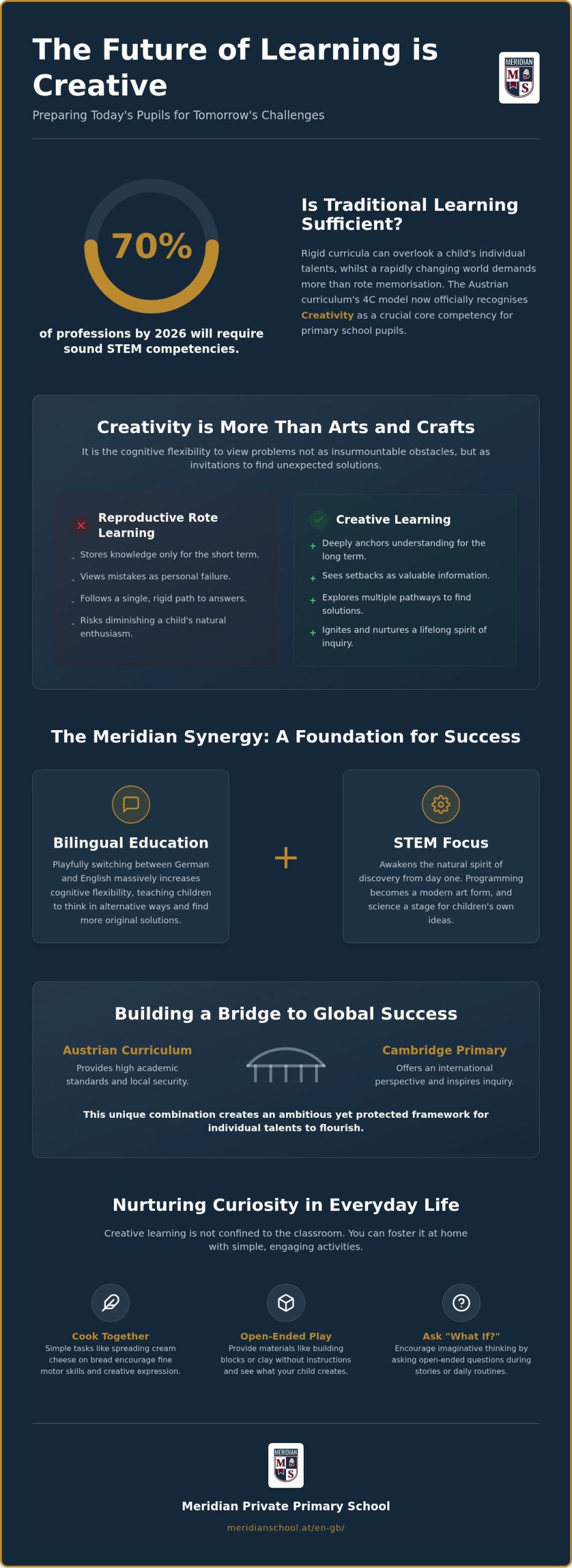
Creativity is often mistakenly reduced to mere crafting or painting. But what does creativity truly mean at the core of our pedagogical work? It is primarily the ability for cognitive flexibility. Children who develop this competence view problems not as insurmountable obstacles, but as invitations to find unexpected solutions. In a world that is rapidly changing due to technological leaps, this creative learning children becomes the indispensable basis for lifelong, proactive knowledge management.
The crucial difference lies in the process. While purely reproductive rote learning only stores knowledge short-term, understanding through active creation leads to a deep anchoring in memory. Creative learning means not just consuming knowledge, but actively re-connecting it. This creates neural networks that last far beyond the next test.
To see this innovative approach in practical implementation, take a look at this inspiring example from the classroom:
When children are allowed to experiment in class, they fundamentally change their attitude towards mistakes. A failed attempt is not seen as personal failure, but as valuable information on the way to the goal. This constructive approach to setbacks is one of the most important lessons for the future. Natural curiosity acts as a constant driving force. It encourages pupils to independently explore subject areas and critically question connections, instead of simply accepting given answers. Thus, creative learning children becomes a real adventure in the classroom.
In many traditional school systems, the principle of mere reproduction still dominates. However, this form of learning carries the risk that children's enthusiasm is lost and individual talents remain undiscovered. Modern, internationally oriented approaches such as the Cambridge Primary Curriculum address precisely this. They create the scope necessary to develop talents within a protected yet ambitious framework. The aim is to combine the high demands of the Austrian curriculum with methods that do not restrict the spirit of inquiry, but specifically inspire it.
Language acquisition is far more than memorising lists. It is a highly creative process. In a bilingual school, children playfully switch between German and English. They find two terms for a concept, which massively increases their cognitive flexibility. Current observations show that bilingual children often develop more original solutions in mathematics. They are accustomed to questioning structures and thinking in alternative ways. This demonstrates that creative learning children not only challenges them cognitively but also strengthens their problem-solving skills.
A targeted STEM focus awakens the natural spirit of discovery as early as the first year of primary school. Forecasts for 2026 underscore the urgency: around 70 per cent of future professions will require sound STEM competencies. Programming here is not a dry subject, but a modern form of expression, comparable to an art form. Whether building small robots or conducting biological experiments; science becomes a stage for their own ideas.
We consistently rely on the principle of