Choosing the right primary school today is far more than just opting for a short school run; it's a pivotal decision for your child's future in a globally connected world. As the new Vienna primary school curriculum is gradually introduced across all school years until the 2026/27 academic year, many parents face a mountain of confusing official documents and specialist terminology. It's perfectly understandable that you seek clarity in this process and wonder whether your child's individual development will find sufficient space amidst new subject titles such as “Technology and Design” or “Art and Design”.
In this guide, we shed light on Vienna's educational maze, translating complex legal requirements into a clear, practical overview. You'll discover exactly which competencies are prioritised from the very first day of school and how to gain the necessary confidence in choosing a school. We also demonstrate how private educational institutions effectively complement the state framework with exclusive focuses such as MINT (Science, Technology, Engineering, and Maths) and the Cambridge Primary Curriculum. In doing so, we pave the way from a local foundation to international excellence, opening all doors for your child's future.
Many parents imagine the curriculum as a rigid set of rules that precisely dictates every minute of the school day. In reality, however, the Vienna primary school curriculum functions much more as a pedagogical framework. It defines the overarching educational goals and essential content, whilst allowing teachers the necessary freedom to address the individual needs of the children. In modern pedagogy for 2026, rote memorisation of facts is consistently moving into the background. Instead, the focus is on competence orientation. Children should learn to actively apply knowledge and solve problems independently. It's about "doing" and understanding connections.
To better understand the current developments and the discussion surrounding new school subjects in Vienna, this video offers a helpful insight:
The foundation of primary school rests on four essential pillars: German, Mathematics, General Studies, and Physical Education. Particularly in the initial school phase, which comprises the 1st and 2nd school years, care is taken to make the transition from kindergarten playful yet structured. The primary goal here is to awaken the joy of discovery and lay a stable foundation for all further learning steps. A child who feels secure learns more effectively.
The curriculum is structured on a rolling basis over four years. This means that learning content is not viewed in isolation but is continuously deepened. An important milestone in the 1st year is grasping the initial number range and systematically encountering letters. By the end of the 2nd year, these skills are consolidated, enabling children to read fluently and confidently master simple arithmetic operations. This rhythm gives pupils the necessary time for their individual development.
The Federal Ministry of Education, Science and Research establishes the legal basis for teaching. The Vienna Education Directorate is responsible for regional implementation. Although the Vienna primary school curriculum thus guarantees high quality and comparability, it allows specialised schools flexible design. We specifically utilise this autonomy to set additional priorities beyond the standard, optimally preparing your child for an international future.
The modern Vienna primary school curriculum focuses on competencies that go far beyond merely recalling knowledge. In German, it's no longer just about correct spelling; rather, the subject forms the basis for communication and critical thinking in the 21st century. Children learn early on to filter information and express their own thoughts in a structured way. Mathematics, in turn, transforms from a mere arithmetic class into training for logical thinking. Recognising patterns and justifying solution paths are the central goals here, helping pupils to better understand the world around them.
Music Education and Art Education are by no means mere pastimes. They provide the necessary creative balance to the cognitive focus and promote fine motor skills as well as emotional expression. This holistic approach ensures that the joy of learning is maintained throughout the entire primary school period.
Technology and natural sciences are tangible from as early as six years old. In our MINT (Science, Technology, Engineering, and Maths) focus, pupils discover physical laws through practical experiments that awaken their natural spirit of inquiry. This early curiosity lays the groundwork for a deep understanding of complex systems. Those who learn how an electrical circuit works in primary school develop healthy self-confidence in their own technical abilities. Many of these approaches are also found in the internationally renowned Cambridge Curriculum, which links global knowledge with local standards.
An active body learns better. The connection between physical activity and cognitive performance is scientifically proven; therefore, daily exercise units are an integral part of our curriculum. Sport not only promotes health but also strengthens team spirit and concentration. After an active break, children return to the classroom with renewed energy, which noticeably increases their receptiveness for the next lessons. If you would like to learn more about how we integrate these subject areas into daily life, take a look at our versatile educational programme.
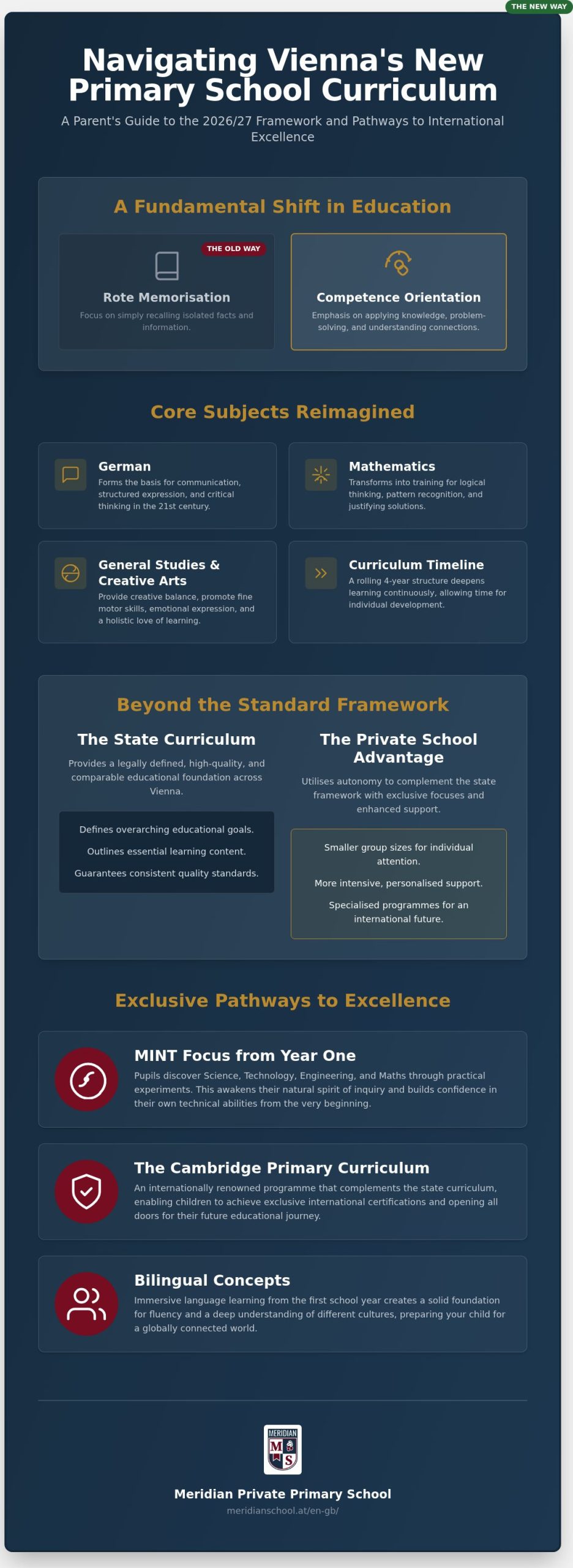
The statutory Vienna primary school curriculum forms the binding foundation for all educational institutions in the city. However, whilst public schools often struggle with large classes and limited resources, private institutions use their autonomy to qualitatively enhance this framework. A crucial point for parents is state recognition: despite its specialised offering, Meridian Private Primary School has public status. This means that every report card is officially valid and allows for a seamless transfer to any other school. We offer stability and security in an exclusive environment.
Funding through school fees creates the scope for first-class staffing. We specifically invest in additional teachers and native speakers to ensure individual support in small group sizes. Where state systems reach their limits, we begin with care that supports each child at their own pace. In our all-day school, we also rhythmically distribute the Vienna primary school curriculum throughout the entire day. Instead of overloading the morning with frontal teaching, concentrated learning phases organically alternate with creative projects and periods of rest.
Our bilingual concept integrates the English language far beyond the standard curriculum. We rely on the principle of immersion: children learn the language not through tedious vocabulary memorisation, but through daily activities. Whether experimenting or playing together; English becomes the natural working language. This anxiety-free approach to multilingualism is a core promise of our educational vision.
Education with us also encompasses physical well-being. A healthy snack is the basis for sustained concentration; you won't find a bread roll with chocolate spread here. We view shared snack time as a hidden part of general studies. This is where practical nutrition education takes place, where children learn which foods truly provide energy for their body and mind. Would you like to enrol your child for this future-oriented path? Here you will find all information on enrolment at Meridian Private Primary School.
Whilst the Vienna primary school curriculum forms the solid foundation for the academic career, the Cambridge Primary Curriculum opens the door to the world. We see ourselves as a bridge between local tradition and global excellence. This combination enables your child to fully meet Austrian educational standards whilst simultaneously achieving exclusive international certifications. It's not an either/or; it's the best of both worlds. Through regular international benchmarks, you can objectively track your child's progress. You see exactly how their competencies develop in a worldwide comparison.
The integration of the Cambridge approach fosters an open-minded identity from the first school year. Children grasp early on that knowledge knows no bounds. We prepare them to act confidently in a globalised society, without losing their roots in the Viennese education system. This foresight makes a decisive difference for their later academic career and personal development.
The decision for a bilingual educational path is a significant step for the entire family. For successful school enrolment in Vienna, we recommend a personal consultation to discuss your child's individual talents. Prerequisites for our bilingual stream are primarily curiosity and a joy for communication. We will guide you safely through the entire process, ensuring a smooth start to school in September or January.
A combined curriculum significantly eases the transition to secondary schools. Whether it's a Gymnasium or an international secondary level; our graduates are excellently equipped academically and linguistically. The long-term benefits of bilingualism are evident not only in academic success but also in a cognitive flexibility that lasts a lifetime. Your child acquires an international identity that will later open all doors for them worldwide. We are proud to be an innovative educational pioneer, embarking on this journey with you and instilling a joy for lifelong learning.
The journey through the first school years decisively shapes your child's entire future career. As we have seen, the Vienna primary school curriculum offers a modern pedagogical foundation until 2026; however, true future security is only created by targeted supplementation with international standards. The combination of the state curriculum and the Cambridge Primary Curriculum optimally prepares pupils for a world that demands flexibility and excellent language skills.
As a certified Cambridge International School in 1190 Vienna, we stand for bilingual excellence and holistic all-day care that goes far beyond merely imparting facts. Your child benefits from small group sizes and an innovative MINT (Science, Technology, Engineering, and Maths) focus from the first school year, which sustainably strengthens their natural spirit of inquiry. This structured yet warm environment promotes not only academic knowledge but also social competence and the joy of lifelong learning.
Secure a place for your child for 2026 – Enrol now!
We look forward to accompanying your child on this exciting journey and together laying the foundation for a successful, international identity.
The new curriculum has been gradually introduced since the 2023/24 academic year and will be mandatory for all four primary school years from the 2026/27 academic year. This rolling introduction ensures that the transition to modern, competence-oriented content is pedagogically well-supported. In Vienna, this applies equally to both public and private educational institutions.
In the first year, the Vienna primary school curriculum typically provides for between 20 and 22 lessons per week. This time is distributed among core subjects such as German, Mathematics, and General Studies, as well as Physical Education. At our all-day school, these units are supplemented by additional bilingual offerings and creative projects, whilst we ensure a balanced rhythm throughout the entire day.
Yes; numerical grades are still provided for, but can be supplemented or temporarily replaced by alternative forms of performance assessment during the initial school phase. Today, the focus is increasingly on detailed feedback regarding individual learning progress. This form of assessment helps children to better recognise their own strengths and motivates them to learn without the early pressure of a purely numerical grading scale.
Private schools with public status generally follow the same legal framework as public schools, but they expand upon it with specialised focuses. Whilst the Vienna primary school curriculum forms the basis, we integrate exclusive content such as the Cambridge Primary Curriculum and bilingual teaching. This enhancement of the standard programme enables an education that goes far beyond state minimum requirements and sets international standards.
Competence orientation means that children learn to actively apply their knowledge in various situations, rather than just memorising facts. It's about acquiring skills that truly matter in everyday life and later professional careers. Pupils should solve complex tasks independently and understand connections. This approach optimally prepares them for the demands of a constantly changing, global world.
A transfer to an Austrian Gymnasium is absolutely possible without any problems, provided the school has state public status. Our report cards are legally equivalent to state documents. In fact, the combination of the Vienna curriculum and international certifications often significantly facilitates the transfer, as children already possess high linguistic competence and a strong logical understanding.