What if your child's musical education not only fosters creativity but simultaneously lays the crucial foundation for success in mathematics and science? When searching for the right music primary school Vienna, many parents face the challenge of finding a balance between artistic development and an academically demanding curriculum. It is perfectly understandable that you desire an environment where your child is not just a number, but is individually recognised and nurtured in their talents.
In this article, you will discover how targeted musical education sustainably strengthens your child's cognitive development and why music is far more than just a pastime on the timetable. We provide you with a comprehensive overview of the musical programmes in Vienna for the 2026 school year and explain how the combination of rhythm and melody supports learning in STEM subjects. Additionally, you will receive valuable tips on how to find the ideal school in the 19th district that offers your child a stable, high-quality, and simultaneously future-oriented foundation for their further life path.
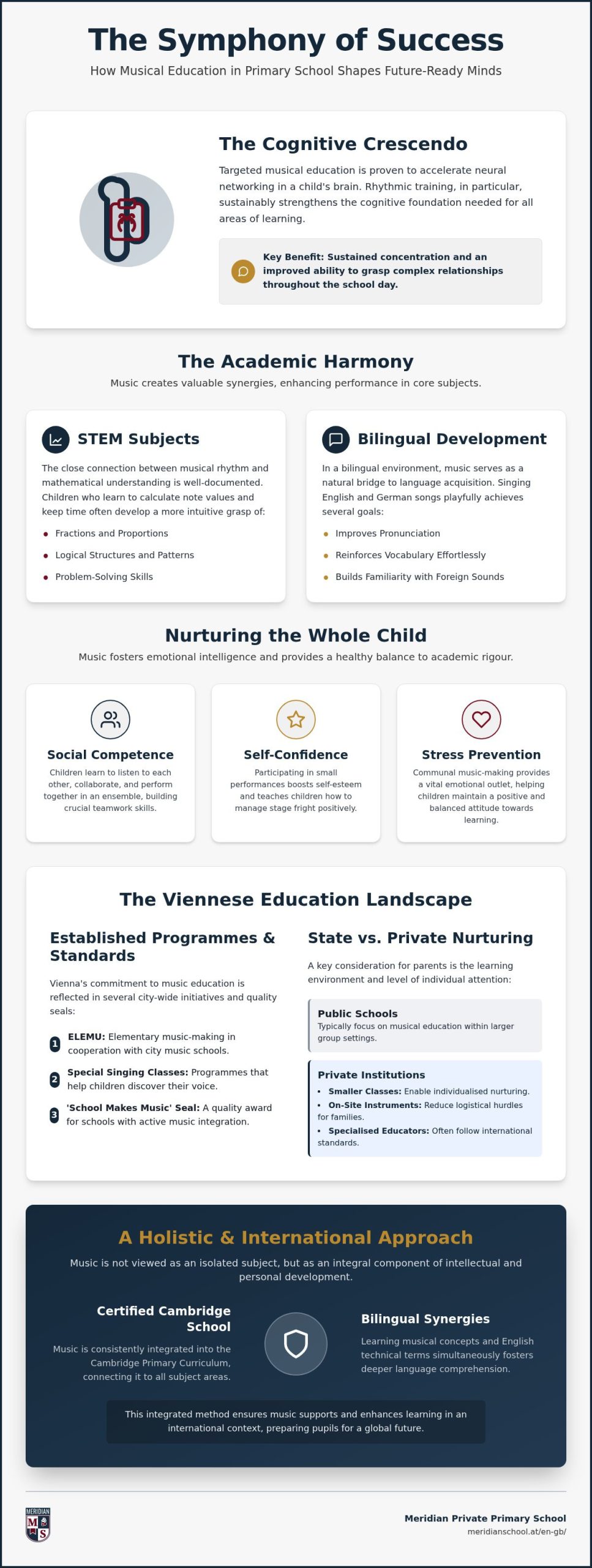
Music is deeply rooted in the federal capital; it not only shapes the cultural heritage but also forms a crucial pillar in the Austrian education system. When parents search for a suitable music primary school Vienna, it's usually about far more than just traditional recorder lessons. It's about the realisation that rhythmic training and active music-making significantly accelerate neural networking in a child's brain. This cognitive foundation helps pupils grasp complex relationships in other subject areas more quickly and maintain concentration consistently throughout the school day.
To better understand the importance of musical education in Vienna, this video offers an insight into the professional world of music pedagogy:
Scientific studies prove the close connection between mathematical understanding and a sense of rhythm. Children who learn early to keep rhythms and calculate note values often find fractions and logical structures easier. In a bilingual environment, music also acts as an ideal bridge to language. Singing English and German songs improves pronunciation and playfully reinforces vocabulary, without it feeling like hard work. It creates a natural familiarity with foreign sounds, which is essential for learning success. This is a central component of our offering for a holistic education.
Daily school life can be demanding, especially when there's a strong focus on STEM subjects. Here, communal music-making offers a necessary emotional balance. It fosters social competence, as children learn to listen to each other and perform in an ensemble. Small performances boost self-confidence and teach how to manage stage fright. Music thus becomes a tool for stress prevention, helping children maintain a positive attitude towards learning. This holistic nurturing ensures a harmonious classroom atmosphere where every child feels secure and valued.
In Vienna, foundational musical education is deeply embedded in daily pedagogical practice. Programmes such as ELEMU (Elementary Music-Making) are often implemented in close cooperation with the City of Vienna Music Schools directly at school locations. Here, the shared experience of rhythm, movement, and sound is paramount. Playful approaches such as the „Monsterfreunde“ or special singing classes also motivate children to discover their voice as a natural instrument. Parents choosing a music primary school Vienna for their child often also look for the 'School Makes Music' quality seal. This award from the Directorate of Education serves as an important guide, as it identifies locations that actively and regularly integrate music into daily school life.
A key difference often lies in the intensity of care. Whilst public schools usually focus on large groups, private institutions, through smaller classes, enable significantly more individualised nurturing. A crucial advantage is the availability of instruments directly at the school premises. This saves families additional journeys and allows children to practise in a familiar environment without time pressure. The quality of education is ensured by specialised educators who consider both the Austrian curriculum and international standards.
A modern educational approach in the 19th district combines local traditions with global requirements. As a certified Cambridge International School, we consistently integrate music into the Cambridge Primary Curriculum. Here, music is not viewed as an isolated talent subject, but as an integral component of intellectual development. Pupils learn musical concepts in an international context, which creates valuable synergies, especially in bilingual lessons. The combination of English-language technical terms and practical music-making fosters language comprehension in a way that goes far beyond traditional frontal teaching.
If you would like to learn more about how we integrate these high standards into our daily school life, take a look at our holistic offering for young talents.
Choosing the right music primary school Vienna is a decision that lays the foundation for your child's entire academic career. It's not enough for music to simply appear as a compulsory subject on the curriculum. During your research, primarily focus on the qualifications of the teaching staff: Are there specialised music educators on site who master an instrument and are pedagogically up-to-date? Equally crucial is the existing infrastructure. A dedicated music room with high-quality equipment or a stage for regular performances demonstrates the true importance of musical education in daily school life. Specifically ask whether music is integrated into lessons daily or only treated as an isolated single lesson per week. An ideal additional offering allows children to learn instruments directly at the school premises after school; this noticeably eases family life.
For the upcoming 2026/27 school year, you should definitely keep an eye on the central deadlines in January 2026 for public schools. For private educational institutions, the orientation phase often begins significantly earlier, frequently as early as November of the previous year. It is advisable to prepare all necessary documents for school enrolment in Vienna well in advance. A personal meeting and a thorough consultation help ensure that the school's pedagogical direction harmonises with your child's individual talents and needs.
Take the opportunity to observe lessons and get a look behind the scenes. During a music lesson, observe how the children interact. Is there an atmosphere of joy and discovery, or does the lesson seem rigid? Ask the school management specific questions about the weighting of artistic subjects compared to STEM focus areas. A modern school distinguishes itself by viewing these areas not as opposites, but as synergistic complements. Also pay attention to small details such as the quality of the instruments or the presentation of pupil projects in the corridors.
Would you like to see our innovative pedagogical concept for yourself? Arrange a consultation appointment now and discover our premises in 1190 Vienna.
At Meridian Private School, we view music not as an isolated talent subject, but as a central driver for overall learning success. Our pedagogical concept directly links rhythmics with bilingual instruction in German and English. When children sing songs in both languages or clap complex rhythms, they reinforce grammatical structures and vocabulary almost incidentally. This method is a crucial pillar in our comprehensive offering in 1190 Vienna. We regularly observe valuable synergistic effects: pupils who actively make music often bring a deeper understanding of STEM subjects. The ability to analyse musical patterns can be directly transferred to mathematical logic and scientific questions.
Our full-day care is characterised by warmth and pedagogical expertise. In the afternoon, children have the freedom to express their creativity without time pressure. Whether trying out new instruments or in sports modules; individual development is always paramount. Anyone looking for a music primary school Vienna that combines academic professionalism with a warm atmosphere will find a future-oriented educational environment with us. We place great importance on ensuring that the joy of acquiring knowledge is maintained even after core lesson times.
Our school's location in the heart of Döbling offers the ideal setting for undisturbed development. Get to know the surroundings of our Private School in Vienna 1190 and see for yourself the family atmosphere on Grinzinger Straße. Excellent accessibility and proximity to green spaces make our location a place where children and parents alike feel comfortable. It is important to us that the school journey is safe and daily life for families remains stress-free, so that more time is left for the essential things in life.
We consistently prepare our pupils for the demands of a globalised world. Discover how the Cambridge Primary Curriculum in Vienna fosters talents and creates an international identity. Early musical education here functions as a universal language that deepens cultural understanding. By linking local state recognition with a globally valued curriculum, we position ourselves as an exclusive interface between tradition and an international future. Every child starts their educational career with us with the best possible prerequisites.
The deliberate choice of a music primary school Vienna is far more than a decision for an artistic hobby. It is an investment in holistic development that equally fosters mathematical understanding, linguistic fluency, and social competence. Rhythm and melody form the ideal foundation to master complex challenges in STEM subjects with ease whilst preserving the joy of learning.
As a certified Cambridge International School, Meridian Private School offers a stable framework where these synergies can fully unfold. Through bilingual instruction from the 1st school year and individual nurturing in small groups, we ensure that every talent receives the space it needs to develop. We warmly invite you to embark on this innovative path with us and actively shape your child's future.
Arrange a consultation appointment at Meridian Private School now
We look forward to accompanying your child on their musical and academic journey of discovery and jointly laying the foundation for a cosmopolitan identity.
A Music Primary School consistently integrates music as a fundamental pedagogical principle into almost all subjects, whilst schools with a music focus usually only offer additional lessons or non-compulsory activities. Anyone choosing a specialised music primary school Vienna opts for an environment where rhythm and sound structure the entire daily routine. This promotes cognitive flexibility significantly more intensely than sporadic additional offerings, as musical education here is understood as a central element of personality development.
No, instrumental prior knowledge is generally not required for admission to the first year. The focus during primary school is on elementary music-making, where children are playfully introduced to rhythmics, ear training, and communal singing. The primary aim is to awaken natural curiosity and joy in music. This foundation later enables pupils to make an informed decision about a specific instrument that matches their individual inclinations.
In bilingual instruction, music serves as a natural catalyst for language acquisition and correct intonation. Through English-language songs, rhymes, and rhythmic language games, pupils internalise the vocabulary of the second language significantly faster and more sustainably. This cross-curricular method ensures that language learning is perceived not as tedious vocabulary work, but as a lively process. The combination of sound and language activates both hemispheres of the brain and playfully reinforces language proficiency.
The costs for a private institution with an additional musical offering vary depending on the provider and the scope of included services such as small group care or international certifications. As a rule, the monthly fee not only covers tuition according to the Austrian curriculum but also funds specialised educators and high-quality infrastructure. As private schools often provide additional resources for individual talent nurturing, the fees are naturally higher than those of public schools, which is reflected in the quality of education.
Yes, in the 19th district, there are specialised holiday programmes such as bilingual Summer Camps that focus on musical and creative aspects. These weeks allow children to further develop their talents in a relaxed, international atmosphere even during non-school time. Such offerings are ideal for playfully deepening language proficiency whilst simultaneously providing new musical impulses. Children benefit from continuous pedagogical care that focuses on social competence and creativity.
Music and STEM subjects share fundamental logical structures such as pattern recognition and mathematical proportions. Understanding note values and time signatures trains abstract thinking, which particularly benefits pupils when learning fractions and complex logical sequences. Musical education thus optimally prepares the brain for scientific questions. Through the training of rhythm and structure, a cognitive foundation is created that significantly facilitates the understanding of mathematical regularities.