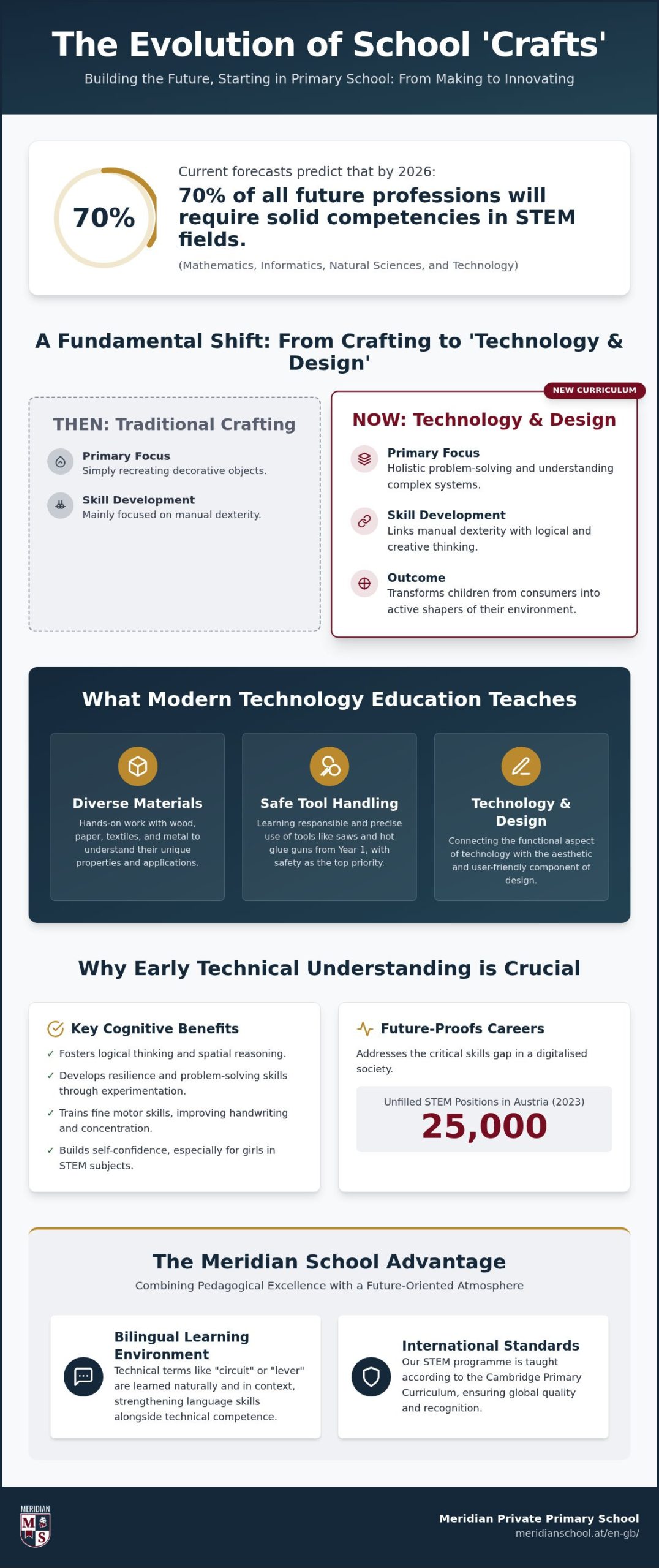
Did you know that, according to current forecasts, by 2026, 70% of all future professions will already require solid competencies in mathematics, informatics, natural sciences, and technology? It is perfectly understandable if, as parents, you wonder whether traditional crafting is still sufficient to prepare your child for this highly dynamic, digital world. It often remains unclear how exactly classic craft lessons differ from modern basic technical education that truly meets the high demands of a globalised society.
In this article, you will discover how innovative technology education in primary school awakens a natural spirit of inquiry and specifically prepares children for the challenges of tomorrow. We provide a clear insight into the current curriculum for Technology and Design and explain why a bilingual STEM focus at a specialised private school offers crucial added value for individual development. We demonstrate how the bridge between local stability and international educational quality is built to enable your children a confident start to a successful future.
Classic craft lessons have fundamentally changed in recent years. Since the 2023/2024 school year, a new curriculum has been gradually implemented in Austria's primary schools, establishing 'Technology and Design' as the successor to traditional craft education. Today, it's no longer just about simply recreating decorative objects. Instead, a holistic STEM promotion is at the forefront, linking manual dexterity with logical thinking. To thoroughly classify what technology education is at its pedagogical core, one must consider the development from purely manual activity to basic technological literacy. Modern technology education in primary school teaches children how to solve problems independently and grasp complex relationships through haptic experience.
Pupils work with diverse materials such as wood, paper, textiles, or metal. In doing so, they not only learn about specific material properties but also the precise handling of tools. Safety is paramount from Year 1; children learn early on how to use a saw or a hot glue gun responsibly. This hands-on experience directly leads to understanding. Those who learn how a bridge made of simple paper becomes stable through folding techniques will later understand digital construction principles much more easily. Our educational programme starts precisely here and systematically promotes these basic competencies.
The new name reflects a modern understanding of education. It connects the functional aspect of technology with the aesthetic component of design. A technical object must primarily function; however, it should also be appealing and user-friendly. This combination massively fosters creativity. When children are faced with the challenge of building a vehicle that both rolls stably and has a futuristic appearance, they develop a genuine basic technical understanding. They transform from mere consumers into active shapers of their environment, which lays the foundation for a successful career in a technologically advanced world.
Early childhood education shapes how children perceive the world. High-quality technology education in primary school starts precisely here by systematically fostering logical thinking and spatial reasoning. Given approximately 25,000 unfilled STEM positions in Austria (as of 2023), technical understanding is no longer a niche topic. It is the foundation for professional success in a digitalised society. It is particularly important to us to break down barriers early on. When girls experience from a young age that they can solve complex mechanical problems, they develop healthy self-confidence in their own abilities. High-quality teaching is guided by standards, such as those set by the MINT Seal of Quality for Schools initiative.
The synergistic effects with other subjects are remarkable. Concepts from mathematics, such as geometry or units of measurement, suddenly become tangible and lively when building a model. General studies also benefit enormously when physical laws are not only discussed theoretically but also practically tested.
In the technology room, children learn a healthy tolerance for errors. If a construction isn't stable, they look for the cause and correct their design. This principle of experimentation is essential for developing resilience and problem-solving skills. Furthermore, precise work with various materials trains fine motor skills, which in turn has positive effects on handwriting and general concentration ability.
At our school, we consistently combine technical expertise with linguistic competence. Children naturally learn terms like "circuit", "gear" or "lever" within the context of their projects. This form of immersion strengthens language awareness in a way that goes far beyond traditional rote vocabulary learning. Learn more about the benefits of immersion: How children learn languages. Those who link technology and language are optimally prepared for international exchange in the future research community. We invite you to learn more about our holistic educational programme.
Theoretical knowledge only unfolds its full potential through practical application. Lively technology education in primary school is characterised by children becoming active creators themselves. Robot building is particularly fascinating. Here, pupils take their first steps in mechanics and logic. They immediately grasp how gears interlock and how simple command chains bring a machine to life. It is this moment of success that solidifies genuine interest in STEM subjects.
Another essential component is the 'Electricity and Energy' project. In a protected environment, children explore simple circuits and experiment with series and parallel connections. Sustainability is always a focus; we integrate upcycling projects and address renewable energies such as wind and solar power. Children use tablets to document their experiments. Thus, the use of digital media becomes a natural tool for gaining knowledge, strengthening media literacy early on. This holistic approach ensures that technology education in primary school goes far beyond mere crafting.
Whether building stable bridges, fast vehicles, or simple pulley systems; our pupils construct models that make physical laws tangible. We often use everyday objects for this. This shows children that technology is everywhere in their immediate surroundings. They learn to use materials efficiently and to creatively overcome static challenges.
In inquiry-based learning, the question "Why?" is central. It's not just about an experiment working in the end. Rather, the journey there and the understanding of the underlying processes are what count. Children regularly present their results to the group, which massively strengthens self-confidence and rhetorical skills. Read more here about how our STEM focus in primary school: Why a spirit of discovery in Vienna 2026 lays the foundation. Would you like to learn more about our innovative learning methods? Find out now about our diverse educational programme.
At Meridian Private School, we see ourselves as innovative educational pioneers who link local pedagogical stability with a global horizon. Our technology education in primary school goes far beyond the minimum requirements of the state curriculum. We seamlessly integrate the internationally recognised Cambridge Primary Curriculum into the Austrian school day. This means that our pupils not only theoretically grasp technical principles but also apply them in a consistently bilingual environment in German and English. Our specialist teachers convey their passion for technology in both languages, allowing technical terms to naturally transition into active vocabulary.
The facilities at our school in 1190 Vienna are specifically designed to meet the needs of small research groups. Modern premises provide high-quality tools and digital aids that enable safe yet ambitious work. We pursue a holistic approach; the technical competencies acquired in the morning are complemented in the afternoon by our additional musical and sports programmes. This structure ensures balanced development that equally promotes intellectual, physical, and creative strengths.
The combination of proven Austrian craft tradition with international STEM standards creates a unique learning environment. Our pupils are thus optimally prepared for transitioning to further international schools. They acquire competencies that are in demand worldwide; from the first precise sketch to the functioning prototype. Detailed information about our comprehensive programme can be found on our website.
In our manageable small groups, we guarantee individual support that specifically addresses the talents of each child. We accompany our pupils in discovering their own spirit of inquiry and bravely tackling complex challenges. Would you like to enable your child to receive this first-class, future-oriented education? You can register your child for the upcoming school year now. We look forward to welcoming you and your child to our warm school community.
Modern technology education in primary school is far more than just a creative pastime; it is the foundation for a profound understanding of our technologically advanced world. We have seen how the combination of hands-on work and digital logic awakens a spirit of inquiry while simultaneously training important cognitive skills. The bilingual teaching of technical content, in particular, optimally prepares children for global challenges and breaks down apprehension towards complex systems early on.
As a state-recognised private school and certified Cambridge International School, we offer a learning environment in Vienna 1190 that combines academic excellence with a warm atmosphere. In our bilingual all-day school, technology becomes an experience that extends far beyond the classroom. Our aim is not just to impart pure knowledge, but to foster an international identity that makes your children the shapers of tomorrow.
Visit Meridian Private School and discover our STEM focus. We look forward to working with you to unleash your child's full potential and safely guide them on their path to a successful, digital future.
Technology education in primary school at our institution begins as early as Year 1. We utilise the natural curiosity of new pupils to gently introduce them to technical questions and simple mechanical principles. The gradually implemented curriculum for "Technology and Design" ensures that the complexity of projects continuously increases with each school year, and children are systematically supported.
No, no prior technical knowledge is required to participate in our STEM focus. Each child is individually supported at their current stage of cognitive and motor development. We place great importance on the joy of discovery and playful experimentation being paramount, so that all pupils can equally experience success in the technical subject areas.
The safety of our pupils is our top priority and is ensured through small group sizes and continuous expert supervision. Before children work with tools such as saws, drills, or hot glue guns, they complete targeted safety training for the respective material. From the outset, we teach responsible handling of materials and machines, so that inquiry-based learning can take place in a stable and protected environment.
Yes, digital media are an integral part of our modern pedagogical concept. We specifically use tablets to document experimental series, analyse building instructions, or learn simple programming logic during robot construction. This conscious combination of hands-on work and digital application optimally prepares children for the demands of a connected world and naturally strengthens their media literacy.
The English language holds a central position, as we design technology education in primary school bilingually. Through the integration of the Cambridge Primary Curriculum, children naturally learn technical terms such as 'gravity', 'energy', or 'construction' in both languages. As English is the lingua franca of the international research community, we thus create a solid foundation for a cosmopolitan identity and future educational paths from a young age.