What if, from the very first day of school, English for your child wasn't about tedious vocabulary lists, but a completely natural way of understanding the world? Many parents in the capital face the important decision of which primary school will lay the best foundation for the coming years. Often, there's a quiet concern about whether bilingual education in Vienna might already overwhelm a child in Year 1, or if their German language skills might suffer from an early focus on a foreign language. These concerns are absolutely understandable; after all, the joy of learning should be paramount, not performance pressure.
In this article, you will discover how bilingual education in Vienna lays the crucial foundation for a global future and why the combination of the proven Austrian curriculum and international Cambridge standards offers an ideal framework. We will clarify the essential differences between public Vienna Bilingual Schooling (VBS) and private educational models. Furthermore, you will gain a well-founded insight into the immersion principle and a clear roadmap for registration, including the November deadlines, so you can make your school choice with complete confidence and assurance.
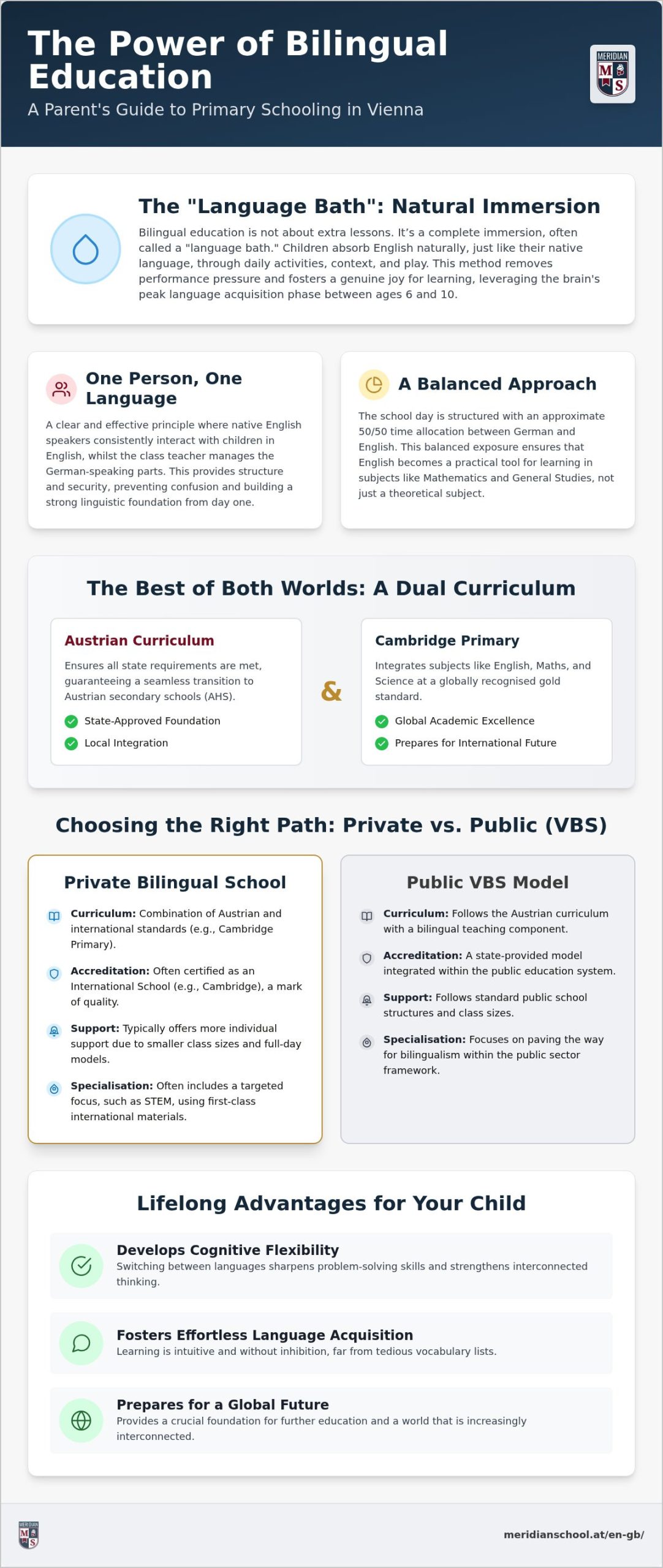
Bilingual education in Vienna is far more than an extra hour of English per week. It's about a holistic concept where the foreign language becomes the natural working language in daily school life. During primary school, typically between the ages of 6 and 10, the brain is in a golden era for language acquisition. Children at this age absorb new structures almost effortlessly, without having to painstakingly analyse them. They learn intuitively and without the inhibitions that often only emerge later in life.
The core of this model is the "One Person, One Language" principle. In the classroom, native speakers act as consistent points of contact, speaking English exclusively. This way, the little ones learn the correct pronunciation and intonation from the outset, whilst the class teacher handles the German-speaking part. This clear system provides children with security and prevents confusion in the classroom.
To better understand this concept, watch this helpful video:
In pedagogy, we often speak of a language bath (immersion). Children immerse themselves in the English language and grasp meanings directly from the respective context, for example, through pictures, facial expressions, gestures, or concrete actions. It's not about traditional rote learning, but about actively experiencing the language. Through constantly switching between German and English, pupils develop remarkable cognitive flexibility, which sustainably strengthens interconnected thinking. Even children without any prior knowledge playfully find their place, as visual support and established daily routines prevent any feeling of being overwhelmed.
It is essential to understand the difference from conventional foreign language instruction. Whilst English as a subject often only conveys theoretical knowledge, in the bilingual education Vienna model, the language serves as a tool for subjects like Mathematics or General Studies. A time allocation of approximately 50 per cent for each language has proven particularly effective in primary education. Those interested in state-provided options often encounter the Vienna Bilingual Schooling (VBS) model, which has paved the way for this approach in the public sector. In private institutions, this approach is often further deepened through international curricula to guarantee individual support and seamless preparation for a global future.
The decision for an education at the intersection of two systems offers your child unique security. On the one hand, strict adherence to the Austrian primary school curriculum guarantees that all state requirements are met. This enormously facilitates the later transition to a secondary school (AHS) in Austria. On the other hand, the Cambridge Primary Curriculum integrates subjects such as Mathematics, Science, and English at a level considered a global gold standard. Think globally, learn locally.
Scientific studies underpin the advantages of bilingual education, as the cognitive demands of two parallel curricula sharpen problem-solving behaviour. A crucial aspect here is regular progress monitoring. These so-called Checkpoints are based on global benchmarks and provide parents with clear feedback on their child's progress, entirely without the usual performance pressure of traditional examination periods.
The status as a certified Cambridge International School is an exclusive mark of quality. It ensures access to first-class teaching materials from Great Britain, specifically developed for language acquisition in content subjects. Furthermore, teachers benefit from continuous professional development at an international level. This ensures that pedagogical excellence is not just a buzzword but is lived daily in the classroom.
The strength of this model is particularly evident in the natural sciences. When children experiment in general studies, they learn complex technical terms incidentally. A targeted STEM focus fosters a natural spirit of discovery and directly links technical understanding with the English language. Thus, bilingual education in Vienna becomes a springboard for future careers where English is already the lingua franca.
For further details, take a look at our versatile educational programme.
A school day in a full-day school is far more than a mere sequence of lessons. It is a lived rhythm. Everything begins with the morning circle. Here, children discuss their plans for the day in English and German. This structured routine provides security and creates space for social interaction. In Vienna 1190, we place importance on bilingual education in Vienna not ending at the classroom door. It accompanies pupils into after-school care.
Informal learning moments are particularly valuable. During shared snacks or lunch, the foreign language comes alive. When a child asks for tomatoes or requests a glass of water, it happens quite naturally in English. These everyday situations reinforce vocabulary more effectively than any vocabulary list. Furthermore, additional musical and sports activities promote holistic development. In the gym or music room, language recedes into the background, whilst shared activity dominates. Children from different backgrounds benefit immensely from each other here and develop a natural open-mindedness towards the world.
The concept of Content and Language Integrated Learning (CLIL) becomes tangible here. In maths lessons, geometric shapes are named in English, whilst in the gym, commands are given in both languages. The brain learns to store knowledge independently of the language. For a particularly smooth transition, a bilingual pre-school course is recommended, which prepares the little ones for this environment even before Year 1.
Many parents wonder if they can support their child if they don't speak perfect English themselves. The answer is a clear yes. It's not about replacing the teacher. Rather, what counts is an interest in progress and appreciation for the effort made. Regular communication between the school and home ensures that each child receives individual support. Thus, bilingual education in Vienna becomes a joint project between educators and families.
Would you like to plan the next step for your child's education? Find out now about registration for the upcoming school year.
Those opting for bilingual education Vienna usually face a choice between the public VBS model and a private institution. Whilst the state system offers valuable basic provision, a private primary school allows for significantly greater flexibility in admissions and more intensive individual support. A key quality advantage lies in the staff-to-pupil ratio. In smaller class groups, educators can more specifically address the strengths of each individual child, which is essential, particularly during the sensitive phase of the first few school years.
Additional services often make the subtle difference. Private schools frequently offer exclusive Cambridge certifications and a wide range of sports and musical activities, which are directly integrated into the full-day schedule. When visiting schools, use this short checklist:
Planning for the 2026/2027 school year begins earlier than many parents might expect. The official registration week for public schools is between 10th and 21st November 2025. In private schools, there's often more flexibility with dates, but places are also quickly filled due to high demand. The compulsory orientation interview is not a rigorous knowledge test. Its primary purpose is to ascertain a child's enjoyment of language and general cognitive maturity. Prepare in good time and inform yourself about the details for school registration in Vienna.
Quality comes at a price, but transparency builds trust. Detailed information on school fees will help you with long-term financial planning for the entire primary school period. Consider the lasting added value: an excellent bilingual foundation in primary education often renders later, costly tutoring unnecessary. It is an investment in your child's global mobility and academic security, serving as a stable foundation for the transition to secondary schools.
Choosing the right primary school profoundly shapes your child's educational path. As we have seen, bilingual education in Vienna offers far more than mere language skills; it fosters cognitive flexibility and a natural open-mindedness from an early age. Through the unique combination of the Austrian curriculum and global Cambridge standards, your child receives an education that connects local roots with an international horizon.
As the first Cambridge International Primary School in Vienna, we at Meridian Private School offer a warm and family-like atmosphere right in the heart of Grinzing. Our holistic full-day concept with a STEM focus ensures that a spirit of discovery and individual talents are central from Year 1. We invite you to see for yourself our pedagogical excellence and modern learning environment.
Book an appointment for a personal consultation at Meridian Private School now and together lay the foundation for your child's global future.
We look forward to competently accompanying you and your child on this exciting journey.
No, absolutely no prior knowledge of English is required for entry into Year 1. The immersion principle allows children to grasp the new language intuitively through context and daily routines. Our educators specifically support this process through facial expressions, gestures, and visual aids, ensuring that even beginners are integrated into the class community without any hurdles or frustration.
There is no scientific evidence to suggest that German spelling is negatively affected by early second language acquisition. On the contrary, bilingual education in Vienna often fosters a deeper understanding of grammatical structures in both languages. Children learn very early to consciously differentiate between language systems, which sustainably strengthens overall language proficiency and cognitive flexibility.
The essential difference lies in the design of the curriculum and the intensity of support. Whilst the state VBS model is firmly embedded in the public system, private primary schools often offer the additional integration of international standards such as the Cambridge Primary Curriculum. Furthermore, families in private institutions usually benefit from significantly smaller class sizes and more individualised support that extends far beyond the regular curriculum.
The financial structure usually comprises monthly school fees, costs for compulsory catering in the full-day model, and one-off registration fees. Parents here invest in an exclusive education with native speakers and international certifications. Reputable private schools transparently provide detailed information on their current price structure and various payment models on their websites to offer families financial planning security.
A transfer to a public secondary school or AHS is possible at any time after Year 4 without any problems. As bilingual private schools fully comply with the Austrian primary school curriculum, their certificates are state-recognised and legally equivalent. Pupils, through their multilingual education, are often even particularly well-prepared for the demands of secondary schools, as they are already accustomed to thinking in interconnected, complex contexts.