What good is the best mark in maths if, in a globally connected world, a child doesn't know how to empathise with others or resolve a conflict constructively? Many parents in Vienna today worry that an overly rigid, purely performance-oriented system hinders their child's social development or even leaves room for bullying and exclusion. The topic of social learning primary school Vienna is therefore no longer just an additional offering, but the heart of a modern education in the 19th district.
You too surely wish for your child an environment where they feel secure whilst simultaneously learning to navigate an international context with confidence. Discover here how social learning in primary school specifically strengthens emotional intelligence and optimally prepares your child for the social demands of a connected future. We show you how Meridian Private Primary School, through the combination of the Austrian curriculum and the Cambridge Primary Curriculum, fosters a strong class community where mutual respect and open-mindedness are lived daily. In this way, we pave the way for a generation that not only accumulates knowledge but possesses true emotional intelligence.
At a time when digital screens often form the first contact with the world, the question of what social learning means in an educational context is gaining massive importance. It is by no means just about merely following class rules or sitting quietly during lessons. Rather, the term describes the targeted acquisition of emotional intelligence and teamwork skills. In a city like Vienna, which is positioning itself even more strongly as an international educational hub by 2026, social learning primary school Vienna is the foundation upon which academic excellence can truly flourish.
Children who feel comfortable in their own skin and learn to regulate frustrations have their minds free for maths and languages. We are talking about cultivating empathy here. This is not a soft optional subject, but an essential protective factor against increasing digital isolation. Children who develop genuine social understanding act proactively instead of merely reacting to instructions. They understand the 'why' behind working together.
To better understand this pedagogical concept, the following video offers a vivid insight:
Before a child can empathise with others, they must learn to name their own emotions. Am I angry, disappointed, or just tired? In modern Viennese school life, mindfulness plays a central role. Through targeted exercises, children learn to pause and control their impulses. This self-regulation is the basis for all further interaction and prevents overwhelm in the demanding school day.
Respectful interaction does not happen by chance. It requires clear conflict resolution strategies that are effective even in the playground. Empathy is the crucial key here. Only by taking the perspective of another can one understand why a dispute arose. In a strong class community, diversity is experienced as an enrichment. This is particularly important in an international environment like Döbling, where children from various cultures meet and grow together.
Those who speak two languages learn early on that there is more than one way to name the world. At Meridian Private Primary School, we observe daily how bilingual instruction (German/English) goes far beyond mere language acquisition. It acts as a catalyst for social learning primary school Vienna, as constantly switching between languages significantly boosts cognitive flexibility. This mental agility helps children adapt more quickly to new social situations and more easily accept different viewpoints.
Native speakers play a crucial role in this. At our school in Döbling, they are not merely teachers but act as cultural bridge-builders. Through them, children experience authenticity and learn directly that successful communication always includes respect for the cultural background of the other person. In this way, intercultural competence grows, which is indispensable in a globalised society. For us, language learning means understanding other worlds and preventing prejudices from arising in the first place.
Scientific approaches to the "Theory of Mind" suggest that children growing up bilingual often grasp earlier that other people may possess different knowledge or beliefs than themselves. This early perspective-taking is a crucial building block of social intelligence. Those who wish to understand why this integrative approach is so successful should delve deeper into bilingual education in Vienna.
As a certified Cambridge International School, we firmly integrate the "Global Perspectives" programme into our daily school life. This aims to awaken a deep sense of social responsibility. Pupils engage with global issues and learn to evaluate local challenges within a broader, global context. This strengthens community spirit and confidently prepares them for life in a multicultural society. If you would like to learn more about how we integrate these values into daily life, take a look at our educational offering.
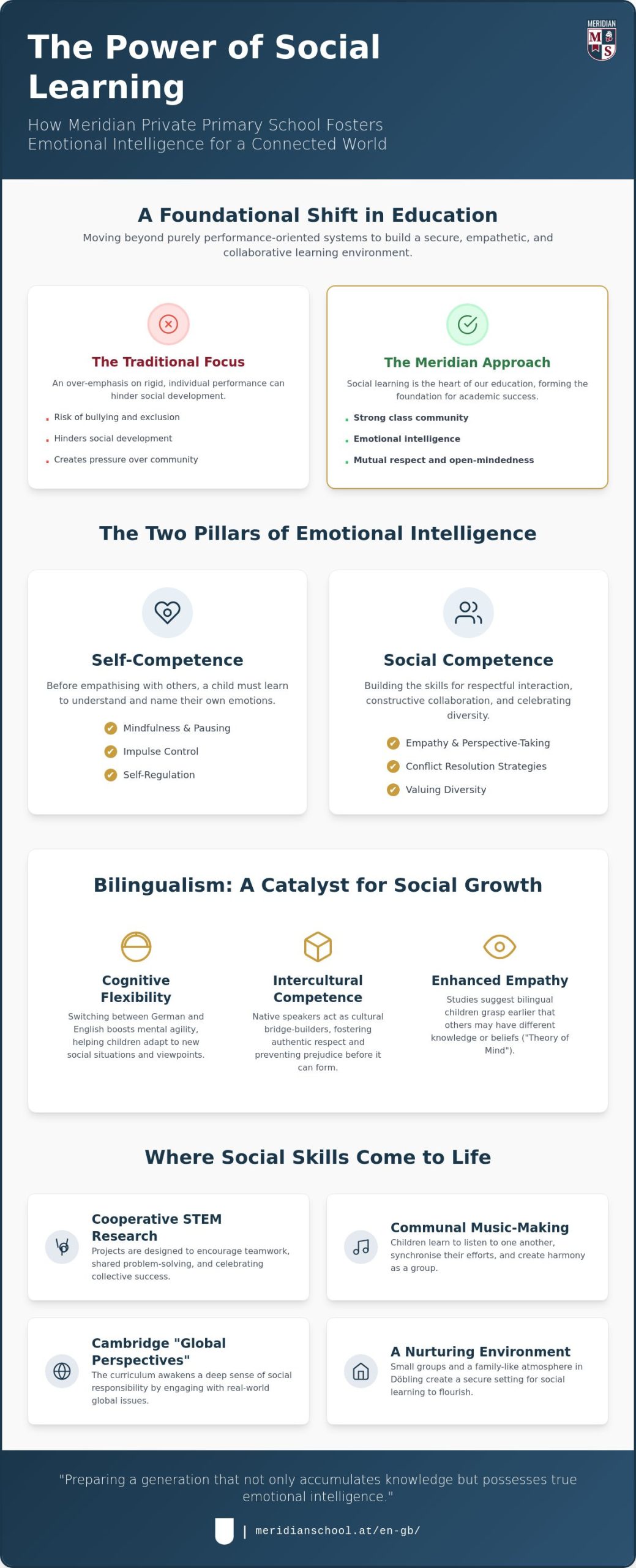
Social learning at a modern primary school is not an isolated subject that one simply puts aside after 50 minutes. Rather, it is the invisible architecture behind every experiment and every melody. At Meridian Private Primary School, we inextricably link academic excellence with interpersonal competence. When children stand together in the laboratory or rehearse a new piece of music, they are incidentally practising what we understand by social learning primary school Vienna: cooperation, reliability, and mutual appreciation.
In music lessons, this social dimension becomes particularly audible. Playing music together requires paying attention to the group's rhythm and giving others space to develop. A form of non-verbal communication emerges that strengthens the sense of togetherness. This approach is complemented by "active breaks" and additional sports activities. Here, pupils learn to celebrate victories together and to deal fairly with defeats. Once a week, all classes come together for our "Assemblies". These gatherings are a central element of our school culture to acknowledge community achievements and strengthen our identity as an international school in 1190 Vienna.
At our school on Grinzinger Straße, young scientists rarely solve complex problems alone. Cooperative learning in STEM means that each child takes on a specific role in the research process. One observes carefully, another records, and together they present the results. Through this division of labour, they understand that the overall outcome is more valuable than the sum of its individual parts. To learn why this approach is so important for the world of tomorrow, read our article on the STEM focus in primary school.
Parents can wonderfully support this development in everyday life. Use simple moments, such as preparing an evening snack together, to talk about the day's social experiences. Don't just ask about maths achievements, but also about who needed help today or who was particularly helpful. For a smooth transition into this social structure, our pre-school course offers the ideal opportunity to playfully make contacts even before the first day of school. Discover our entire educational offering for an optimal start to your child's school career.
At Meridian Private Primary School, we understand education as a shared journey that extends far beyond the classroom. A stable social foundation cannot be built in a hurry. It requires time, space, and conscious guidance from dedicated educators. In our family-like environment in the 19th district, social learning primary school Vienna truly becomes tangible through individual support in small groups. Where everyone knows everyone, the risk of exclusion or bullying significantly decreases, whilst children's sense of security grows.
As a bilingual full-day school, our institution functions as a true living space for children. For us, the afternoon is not merely childcare time, but a valuable phase for social interaction and forming deep friendships. Whether during communal lunch or the diverse additional sports activities; children have the time they need to understand social dynamics. They learn to resolve conflicts constructively under professional guidance. This consistency in the daily routine provides security and sustainably strengthens emotional intelligence.
An educational partnership on equal terms with parents is indispensable for us. We regularly exchange information about your child's individual development to ensure that the values of school and home go hand in hand. In this way, we accompany pupils from their first day of school until their successful transition to a secondary school, laying the foundation for an international identity.
The inspiring environment in Döbling offers the ideal setting for a high-quality education. We place great importance on making the transition from kindergarten to school life particularly gentle. How we socially support this school start in Vienna and what preparations are sensible is an essential part of our educational concept.
Every child is unique in their social and academic development. We warmly invite you to get to know us during a personal consultation and learn more about our holistic approach. All details regarding registration at Meridian Private Primary School, as well as information on school fees for the upcoming academic year, can be found on our website. Together, we will prepare your child for a connected and global future.
The path to a successful school career today inevitably leads through the heart. As we have seen, bilingualism functions not only as a linguistic tool but as an essential bridge to empathy and cognitive flexibility. In a protected environment, characterised by small class sizes and the warm care of native speakers, your child's personality can freely develop. The topic of social learning primary school Vienna becomes a stable pillar for overall development through the combination of the Austrian curriculum with the Cambridge Primary Curriculum.
As a certified Cambridge International School, we prepare the next generation not only to thrive in a multicultural society but to actively and respectfully shape it. We invite you to take the first step for your child's future together with us. A stable social foundation is the most valuable gift you can give your child for their future journey.
Discover our holistic educational offering in Vienna 1190 and learn more about our vision for modern emotional intelligence. We look forward to personally welcoming you and your child to our campus in Döbling soon.
Social learning refers to the targeted acquisition of emotional and social competences directly within daily school life. It encompasses the ability to perceive one's own feelings, develop empathy for others, and resolve conflicts constructively. In primary school, this process forms the indispensable basis for respectful interaction and sustainably strengthens children's self-confidence. The aim is to prepare pupils for the social demands of a connected world.
In Vienna, social learning is often integrated into lessons rather than existing as an isolated subject. However, many schools dedicate specific units to this focus or use morning circles and assemblies for the targeted promotion of class community. At our institution, social learning primary school Vienna is a fixed component of the curriculum, actively practised across subjects in STEM projects, music lessons, and daily sports, and guided by educators.
Shy children particularly benefit from individual support in small groups, as they can more easily find the courage for social interactions in a protected environment. Through targeted exercises for self-assertion and regular, positive feedback, they learn to confidently express their own opinions. A family-like environment, such as the one we cultivate in Döbling, provides the necessary security to reduce social anxieties and gradually take on more responsibility within the class community.
No, on the contrary, bilingual education has a positive effect on social development, as it massively promotes cognitive flexibility and intercultural understanding. Learning a second language like English opens doors to new ways of thinking and strengthens empathy towards diversity. Our native speakers gently guide children throughout the day, ensuring that language is experienced not as a barrier but as a natural tool for community and communication.
Private schools often rely on proactive conflict resolution models and a close educational partnership with parents. In cases of disagreement between pupils, proven strategies such as mediation or moderated group discussions are used to jointly address the causes. Small class sizes allow teachers to intervene early and ensure a respectful atmosphere before tensions escalate. This creates a stable environment where every child feels respected and secure.