Did you know that, according to the iKM-Plus results from March 2026, only 77 per cent of Viennese primary school children achieve the essential educational standards in mathematics? This figure marks the lowest in an Austria-wide comparison and causes many parents legitimate concern about their children's academic future. If you also know the daily stress of homework or wonder how best to prepare your child for secondary school, you are not alone with these thoughts. Many families waver between concern about dyscalculia and the feeling that gifted children remain unchallenged in conventional lessons. It is high time to look at the topic of promoting maths in primary school in a completely new and holistic way.
In this article, you will learn how to specifically support your child's mathematical talents through STEM enthusiasm, bilingual teaching, and everyday impulses. We will show you why a combination of the Austrian curriculum and international frameworks such as the Cambridge Primary Curriculum sustainably awakens the joy of logical thinking. From playful everyday approaches to professional promotion in a modern learning environment, you will gain a well-founded insight into pedagogical strategies for 2026 that impart confidence in dealing with numbers.
Mathematics in primary school is often reduced to merely memorising times tables or faultlessly adding. However, the true educational value of mathematics teaching lies much deeper. It is about building stable problem-solving competence and understanding logical structures. Those who learn early to recognise patterns and grasp connections lay the foundation for success in all STEM subjects. Mathematics is the language in which we describe the world and the natural sciences.
The first four school years are a critical phase. This is where it is decided whether a child develops healthy self-confidence in their own abilities or whether mathematics becomes an anxiety-ridden subject. When we promote maths in primary school, the primary goal is to preserve the natural curiosity for discovering number ranges. It is a balancing act between playful exploration and targeted pedagogical guidance.
To better understand the challenges in this phase, it is worth looking at this helpful contribution:
Many parents wonder when professional learning support becomes necessary. There is a clear difference between occasional practice at the kitchen table and structured promotion, as offered by a specialised institution. Whilst playful impulses in everyday life form the basis, preparation for demanding secondary schools often requires a deeper engagement with abstract concepts. For those looking at international academic standards, the Learning Voyage Education Centre offers valuable insights into comparing secondary pathways to ensure students are well-prepared for future challenges. Targeted measures help to unleash potential and prevent gaps from arising in the first place.
A mathematical talent often manifests through unusual problem-solving approaches or a deep interest in patterns. Such children need mental stimulation to avoid underachievement. On the other hand, it is important to address maths frustration early. If the foundation is missing, every new learning step becomes a struggle. Individual support, as made possible by the educational offer of modern private schools, ensures that every child grows at their own pace. Here, the joy of gaining knowledge is always at the forefront, so that mathematics is perceived not as a hurdle, but as a tool for the future. It is about using curiosity as the strongest drive for learning.
Bilingualism is far more than merely learning vocabulary; it acts as a cognitive catalyst for logical processes. When children grasp mathematical concepts in both German and English, they learn to process information independently of a single language. This immersion process massively promotes the ability to abstract. Mathematics is thus understood as a universal language that plays a central role in the STEM specialisation (Science, Technology, Engineering, and Mathematics). Those who learn early to think in systems develop a mental flexibility that goes far beyond traditional teaching.
The Cambridge Primary Curriculum, which is available in its updated version for 2026, sets international standards in this regard. It combines the Austrian curriculum with globally proven methods that focus on investigative learning. In this way, we can promote maths in primary school by providing children with tools that prepare them for a globalised world. It is not about memorising formulas, but about understanding structures that are valid all over the world. This approach strengthens self-confidence and paves the way for a successful academic career.
The conscious switching between languages when solving word problems prevents children from merely looking for signal words. They must grasp the actual logical core of a task to be able to formulate it in both languages. Action-oriented learning plays an essential role here, as it overcomes language barriers through practical doing. Studies and projects on playful mathematical promotion prove that movement and haptic experiences deepen abstract understanding.
Through this method, cognitive load is not increased; rather, the networking of brain areas is optimised. A well-founded Cambridge Primary Curriculum in Vienna offers the ideal framework for this. It combines local stability with international standards. If you would like to learn more about how this integrative approach supports your child's development, it is worth taking a look at our versatile educational offer in Vienna-Döbling.
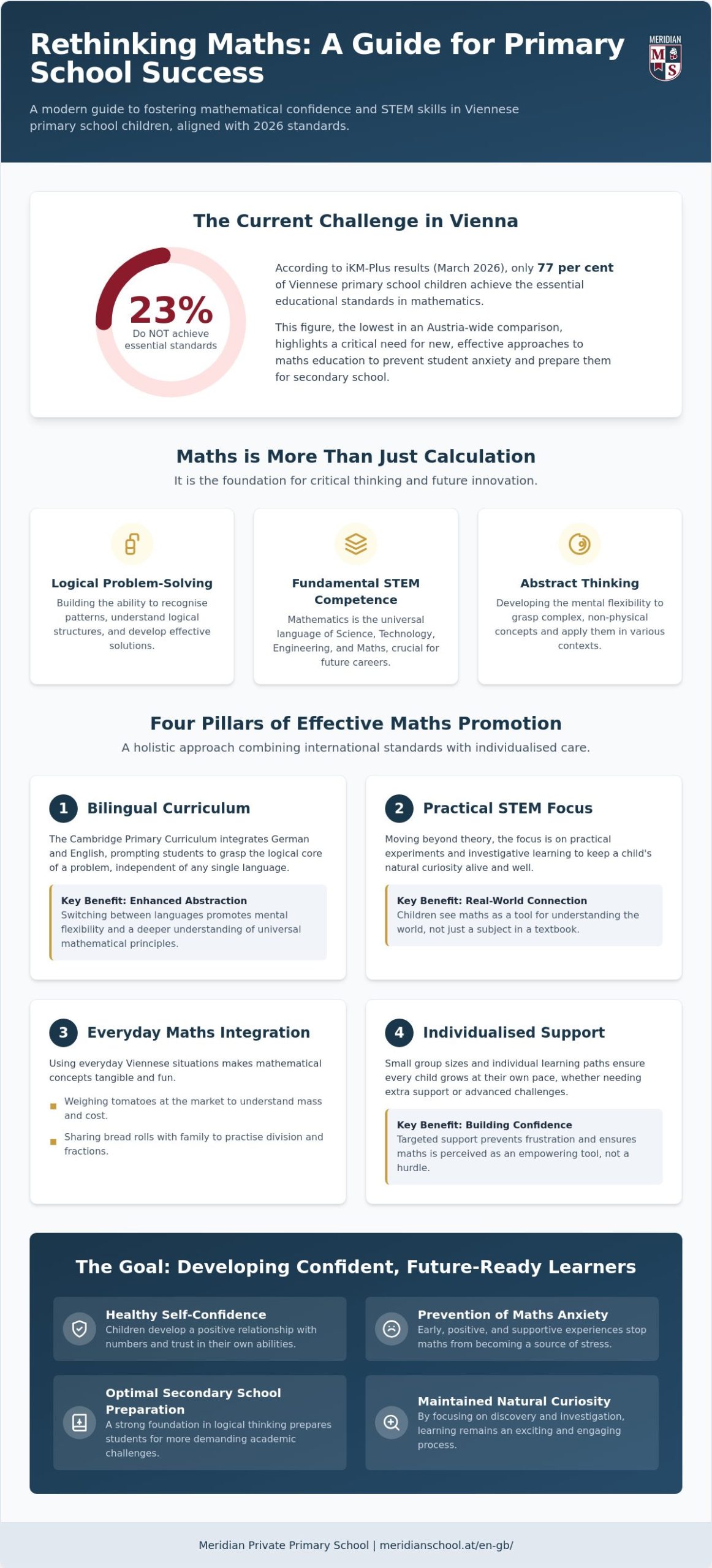
Mathematics greets us on every street corner in Vienna. No complicated worksheets are needed to spark curiosity. A visit to the Naschmarkt offers the perfect opportunity to develop a feel for weights and measures. When the child weighs three kilos of tomatoes, the abstract suddenly becomes tangible. Such real-life experiences are essential if parents actively want to promote maths in primary school. It transforms a theoretical number into a physical experience that remains in memory.
Valuable lessons are also hidden in the daily trip to the baker's. Sharing a bread roll or a doughnut playfully introduces children to the concept of fractions. Anyone who understands that two halves make a whole has already taken the first step in fraction arithmetic. Geometry can be excellently discovered in the 19th district. The facades of the villas and historic buildings offer a wealth of shapes. Triangles, circles, and symmetries are just waiting to be named. Counting the steps on the Underground whilst waiting or recognising patterns in the tiles trains one's mathematical eye incidentally.
Scientific approaches to the promotion of maths strengths in primary school emphasise the importance of this connection to real life. Mathematics must not remain an isolated school subject. It must be understood as a tool to structure one's own environment. This everyday practice forms the foundation for more complex STEM topics in later school stages. It removes the pressure of "learning" and replaces it with "discovering".
The daily snack offers ideal moments for small logic puzzles. Set theory comes alive when distributing apple slices or quark plaits. Estimation games also promote mathematical intuition. How many blueberries might fit into the snack box? Such questions stimulate thinking without creating performance pressure. Even the school journey on the tram can be used for short mental maths challenges. Those who set these impulses ensure that the joy of thinking remains a constant companion.
Would you like to learn how we integrate these everyday impulses into our structured lessons? Discover our holistic educational offer in Vienna-Döbling and support your child on their path to learning success.
In a city like Vienna, where educational tradition meets global innovation, we rely on a concept that goes far beyond the standard. When we promote maths in primary school at our school, this is done through a precise alignment with the needs of each individual child. Individual learning paths enable us to specifically develop strengths and overcome potential hurdles early on. Confidence in arithmetic and geometry forms the backbone for a smooth transition to secondary schools.
An essential component is our STEM specialisation, which brings mathematics to life through exciting experiments. Children no longer perceive numbers as abstract symbols on paper, but as tools to explain scientific phenomena. The use of interactive digital media actively supports this process. It allows pupils to visually grasp complex relationships and deepen their understanding playfully. This creates a modern learning environment that awakens natural curiosity and sustainably consolidates mathematical competences.
The key to this success lies in our small class sizes. They allow teachers to respond to each child's individual pace, ensuring no one falls behind or feels unchallenged. Teamwork is highly valued here; especially with complex mathematical puzzles, children learn to develop solutions together. This not only trains logical thinking but also social competence in an international context. Detailed information on registration and school fees can be found transparently on our website. We invite you to become part of this innovative educational community in the heart of Döbling, which perfectly combines tradition and future.
The journey through the world of numbers begins with natural curiosity and the right environment. We have seen that sustainable mathematics promotion goes far beyond merely filling out arithmetic workbooks. It is the powerful combination of bilingual abstraction skills, a deep understanding of logical STEM connections, and playful integration into Viennese everyday life that makes the decisive difference for an academic career. Those who understand mathematics as a universal language gain the necessary confidence for the transition to secondary schools.
When we specifically promote maths in primary school, we create the foundation for lifelong learning and professional success in a technologically advanced world. Meridian Private School has stood for bilingual excellence since 2016 and, as a STEM-certified institution in the heart of Vienna-Döbling, offers the ideal framework for this development. Trust in our experience and small group sizes to fully unleash your child's individual talents. We look forward to accompanying you and your child on this exciting journey.
Arrange a get-to-know-us appointment at Meridian Private School now
Signs of a need for promotion often manifest through persistent frustration with homework or difficulties intuitively grasping quantities and number ranges. Even if a child solves tasks remarkably quickly and gets bored in class, it is advisable to specifically support their mathematical talents. A professional assessment helps create individual learning paths and secure the joy of logical thinking early on, preventing knowledge gaps from forming.
Bilingual teaching following the Cambridge Primary Curriculum is by no means overwhelming; instead, it utilises the natural principle of immersion. Children organically perceive the English language as a tool to solve mathematical problems. This process fosters cognitive flexibility and helps them understand concepts deeply, independently of a single language. It massively strengthens abstraction skills and optimally prepares them for an international future.
If a child dislikes calculating, it often helps to integrate mathematics into Viennese everyday life and reduce performance pressure. Use practical examples such as weighing tomatoes at the market or counting steps on the Underground. This way, children experience that numbers are useful tools for understanding their environment. Those who playfully want to promote maths in primary school often awaken curiosity more successfully than through mere rote learning.
STEM subjects offer the ideal context for understanding mathematics as the language of natural sciences. Through practical experiments in technology or natural history, abstract formulas suddenly become tangible and logically comprehensible. This interdisciplinary approach ensures that pupils understand the practical meaning behind calculations. It motivates them to independently explore complex relationships and confidently apply mathematical tools in various areas.
Targeted support is beneficial from the very first school year to lay a stable foundation for the entire academic career. In the first four years, it is often decided how confident a child feels with numbers and whether they develop self-confidence in their logical abilities. Early, individual care in small groups ensures that talents are nurtured and hurdles are overcome before they lead to lasting frustration.