Did you know that, according to current forecasts, 70% of all future professions will require sound STEM competencies by 2026? Yet, many parents worry that their children's natural spirit of inquiry is neglected in everyday school life or that experimental setups are often far too complex. It's understandable that you desire an environment for your child that not only permits curiosity but actively fosters it. With the right approaches for exciting STEM experiments for primary school children, an ordinary morning transforms into a fascinating journey of discovery into the world of science.
In this article, you'll discover how STEM experiments can sustainably awaken your child's urge to explore and why bilingual learning in primary school offers a decisive advantage for their future career. We'll show you how simple experiments with everyday objects can be achieved without much effort and why a solid understanding of STEM from Year 1 onwards lays the foundation for a successful future. Learn more about modern educational concepts that combine academic professionalism with the joy of acquiring knowledge and an international spirit.
STEM is far more than a mere sequence of school subjects. It's an interdisciplinary approach that makes our world comprehensible in its entirety. What are STEM subjects? At its core, it's about understanding Mathematics, Informatics, Natural Sciences, and Technology not in isolation, but as an interwoven unit. In primary school, we lay the groundwork for children not just to consume complex phenomena, but to actively question and shape them.
When a child gets hands-on, the valuable "aha moment" occurs. This moment of understanding greatly strengthens self-confidence. The child realises: "I can comprehend and influence my environment." Targeted STEM experiments for primary school children foster precisely this problem-solving competence, which is essential in a technology-driven future. It's the shift from passive user to creative designer.
To illustrate this process, the following video shows a fascinating example of haptic learning:
Year 1 marks the beginning of a "golden window" for curiosity. At this age, the thirst for knowledge is almost boundless. If children are encouraged to ask questions and form their own hypotheses during this phase, this enthusiasm often lasts a lifetime.
Through hands-on experience, abstract theory suddenly becomes tangible. An experiment doesn't succeed on the first attempt? That's excellent news. It trains frustration tolerance and teaches children that mistakes are necessary stepping stones to success. Our holistic educational offering begins precisely here, to solidify this resilience and perseverance early on.
Research must be enjoyable. Without the pressure of rigid grades, creativity unfolds best. Whether in science lessons or at the kitchen table; the joy of discovery is central. Parents ideally act as curious learning companions. They don't need to be professors. It's perfectly sufficient to marvel at the wonders of nature together with the child and jointly seek answers. In this way, STEM experiments for primary school children become a bonding family experience.
You don't need a sterile laboratory to spark curiosity. Your own kitchen often provides the best conditions for STEM experiments for primary school children. Before you start, it's advisable to set up a dedicated "discovery corner". This creates structure and signals: discoveries happen here. Always pay attention to safety; even when harmless everyday objects are used, parents should act as mindful companions.
Expensive experiment kits are usually not necessary at all. Baking powder, vinegar, or empty plastic bottles serve excellently as laboratory equipment. This sustainable approach also promotes awareness of upcycling. For those who want to delve deeper, the 'Stiftung Kinder forschen' (Children Research Foundation) offers numerous other simple experiments for home that fuel the spirit of inquiry.
A research diary is essential. Children can draw observations or record initial results in it. It's exciting to compare whether an experiment turns out differently in cold January than in warm May. Such comparisons sustainably train analytical thinking. If you notice that your child craves more academic depth, our holistic educational offering provides the ideal environment to professionally support these talents.
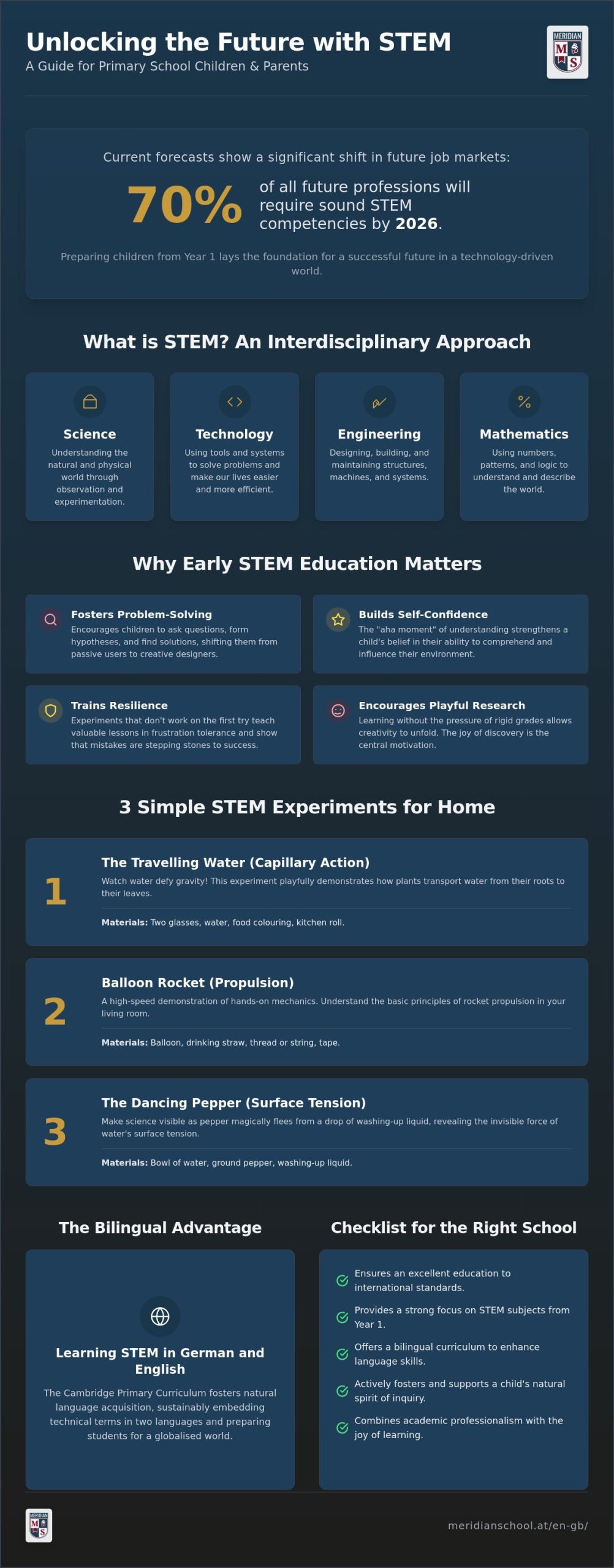
Science and foreign languages complement each other excellently. Through the immersion approach, children learn English not as an isolated subject, but as a living tool for understanding the world. When pupils observe how water freezes or plants grow, technical terms become much more deeply embedded in both languages. An experiment serves as a visual bridge here. You don't have to painstakingly memorise the word "Gravity" when you've just experienced the effect of gravity yourself with the balloon rocket propulsion.
Preparation for a global academic career begins right here. Those who learn to grasp complex matters bilingually from a young age later enjoy a massive head start in their studies or career. For inspiration for additional projects, the STEM experiments from 'Komm, mach MINT' are suitable, specifically tailored for young explorers. In this way, STEM experiments for primary school children become a gateway to a networked world.
At our school, we embrace internationality. We consistently implement the Cambridge Primary Curriculum in Vienna to guarantee the highest global educational standards. In lessons, we fluidly switch between languages. Thus, a science lesson becomes an exciting "Science Lesson". A child intuitively understands the difference between "Solid" and "Liquid" whilst exploring the states of water. These practical STEM experiments for primary school children make language tangible.
Our special STEM focus in primary school goes far beyond mere observation. We directly link classic experimentation with modern IT competence. Children learn not only why an electrical circuit works, but also how to digitally control simple processes. This combination of practical skills and digital understanding optimally prepares them for the challenges of tomorrow.
Would you like to learn more about how we individually support your child's urge to explore? Discover our holistic educational offering and arrange a personal consultation to learn about the benefits of our bilingual education.
As an educational hub, Vienna offers a wealth of opportunities to nurture young people's scientific enthusiasm even outside the classroom. Places like the Technical Museum, the Haus des Meeres (House of the Sea), or the Zoom Children's Museum are ideal excursion destinations to deepen theoretical knowledge through hands-on experience. Nevertheless, the main responsibility for sustainable development lies in choosing the right educational institution. A school should not merely administer knowledge, but provide a protected space for curiosity.
For parents, the question often arises as to how to recognise excellent STEM provision. When choosing a school, pay attention to the following criteria:
The full-day school, in particular, proves to be a decisive advantage here. Complex experimental setups and their subsequent analysis require time and calm to deeply embed the learning process.
The decision for a private school in Vienna often allows for significantly more individual support for pupils. In Döbling, parents find an environment that combines academic professionalism with state-of-the-art facilities. To gain initial impressions even before school starts, our Bilingual Summer Day Camp offers an excellent opportunity to playfully experience initial STEM experiments for primary school children in an international environment.
We warmly invite you to see our innovative educational concept for yourself on-site. All information regarding enrolment at Meridian Private School can be found on our website. Together, we lay the foundation for a successful school career and foster the talents of tomorrow in an atmosphere of appreciation and open-mindedness.
Your child's natural urge to explore is a precious asset that extends far beyond primary school. We have seen how simple experiments in a familiar environment lay the groundwork and why the combination of language and science offers a decisive advantage. A bilingual approach not only trains logical thinking but also opens doors to a globally connected future. It's about developing competencies that make a crucial difference in a technologised world.
Through targeted STEM experiments for primary school children, abstract theory transforms into tangible enthusiasm. As a certified Cambridge International School, we consistently offer bilingual instruction in German and English from Year 1. In our exclusive location in 1190 Vienna, directly on Grinzinger Straße, we create an environment where academic excellence and warm care go hand in hand. We invite you to become part of this innovative educational community.
Register for a school tour now and experience our STEM focus live!
We look forward to personally welcoming you and your little explorer to our school and together laying the foundation for a successful, international school career. Let us jointly transform your child's curiosity into lasting enthusiasm.
STEM experiments are beneficial from kindergarten age and particularly intensely from Year 1 of primary school. During this phase, the natural urge to explore is greatest. Targeted STEM experiments for primary school children utilise this "golden window" to make complex connections playfully comprehensible. It's not about memorising formulae, but about marvelling and gaining an initial understanding of cause and effect, which profoundly shapes cognitive development.
For getting started, absolutely no expensive laboratory equipment is required. Most experiments succeed excellently with ordinary everyday objects such as vinegar, baking powder, empty plastic bottles, or food colouring. More important than the materials is a structured approach and attentive guidance from parents. A small "discovery corner" in the home kitchen is entirely sufficient to safely and sustainably explore the principles of mechanics, chemistry, or biology in your own home.
Bilingual education acts as a visual and practical bridge to language acquisition. Scientific phenomena are experienced directly, whereby technical terms like "Gravity" or "Solid" are intuitively embedded. The child learns English not through an abstract vocabulary book, but as a living tool for understanding the world. This immersion breaks down language barriers and optimally prepares pupils for a later global academic career in technical or scientific professions.
Yes, Vienna has a dense network of support opportunities for innovative educational projects. For example, the NaWi-Netzwerk Wien (Science Network Vienna) offers unbureaucratic funding for material costs up to 250 Euros. Additionally, through the "Talente Regional" (Regional Talents) programme, there are cooperation grants of up to 1,000 Euros for school projects. These initiatives support schools in implementing high-quality STEM experiments for primary school children and sustainably strengthening the spirit of inquiry in the region through professional resources.
Whilst General Studies represents a classic school subject in the Austrian curriculum, the STEM focus forms a cross-curricular pedagogical philosophy. It connects Mathematics, Informatics, Natural Sciences, and Technology into a logical unit. A modern STEM focus also integrates international standards such as the Cambridge Primary Curriculum and specifically fosters IT competence from the first year of school. It moves away from merely consuming knowledge towards process-oriented problem-solving and hands-on creation.