Did you know that your child's brain during primary school works like a high-performance processor, handling far more than just simple vocabulary? Many parents in Vienna understandably worry whether the additional burden of a foreign language might lead to overwhelm or if German language skills could suffer. However, the scientific reality is different: the significant benefits of bilingual education are evident in markedly increased cognitive flexibility and pronounced social empathy. This isn't about mere pressure to perform, but about creating an international foundation in a trusting environment.
In this article, you will discover how the targeted combination of the Austrian curriculum and the globally esteemed Cambridge Primary Curriculum sustainably fosters your child's development. We provide reassurance regarding long-term educational opportunities and explain why early exposure to English in subjects like Maths or General Studies supports natural knowledge acquisition. Discover how a modern STEM focus and a structured daily routine lay the foundation for a global future, without neglecting local identity.
Bilingual education means far more than just an additional language on the timetable. In modern pedagogy, we understand it as subject-specific teaching in two languages, where English is not merely a laborious vocabulary list, but an active tool for subjects like Maths or General Studies. The cognitive benefits of bilingualism are scientifically well-founded. Children who learn in two languages develop higher cognitive flexibility and pronounced abstract thinking skills. As the brain constantly has to choose between two systems and filter out irrelevant language stimuli, concentration often improves quite naturally in daily school life.
To better understand this concept and the associated pedagogical approaches, watch this helpful video:
A crucial aspect is the early development of metalinguistics. Pupils grasp more quickly how language itself works. They recognise patterns and structures, which gives them a massive advantage later when learning further foreign languages. The significant benefits of bilingual education therefore lie not only in vocabulary, but in the fundamental architecture of thinking.
In primary school, a special window of opportunity opens. Up to the age of ten, the so-called "Window of Opportunity" for accent-free language acquisition is wide open. Children at this age learn playfully and without the typical speaking inhibitions that often only appear in older pupils. By starting early from the first school year, they build a natural language identity. English thus becomes a firm part of their personality, without German language skills suffering. The comprehensive educational programme of a specialised primary school ensures that both languages grow harmoniously side by side.
In addition to cognitive excellence, this approach fosters social empathy. Through constantly switching between languages, children automatically learn to adopt different cultural perspectives. This is a key qualification for our society. You are thus preparing your child for a connected world, where cultural openness and linguistic confidence form the basis for any successful career.
Bilingual education in primary school does not work through the laborious memorisation of vocabulary lists. It is, rather, a constant immersion in a "language bath". In this environment, English serves as a completely natural tool for understanding the world. Children do not learn the language as an isolated subject, but actively use it to solve everyday tasks or in General Studies. The benefits of bilingual education unfold precisely in this naturalness: the language is absorbed unconsciously and "breathed in" through daily interaction.
A central pillar of this success is the "Total Physical Response" method. Here, pupils directly link linguistic content with physical actions. When the Native Speaker gives an instruction, it is supported by facial expressions and appropriate gestures. This creates strong neural connections in the brain that go far beyond purely auditory learning. Native Speakers do not act as traditional language teachers, but as authentic reference figures who exemplify a living language culture. Studies prove that this emotional bond massively accelerates learning success, as highlighted by the US Department of Education regarding the benefits of bilingualism in its publications.
Despite the strong focus on English as a global language, first language proficiency remains the foundation. We consistently follow the Austrian primary school curriculum and ensure that children achieve excellent results in both languages. To avoid language mixing, we rely on a clear separation based on the "one person, one language" principle. This way, children instinctively know which language to communicate in. This guarantees that German language skills are precisely and confidently developed, whilst English grows in parallel as a second mother tongue. If you would like to know more about how we manage this pedagogical balancing act, take a look at our bilingual programme in Vienna.
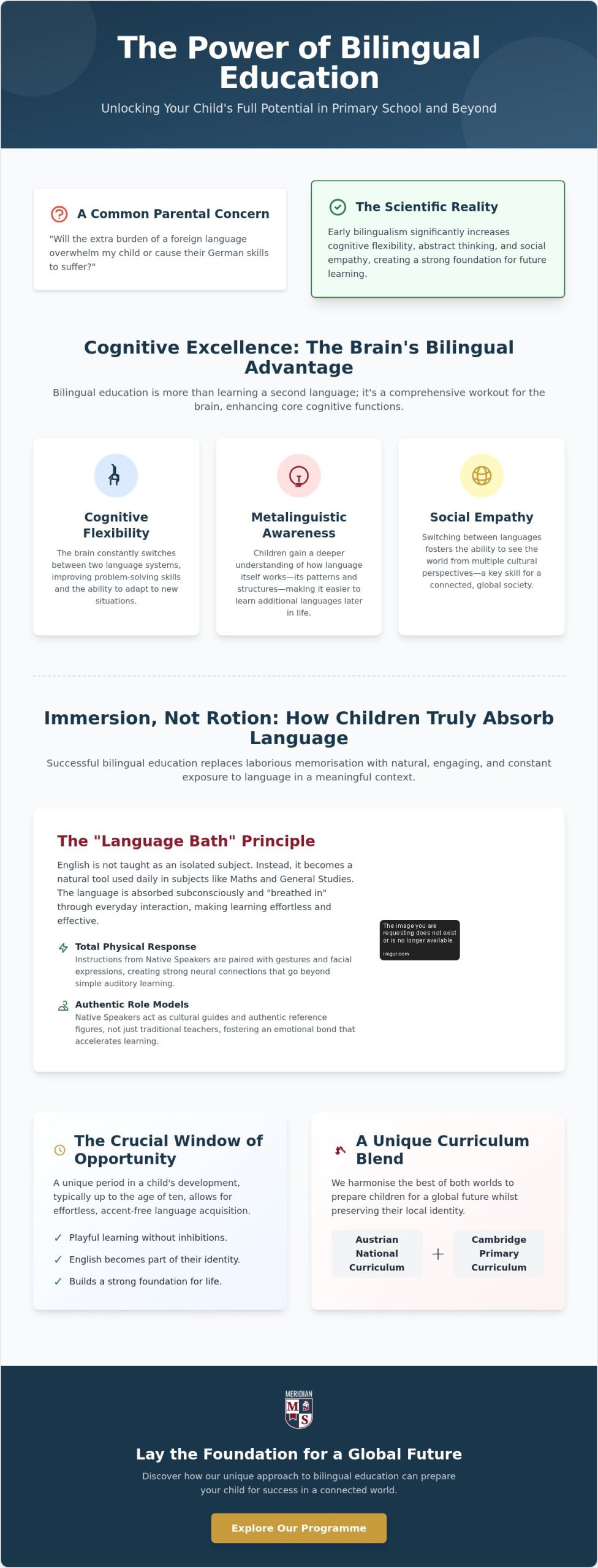
The combination of the Austrian curriculum with internationally recognised standards creates an educational environment that goes far beyond the conventional. In Vienna, we rely on the renowned Cambridge Primary Curriculum, which is considered the gold standard worldwide in over 10,000 schools across 160 countries. Here, the benefits of bilingual education become particularly clear: children not only acquire language skills but also develop a global identity. UCLA research on bilingual education impressively demonstrates that such programmes massively strengthen academic performance and socio-cultural competence.
By integrating global standards, we specifically foster critical thinking and problem-solving skills. International certifications serve as the first important milestones in your child's academic career. It's not just about consuming knowledge, but about questioning and applying it in a global context. English acts as a bridge to scientific findings, which are often first published in this language.
In STEM subjects (Science, Technology, Engineering, and Mathematics), English is the undisputed lingua franca. When children already experiment and research in primary school, whilst naturally using the corresponding technical terms in English, they lay the foundation for a career in modern research. In Austria, there are already 892 STEM-certified educational institutions, which underlines the high importance of this area. Our specific STEM focus in primary school uses this spirit of inquiry to convey complex content playfully and bilingually.
An excellent education also encompasses the creative and physical aspects of development. Additional musical and sports activities deepen language practice in a relaxed setting. Whether singing together or playing sports during break time; children use English intuitively. The structure of a private full-day school offers the ideal timeframe to consolidate bilingual competencies without time pressure. Would you like to learn more about how we connect these areas? Find out everything about our comprehensive educational programme in Vienna here.
The decision for the right primary school shapes your child's educational path sustainably. In Vienna, there is a multitude of options, but the quality often only becomes apparent upon closer inspection. A crucial factor is the qualification of the teaching staff. It makes a noticeable difference whether English is taught by conventional language teachers or by Native Speakers who act as authentic reference figures. The benefits of bilingual education only fully come into play when the balance between German and English on the timetable is precisely calibrated. This ensures that the first language is consolidated, whilst the second language grows quite naturally.
Transparency is another core criterion. Look for clear information on the enrolment processes and open communication regarding monthly fees. The school's location also plays a role in daily life. A location in green 1190 Vienna, for example in Grinzinger Straße, offers a calm learning environment away from the hectic city. This creates a stable atmosphere where children can feel secure and work with concentration.
Look for clear quality seals. Accreditation as a "Cambridge International School" guarantees that the education meets global standards. In such schools, individual support is often the focus. Small groups enable teachers to specifically address the strengths of each individual child, instead of teaching in anonymous large classes. For details on deadlines and the enrolment process, you can find all information on registration and dates here.
Nothing replaces a personal impression on site. A visit to an open day offers you the chance to view the premises and meet the team. A personal conversation with the school management is the best way to clarify individual questions. Since admission interviews for the 2026/2027 school year usually take place in January 2026, it is advisable to make contact in autumn 2025. For comprehensive guidance on the Vienna school system, also use our Guide to School Choice 2026.
The decision for a bilingual education is a valuable investment in your child's cognitive agility and social competence. As we have seen, the benefits of bilingual education go far beyond merely learning vocabulary; they create a flexible framework for thinking and prepare for a globalised world. By combining the Austrian curriculum with international standards such as the Cambridge Primary Curriculum, your child receives the best of both worlds.
At Meridian Private School in the heart of Döbling, we accompany this journey in a family-like atmosphere. With our STEM focus from the first year and our status as a certified Cambridge International School, we offer an excellent foundation for academic future. Secure a place for your child for the 2026 school year at Meridian Private School and together with us, lay the groundwork for a successful, open-minded career. We look forward to supporting your child in discovering the world.
No, bilingual education in primary school generally does not overwhelm children, as it is based on the principle of immersion. Children absorb the language playfully and without pressure to perform, similar to acquiring their mother tongue. Statistics show that approximately 80% of children at international schools start without native English proficiency and develop considerable language competence within just a few months. The structured daily routine and support from Native Speakers provide pupils with the necessary security.
The concern that the first language will be neglected is unfounded, as we consistently implement the Austrian primary school curriculum. The benefits of bilingual education even manifest in a sharpened perception of linguistic structures, which can promote spelling in both languages. Through the clear separation of languages in lessons, mixing is prevented, so children develop precise expression in both German and English.
No, it is absolutely not necessary for parents to have perfect English skills. The responsibility for language acquisition lies entirely with the school and its qualified educators and Native Speakers. At home, the language in which the family feels most comfortable should be spoken, to provide a stable emotional foundation. The school also communicates all important organisational matters transparently, so no barriers arise for parents.
The main difference lies in the sponsorship, group size, and curriculum. Whilst the VBS programme is a public offering by the City of Vienna, private schools often offer exclusive additional qualifications such as the Cambridge Primary Curriculum. Private institutions are also characterised by smaller groups and more individualised support. Furthermore, admission to public VBS places is often tied to a strict selection process and early deadlines in January.
The costs for a private bilingual primary school vary depending on the provider and the extent of included additional services. In Vienna, these contributions usually cover specialised instruction by Native Speakers, international certifications, and comprehensive full-day care. Since each institution sets individual priorities, a personal consultation is the best way to gain clarity about the investment in your child's future.