Did you know that the ability to confidently solve complex problems often has less to do with dry arithmetic tasks and much more with the structure of our everyday language? Many parents in Vienna are rightly concerned today that valuable talents in STEM subjects remain undiscovered in traditional classroom teaching, or that children fall behind early due to rigid learning methods. It is absolutely understandable that you are looking for a learning environment for your child that combines academic excellence with warm, individual support.
In this article, you will learn how the targeted nurturing of logical thinking in primary school children is sustainably strengthened through the combination of bilingual approaches and innovative STEM education. We will show you how international standards and modern educational concepts interlink to optimally prepare your child for the demands of tomorrow. We will guide you through the fascinating synergy between multilingualism and analytical reasoning, and provide you with clear guidance for choosing the right school in the 19th district for the year 2026.
Logical thinking is far more than just the ability to solve arithmetic problems. It describes the competence to recognise patterns in complex information, understand connections, and draw logical conclusions from them. The formal study of correct reasoning clarifies that this cognitive basis is crucial for maintaining an overview in a data-rich world. In primary school, this structure forms the essential foundation for later success in mathematics and the natural sciences.
In 2026, the world is more interconnected than ever. Problem-solving competence is now considered the most important core skill of the 21st century. The targeted nurturing of logical thinking in primary school children prepares children to view complex challenges not as obstacles, but as solvable tasks. There is a direct link between the ability to concentrate, a high memory capacity, and structured thinking. A child who learns to organise their thoughts logically will also keep a cool head in demanding situations.
To better understand the importance of focus and attention for these cognitive processes, watch this helpful video:
In educational practice, we distinguish two essential paths to knowledge. With inductive thinking, children infer general rules from observed individual cases. For example, they notice that various plants in the school garden need water to grow, and from this, they derive a general principle. Deductive thinking works in reverse: here, children apply already known, general rules to a new, specific situation. Logical thinking is defined here as the indispensable foundation for critical questioning and independent judgment, as it allows children to check information for its plausibility.
Children of primary school age possess a natural urge to understand the world. This constant "why-questioning" is not merely a sign of curiosity, but the first step towards active problem-solving. A structured learning environment, as provided by the Austrian curriculum, massively supports the brain in meaningfully organising incoming information. When schools in Vienna offer a clear, reliable framework, it becomes easier for children to set cognitive anchors. This not only fosters understanding of STEM subjects but also strengthens self-confidence in their own intellectual capabilities.
Bilingual education is far more than just vocabulary training. When primary school children fluently switch between German and English, they unconsciously train their cognitive flexibility. This mental switch strengthens the ability to view information from different perspectives and grasp complex rules at lightning speed. It is precisely this flexibility that later provides the decisive advantage when solving challenging mathematical equations or scientific puzzles.
The synergy effects between language and logic are remarkable. Anyone who learns that a thought can be expressed in two completely different language systems develops a deeper understanding of abstract structures. The STEM focus in primary school serves as an ideal training ground for applying logical chains in practice. In projects that playfully combine mathematics and technology, logic becomes tangible and understandable for children.
An internationally oriented curriculum provides the necessary framework for this cognitive development. The Cambridge Primary Curriculum consistently focuses on inquiry-based learning. Children are encouraged to formulate their own hypotheses and test them through small experiments. This scientific approach is an excellent way of nurturing logical thinking in primary school children, as it places the process of comprehension at its core. It is not about memorising facts, but about understanding the underlying mechanisms.
Grammar rules are essentially mathematical patterns. When children compare sentence structure in English with that in German, they unconsciously analyse systems. This constant comparison massively promotes abstract thinking and sharpens attention to detail. It is fascinating to observe how bilingual pupils often recognise logical errors more quickly because they have a finer sense for structural inconsistencies. For parents looking for ways to exploit this potential, there are many practical methods for nurturing logic that go far beyond traditional teaching.
Take a look at our versatile educational programme to see how we utilise these synergies in daily school life for your child's individual development.
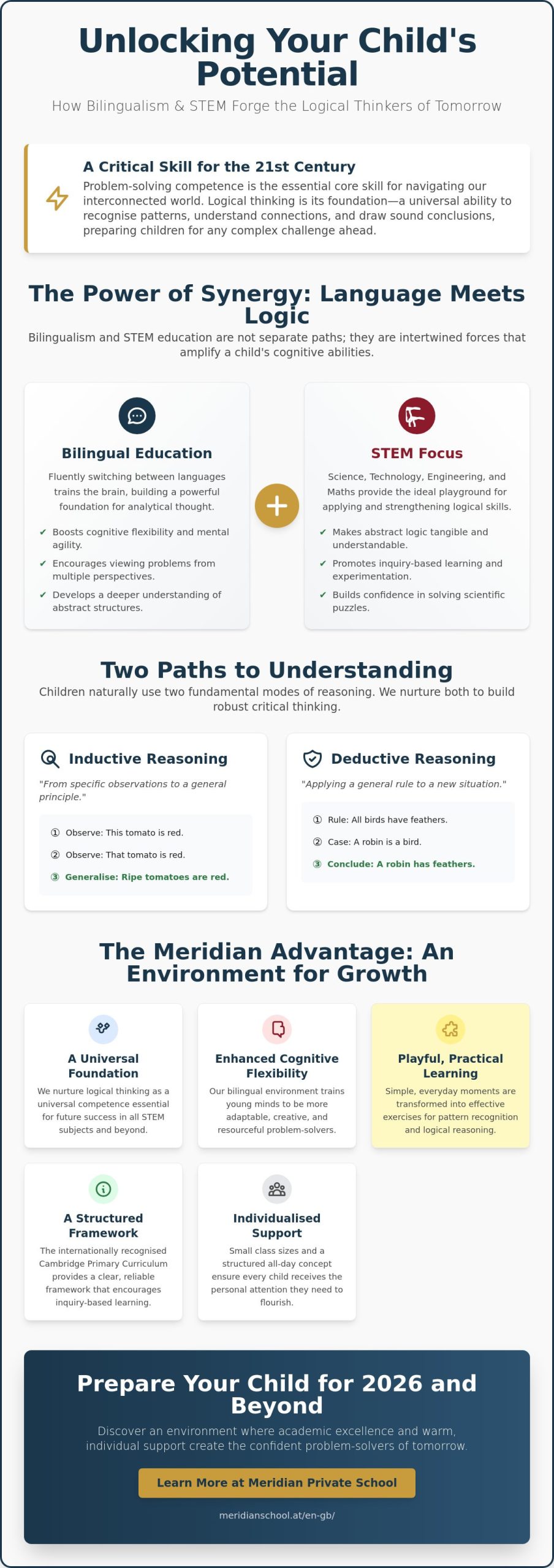
Logic doesn't just begin when you open a schoolbook. Everyday life offers countless opportunities to playfully train the brain. Simple sorting games are an excellent starting point. Let your child help with unpacking the shopping: the tomatoes are sorted by size, the bread rolls counted, and the quark pots arranged by their expiry date. Such small tasks are an effective way of nurturing logical thinking in primary school children, as they teach the recognition of categories and hierarchies.
Strategic board games or tricky puzzles demand forward-thinking action. A special highlight for children are analogue coding games. Give clear commands to safely navigate a "human machine" over the stairs. This trains understanding of precise instructions and logical sequences. Don't forget the basics: a healthy snack is the fuel for these cognitive peak performances and ensures the necessary concentration.
When cooking classic Austrian dishes together, mathematics comes alive. How many apples do we need for the strudel? Estimating quantities and precise weighing foster a sense of proportion. Recipes are essentially algorithms: if the sequence of steps is not logically followed, the dish will not succeed. This understanding of cause and effect is essential for cognitive development.
In 2026, tablets are part of everyday life, but tactile comprehension should take precedence in primary school. Experiments that can be touched embed knowledge deeper in memory than pure screen time. The ideal balance lies in collaborative tinkering. While an app can offer a quick logic puzzle now and then, solving a tricky task in a group also promotes social competence and the exchange of problem-solving strategies.
Learn more about our holistic educational programme and how we integrate these practical methods into daily lessons.
Choosing the right educational institution is a decision for your child's future. In our private primary school in 1190 Vienna, we create an environment that combines academic excellence with a warm atmosphere. Through small class sizes, we ensure that every child receives the attention they need for their individual development. Within this protected framework, the nurturing of logical thinking in primary school children is not just taught as a subject, but lived as an interdisciplinary principle.
Our concept as an all-day school offers a decisive advantage: time. While the morning is dedicated to the structured acquisition of basic competencies, the afternoon provides space for in-depth logic projects. Here, children can tinker with complex tasks without time pressure and strengthen their problem-solving skills in a group. To balance intensive cognitive work, we integrate additional musical and sports activities that refresh the mind and promote holistic development. A detailed overview can be found in the educational programme of Meridian School.
We integrate experiments and logical challenges directly into bilingual lessons. When children explore scientific phenomena in English and German, they not only consolidate their language comprehension but also their analytical skills. This interdisciplinary focus on the nurturing of logical thinking in primary school children ensures that abstraction becomes child's play. It lays a strong foundation that massively facilitates the transition to secondary schools.
We prepare our pupils to understand complex systems and act confidently. Interested parents are warmly invited to learn about the modalities for registration and admission to our institution. Together, we lay the foundation for an international identity and a successful academic career in a globalised world.
Logical thinking is not a random product, but the result of a stimulating learning environment that transforms curiosity into structured insights. We have seen how the targeted combination of multilingualism and STEM focuses sustainably increases cognitive flexibility. Whether through tactile comprehension in everyday life or inquiry-based learning according to international standards: the nurturing of logical thinking in primary school children is best achieved where children have the space and time to grasp the world in its complexity.
As a certified Cambridge International School, we offer your child precisely this excellent foundation from the first school year. Our bilingual all-day teaching in Vienna 1190 ensures that talents are not only discovered but also individually nurtured. We invite you to become part of our open-minded school community and entrust your child's cognitive development to professional hands. Trust in an education that combines local stability with a global outlook and optimally prepares your child for the challenges of tomorrow. We look forward to accompanying your child on this exciting journey.
Secure your child a place for a bilingual future – enrol now!
The targeted nurturing ideally begins in pre-school age, but becomes essential with entry into the first school year. At this developmental stage, children begin to recognise abstract patterns and understand complex cause-and-effect principles. A structured introduction in primary school helps to sustainably consolidate the cognitive foundations for later success in STEM subjects.
Classic strategy games like chess or tactile building games are excellently suited for training forward planning. Simple sorting games in everyday life, such as arranging tomatoes by ripeness or bread rolls by size, also train analytical reasoning. We also recommend puzzles that require logical conclusions to playfully increase mental endurance without performance pressure.
Learning a second language like English massively promotes cognitive flexibility, as the brain constantly switches between different rule systems. This mental process is a central aspect of nurturing logical thinking in primary school children, as bilingual children learn to analyse information from different perspectives. The grammar of both languages acts as a logical framework that sharpens abstract thinking.
Yes, analogue methods are often more effective in primary school than purely digital applications, as tactile comprehension demands more from the brain. Hands-on experiments or navigating a person over stairs using precise verbal commands (analogue coding) embed logical sequences deeply in memory. This physical interaction helps children to literally grasp complex connections before applying them on screen.
Patience and individual educational support are crucial for learning success in this case. It often helps to break down complex tasks into very small, manageable sub-steps and to use visual aids for illustration. In a school environment with small class sizes, teachers can specifically address these hurdles to avoid frustration and strengthen self-confidence in one's own thinking ability.