What if the first day of school for your prospective primary school starter wasn't a cause for concern, but a celebration of curiosity? Many parents approach the start of school with mixed feelings, especially if their child cries at the sight of their school bag or complains of a tummy ache. These emotional hurdles must be taken seriously, as current data, such as the “German School Barometer 25/26”, shows that 25% of pupils already suffer from psychological stress. To successfully address the issue of easing school anxiety child 6 years old, sensitive guidance that focuses on the child's individual developmental stage is required.
You undoubtedly share the desire for your child to navigate this new chapter of life with confidence and security. In this article, you will learn how to decipher your child's underlying worries and restore their natural joy of learning with tried-and-tested strategies. We will provide an overview of helpful preparation rituals and demonstrate how modern, bilingual educational concepts in Vienna 1190 minimise academic pressure. This way, you can transform initial uncertainty into genuine anticipation for an international future.
The transition from nursery to primary school marks the first significant upheaval in many 6-year-olds' lives. It is a completely natural reaction for this change to trigger uncertainty. Whilst nursery focused on free play and social interaction, a structured daily routine with fixed lesson times now awaits the young primary school starters. In Austria, the concept of “school readiness” is centrally embedded, but this is often mistakenly equated with pure academic ability. When parents try to address the issue of easing school anxiety child 6 years old, they quickly realise that pressure is counterproductive here. It blocks natural curiosity and transforms the acquisition of knowledge into a stressful situation.
To better understand this concept of children's worries, watch this helpful video:
There is a subtle difference between healthy excitement for a new adventure and distressing fear of the unknown. If the worry becomes so great that the child completely refuses to attend school, experts in clinical discourse often refer to it as School refusal. For children starting school, however, it is usually a temporary reaction to separation from their familiar environment. A modern educational setting, such as that offered by a private primary school in Vienna 1190, specifically addresses these anxieties through individual support and a warm atmosphere.
Children aged six often do not articulate their worries directly. Instead, the stress frequently manifests through physical symptoms. Many complain of tummy aches or headaches, especially in the evening before falling asleep. Behavioural changes are also classic warning signs. Your child may suddenly become extremely clingy, display unexpected tantrums, or revert to toddler-like patterns you thought they had long outgrown. Pay attention to verbal cues such as a clear “I don't want to go there” or constant questions about “why”, which indicate deep insecurity.
How do you tell if your child is merely positively excited or genuinely distressed? An excited child asks many questions, perhaps repacks their school bag several times, and wants to know everything about the new routine. Here, curiosity predominates. With genuine fear, however, withdrawal or crying dominates. In this phase, empathy is your most important tool. Phrases like “I understand that this is all new and perhaps a bit daunting for you” work wonders. Avoid clichés like “Don't be scared”, as these invalidate the child's feelings. Instead, validate their emotions to create a stable foundation for starting school.
To sustainably address easing school anxiety child 6 years old, precise research into the causes is essential. Often, various factors combine to create a diffuse unease. Separation anxiety is usually at the forefront. After years of intensive care in a family environment or small nursery groups, the large school building can seem a bit intimidating. The child unconsciously wonders whether their parents will really come back or if they will cope alone in the new environment. Added to this is the uncertainty about the routines. What happens behind the closed classroom door? This “black box” of school creates a feeling of loss of control for many six-year-olds.
In Austria, starting school often marks the beginning of serious life, which is further fuelled by the traditional grading system. The worry of not being able to keep up with other children in reading or writing runs deep. Whilst state schools are often bound by rigid assessment criteria, private educational institutions focus on holistic documentation of learning progress. This avoidance of early academic pressure helps to preserve natural curiosity. If your child would like to get a little taste of school life beforehand, a bilingual pre-school course offers the ideal opportunity to playfully get to know the structures.
The social component is often the biggest hurdle for 6-year-olds. Getting lost in a class of 25 or more children causes particular concern for sensitive characters. Will I make friends? Will the other children like me? These questions intensely occupy the little ones. Large groups require a high degree of social adaptation, which some children at this age still find overwhelming. Small class sizes and a family-like atmosphere are often the crucial key here. They enable educators to respond to each child individually and actively shape a supportive group dynamic from the outset. This way, school is perceived not as an anonymous system, but as a safe social space.
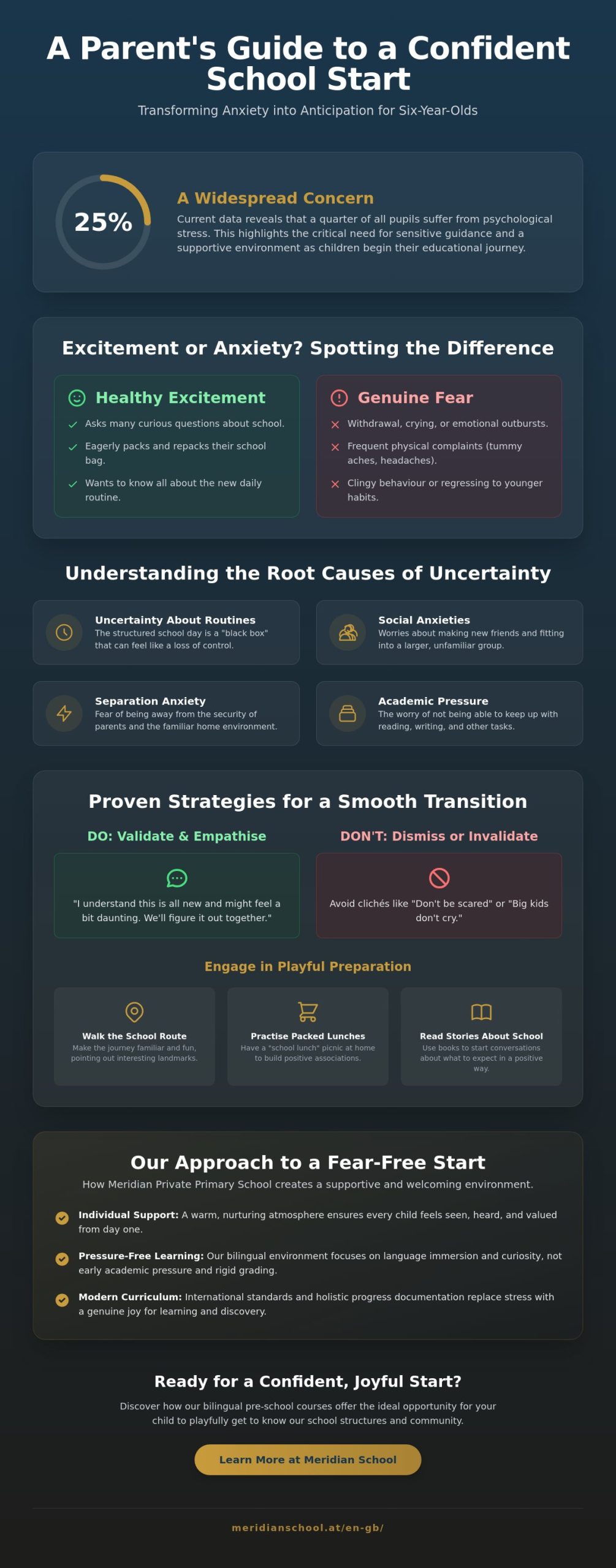
To effectively implement easing school anxiety child 6 years old, it helps to replace the unknown with familiarity. Start in the summer by walking the school route together several times. Don't just go to the building, but right up to the school steps. This way, the route becomes routine and loses its intimidating character. Another practical exercise is “packed lunch practice”. Prepare a healthy packed lunch together, such as a wholemeal roll with tomatoes or a bit of fruit, and let your child practise opening and closing the lunchbox. Such small successes greatly boost self-confidence for everyday life in the classroom.
Use positive narratives to actively shape the image of school. There are wonderful books that portray school as an exciting adventure, where friendships and discoveries are central. If you want to make the environment even more familiar, a bilingual pre-school course offers the perfect opportunity. Here, children get to know the building, the educators, and initial routines in a protected setting before actual lessons begin. This reduces pressure and transforms uncertainty into genuine anticipation.
Structure provides security. A proven method is to pack the school bag together the evening before and lay out clothes for the next day. This avoids morning rush and creates a calm start to the day. A “courage-boosting ritual” can also offer emotional support. A small, smooth stone in their pocket or a family photo in the side pocket of their school bag acts as an invisible anchor. If homesickness briefly becomes overwhelming, this small item gives the child the feeling of not being alone.
Foster natural curiosity by casually integrating letters and numbers into everyday life. Let your child count the number of bread rolls whilst shopping or decipher the label on the quark packet whilst cooking. This way, knowledge is perceived not as a burden, but as a useful tool. This playful approach without academic pressure is essential to maintain the joy of learning in the long term. For further details, take a look at our guide for a relaxed school start.
Discover more about the individual support and warm atmosphere in our educational offerings, which are specifically designed to enable every primary school starter to have an anxiety-free start.
Choosing the right educational institution is often the decisive lever for successfully completing the process of easing school anxiety child 6 years old. At Meridian Private Primary School in Vienna 1190, we create an environment that goes far beyond traditional classroom teaching. Small group sizes guarantee a family-like atmosphere where no child gets lost in anonymity. This social security forms the foundation for confident primary school starters who perceive their new environment as a safe haven. A structured daily routine provides the necessary consistency whilst also allowing space for sporting and musical development.
A central aspect of our concept is the bilingual approach based on the immersion principle. From the first year, children naturally immerse themselves in the English language, without any rote vocabulary learning or rigid exams. This playful acquisition of knowledge lowers inhibitions and massively boosts self-confidence. This is complemented by the Cambridge Primary Curriculum, which combines international excellence with the Austrian curriculum. This combination positions Meridian Private Primary School as a pioneer in the region and prepares pupils for a global future. Discover more about our educational offerings.
Self-esteem is strengthened through targeted STEM focuses and social projects that prioritise individual development. When children experience that they can solve complex tasks independently, the worry about new academic demands diminishes. Mutual support within the group prevents social exclusion and builds bridges between pupils. We see ourselves as a reliable partner for parents, accompanying this stage of life harmoniously and structurally. If you want your child to be in an environment that combines innovation and warmth, find out about school admissions in Vienna.
The transition to primary school marks a significant emotional phase that requires security and clear structures from both parents and the child. We have highlighted the importance of identifying the individual causes of insecurity and playfully preparing for daily life through targeted rituals. By taking these steps, you can sustainably foster easing school anxiety child 6 years old and your child's natural curiosity. A supportive environment that respects the personal developmental rhythm forms the foundation for a successful school career.
At the Meridian Private Primary School, we combine local stability with a global horizon. As a certified Cambridge International School, we guarantee the highest academic quality, whilst our bilingual teaching from the 1st year playfully breaks down language barriers. Through individual support in small groups, we ensure that every primary school starter receives the attention they need for a confident start.
Are you ready to take the next step with us? Visit us at Meridian Private Primary School and meet our team! We look forward to welcoming you and your child to our community in Vienna 1190 and together laying the foundation for an open-minded, self-assured future.
Remain calm and validate your child's feelings without questioning the necessity of attending school. A brief, loving farewell ritual at the school door provides security; prolonged hesitation, however, usually intensifies separation anxiety. Tell your child a specific time for reunion, for example, directly after their packed lunch or sports lesson. This reliability is a central building block for sustainably addressing the issue of easing school anxiety child 6 years old.
Explain the routines factually and positively, focusing on discoveries and new friendships. Use concrete examples such as having packed lunch together or doing gymnastics in the gym to make the unknown tangible. Avoid portraying school as “the seriousness of life”. Instead, the joy of acquiring knowledge should be paramount, with bilingual projects or STEM activities presented as exciting adventures.
A change of school can be a sensible solution if the current environment does not permanently meet the child's emotional needs. If rigid structures or overly large groups chronically intensify anxiety, a move to a private primary school with a family-like atmosphere often offers the necessary fresh start. In an environment with individual support and small groups, sensitive children usually find the courage to engage with lessons again more quickly.
The decision for a private primary school is often crucial, as smaller class sizes and more intensive educational support are usually realised there. Whilst state schools are often bound by strict administrative requirements, private institutions in Vienna 1190 offer more flexible, child-friendly concepts such as the Cambridge Primary Curriculum. For children with pronounced insecurity, this protected environment can make a decisive difference in proactively addressing easing school anxiety child 6 years old.
Such complementary medicine approaches can be supportive as a complementary ritual, but they by no means replace a pedagogical or psychological clarification of the causes. Their effectiveness often relies on the calming attention provided by parents during administration. Far more important than drops is a stable, anxiety-free environment and professional guidance from competent educators. If the distress persists, a discussion with the school management should always be sought to find structural solutions in daily school life.