What if primary school didn't just test knowledge, but empowered your child to independently shape the world of tomorrow? In an era where rigid frontal lectures often overlook the needs of the youngest, it's becoming increasingly important to understand foster learning competence primary school Vienna as a holistic concept. Many parents in the 19th district rightly worry that their children will get lost in large classes or won't be adequately prepared for a globalised future. The desire for individual support rather than mere mass processing is a top priority for many families.
You know best that a child who learns with joy has the best prerequisites for later life. In this article, you'll discover how modern educational concepts and consistent bilingualism sustainably strengthen your child's learning competence in Vienna. We provide you with a well-founded insight into how the combination of the Austrian curriculum and the Cambridge Primary Curriculum creates confidence when choosing the right private school. Discover how innovative STEM focuses and an emphasis on social skills pave the way for world-class education by 2026 and optimally prepare your child for an international career.
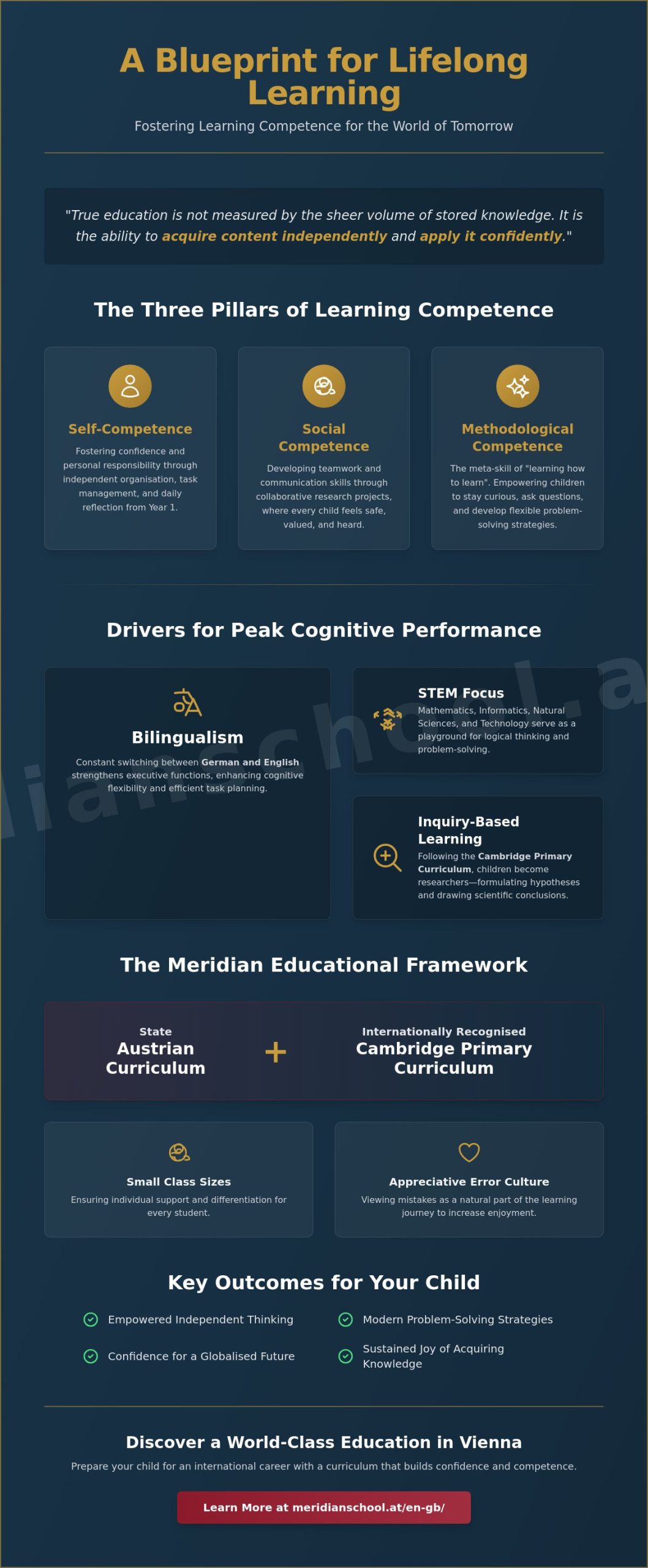
True education in 2026 is no longer measured by the sheer volume of stored knowledge. In a digitalised world, information is accessible at any time. The crucial definition of learning competence therefore primarily encompasses the ability to acquire content independently and apply it confidently. When we set foster learning competence primary school Vienna as our goal, we lay the foundation for lifelong, joyful learning. Primary school offers the ideal window for this. Here, children develop methodological competence that goes far beyond mere subject knowledge. It's a kind of meta-competence. Those who learn how to learn remain flexible. Curiosity is the most important driver. Asking questions and exploring backgrounds is far more valuable than mechanically reproducing answers.
To see this pedagogical understanding in a Viennese school context, the following video offers interesting insights:
Even school starters can learn to organise their morning and tasks independently. This self-structuring fosters confidence in their own abilities. A central element is daily reflection. Children pause briefly and ask themselves: What have I achieved today? Which path led me to my goal? This process transforms passive reception into active creation. Our educational programme supports this development through clear structures and freedom for individual pace.
Learning is not a solitary process. In interdisciplinary projects, pupils experience how teamwork enriches their own understanding. When children work together on a research question, they automatically train their communication skills. They learn to advocate for viewpoints and to compromise. Fostering learning competence primary school Vienna also means understanding conflict resolution as a natural part of knowledge acquisition. This creates an atmosphere where every child feels safe and valued. Knowledge thus becomes a shared discovery.
Those who use two languages simultaneously train their brain in a very special way. The constant switching between German and English strengthens what are known as executive functions. These cognitive control processes help to filter information and plan tasks efficiently. It's a mental high-performance sport. In practice, this flexibility plays a central role when we foster learning competence primary school Vienna. It's not just about vocabulary. It's about connecting complex thought structures.
The STEM subjects of Mathematics, Informatics, Natural Sciences, and Technology serve as an ideal playground. Here, children learn early on to form logical chains and break down problems into manageable sub-steps. These strategies can later be transferred to all areas of life. In Vienna, we specifically rely on such methods to elevate foster learning competence primary school Vienna to a new level. Digital learning also has a firm place with us. We consistently use tablets as research tools to find answers to exciting questions. Those who remain curious will find helpful tips from the school psychology service on the topic of learning success on the relevant authorities' website.
A key feature of our concept is the Cambridge Primary Curriculum. It consistently focuses on inquiry-based learning. This means children become little researchers. Instead of being spoon-fed results, they conduct their own experiments. They formulate hypotheses and draw scientific conclusions from them. This massively promotes critical thinking. A child who understands why a physical process occurs doesn't have to memorise the formula. They have grasped it.
Abstract thinking often begins with the hands. In STEM promotion, we place great emphasis on haptic experiences. When pupils build geometric solids or observe chemical reactions, knowledge becomes tangible. This physical component is crucial for the later transition to more complex mathematical models. Learn more about why a STEM focus in primary school lays the groundwork for a successful educational career. It is the first step towards world-class education.
Would you like to see how your child benefits from this international environment? Take a look at our comprehensive educational programme in the 19th district.
Learning competence isn't a switch you simply flick in the classroom. Fostering learning competence primary school Vienna is best achieved when school and home work together. A prepared environment is the basis for concentrated work. Ensure a fixed place for studying, but don't forget about the snack. The brain needs high-quality energy. A fresh quark pastry or fruit provides more sustained energy than sugary snacks. Equally important are conscious breaks. Only those who switch off occasionally can store what they've learned in long-term memory.
A crucial factor for long-term success is the error culture. We encourage children to view "wrong" answers as valuable milestones in the learning process. Whoever makes a mistake has gained new information. This takes the pressure off homework. Homework should be understood as an opportunity for self-organisation, not as a stress factor for the whole family. When your child learns to pack their school bag themselves and organise tasks, their personal responsibility grows. That this holistic approach bears fruit is also proven by a study on bilingual education, which shows that multilingualism measurably increases performance in all core subjects, including mathematics.
The transition from kindergarten to primary school is a major milestone. Whether the start is in January or at the traditional time in September: prepare your child gently. Visit the new environment together and awaken anticipation for collaborative exploration. Helpful details for a relaxed transition can be found in our School Start Vienna 2026 Guide.
Bilingualism doesn't have to mean performance pressure at home. Integrate English playfully into everyday life. Watch a short film together in its original language or visit the library for English children's books. This strengthens reading competence in both languages and makes the foreign language a natural part of their world. For a gentle introduction to this world, our bilingual pre-school course is ideal.
Would you like to take the next step for your child's education? Secure a place now and use the online registration for our primary school in the 19th district.
In Grinzinger Straße, in the heart of Döbling, we put the vision of future-oriented education into practice daily. Anyone who takes foster learning competence primary school Vienna seriously as an educational mission must view the entire school day as a unit. The Meridian Private Primary School is based on a full-day school concept with a structured daily routine. This means that phases of intense academic concentration organically alternate with phases of relaxation and creative development. This natural flow prevents overstimulation and ensures that children's natural curiosity is maintained until the afternoon.
A decisive advantage for your child's development is our small class sizes. They form the foundation for genuine differentiation, which often falls by the wayside in large systems. Every child is supported exactly where they are in their development. Music and sport are not mere time-fillers for us, but an essential balance to intellectual work. We place great importance on a close partnership with parents. In regular feedback discussions, we jointly discuss individual competence development, so that you always have a clear picture of your child's progress and talents. In this way, we create an atmosphere of consistency and trust.
The decision for multilingual education from Year 1 opens doors to global careers in the long term. Our pupils are optimally prepared for the transition to secondary international or renowned local schools through the combination of the Austrian curriculum and international standards. Learn in our detailed article why a bilingual school in Vienna is the best choice for primary school in 2026.
We warmly invite you to get a personal impression of our welcoming atmosphere in Döbling. An on-site visit is the best opportunity to get to know the school day and our team. All information regarding school registration, as well as the option to arrange an individual viewing appointment, can be found on our website. We look forward to accompanying you and your child on the path to world-class education.
Fostering personal responsibility and learning effective methods are the most valuable gifts you can give your child for their school career. As we have seen, bilingual approaches and a strong STEM focus form the cognitive foundations that extend far beyond primary school age. Those who understand foster learning competence primary school Vienna as a holistic concept create the basis for success in a globally connected world.
At the Meridian Private Primary School, we combine this modern pedagogy with a warm, family-like atmosphere in the 19th district. As a certified Cambridge International School with the STEM Quality Seal, we offer your child the space to develop their talents individually and without time pressure. A structured, rhythmic day ensures that the joy of discovery is always at the forefront and that overstimulation does not even arise.
Would you like to learn more about our path to world-class education? Arrange a consultation appointment for school registration 2026 now and lay the foundation for a successful future. We look forward to welcoming you and your child to Döbling soon and taking the first steps together into a lifelong learning adventure.
Learning competence refers to the ability to acquire knowledge independently and apply it confidently in new situations. In our pedagogical work, foster learning competence primary school Vienna primarily means that children learn how to learn successfully. We teach methods for self-organisation and problem-solving that go far beyond merely memorising facts and form the basis for lifelong learning.
We consistently apply the principle of immersion, where the foreign language is naturally integrated into the school day. Through bilingual instruction in German and English, children playfully immerse themselves in both languages without being subjected to artificial performance pressure. Small groups enable our educators to support each child individually and sensitively adapt the language pace to their respective developmental stage.
The Cambridge Primary Curriculum specifically promotes inquiry-based learning and critical thinking from Year 1. Pupils are encouraged to actively ask questions and find their own solutions for complex tasks. This international orientation perfectly complements the Austrian curriculum and strengthens foster learning competence primary school Vienna by imparting scientific working methods and a global perspective early on.
A STEM focus already promotes logical understanding and natural curiosity about their environment in school starters. Through haptic experiments, 6-year-olds grasp complex connections in science and technology in a playful way. This strengthens general problem-solving competence and lays an important foundation for abstract thinking, which is essential for later success in mathematics and factual subjects.
The costs for private educational institutions in the federal capital vary greatly and depend heavily on the specific programme offered. Statistics show that annual fees for private primary schools in Vienna can range from approximately 2,000 Euros to over 14,000 Euros. International schools often rank at the upper end of this scale. Parents should inquire directly with the institutions about included services such as full-day care or additional offerings.
Yes, a transfer to a state secondary school is easily possible after graduating from our primary school. As we consistently implement the Austrian primary school curriculum, all legal requirements for transferring to the state school system are met. The additional education according to Cambridge standards even offers your child a valuable head start in methodological competence and language proficiency for any secondary school.