Did you know that, according to current forecasts for 2026, 70 per cent of all future professions will require sound STEM competencies? Whilst around 25,000 positions in these specialist areas remain unfilled annually in Austria, many parents are increasingly concerned about their children's future readiness. Excellent STEM education for primary school children in Vienna offers the crucial opportunity to awaken their natural spirit of inquiry early on and confidently prepare children for a globalised world.
We understand your concerns that rigid curricula might miss the boat on digitalisation, or that the term STEM may seem too abstract at primary school age. In this article, you will discover how a modern pedagogical approach harnesses your child's curiosity to make complex connections playfully understandable. We will give you an insight into how the targeted combination of multilingualism and natural sciences not only strengthens the joy of experimenting but also lays the ideal foundation for transitioning to secondary schools in Vienna.
STEM stands for Science, Technology, Engineering, and Mathematics. But for a child in primary school, it means much more than dry formulas or complex calculations. It's about understanding the world with open eyes. When we ask, what does STEM mean for the youngest, we are talking about the joy of observing how a plant grows in the school garden, or the logical understanding of how to fairly share a snack. It is the crucial transition from passive consumption of digital media to actively shaping and understanding technical processes.
To better understand this concept, watch this helpful video:
In 2026, this focus is more important than ever. The Viennese labour market is changing rapidly; estimates suggest that around 70 per cent of future jobs will require sound competencies in these areas. High-quality STEM education for primary school children in Vienna not only prepares the little ones for academic careers. It also trains universal problem-solving skills. Those who learn early to ask questions and test hypotheses will face the challenges of digitalisation with confidence instead of uncertainty.
Natural curiosity is greatest at primary school age. Educators often observe a dip in interest in later puberty, which is why we consistently utilise the window of opportunity from the first day of school. This early contact is especially essential for girls to break down gender stereotypes. If they experience the fun of technology at six years old, they develop an identity as researchers that will carry them throughout their entire school career.
Vienna is increasingly focusing on networking in 2026. The Vienna STEM Stakeholder Forum has defined clear guidelines for supporting young talent. Schools that bear the STEM quality label work closely with local institutions. These collaborations enable children to experience science not just theoretically, but firsthand in museums or during research projects. A continuous system is created that systematically accompanies the spirit of inquiry from the first class onwards. In our private school, we firmly integrate these impulses into our pedagogical offering.
At Meridian Private School, we do not view language and natural sciences as separate disciplines. Our STEM education for primary school children in Vienna is based on the understanding that children grasp specialist terms best in context. Through the immersion method, pupils learn in German and English simultaneously. An experiment on the "Water Cycle" simultaneously conveys the physical principle of the "Wasserkreislauf". In this way, children build a bilingual specialist vocabulary that prepares them for an international future.
The Cambridge Primary Curriculum serves as a stable framework for us. It promotes scientific thinking through systematic questioning and observation. We specifically use digital media such as tablets as tools. They are used for documenting experimental series or for targeted research, through which children learn a responsible approach to technology. It is not about mere consumption, but about understanding the underlying processes.
Our specialised research room offers an environment that invites experimentation. From modern robotics kits to microscopes for biological observations, everything is available. We know that practical work often doubles learning success compared to purely frontal teaching. Children literally grasp the world whilst formulating hypotheses and discussing their results together.
Mathematics with us is far more than just solving equations. We rely on playful approaches to geometry and logic, which are often solved through bilingual teamwork. This joy of thinking is also reflected in the diverse additional offerings of the Meridian School. If you are curious about how we live these concepts in everyday school life, take a look at our detailed pedagogical programme.
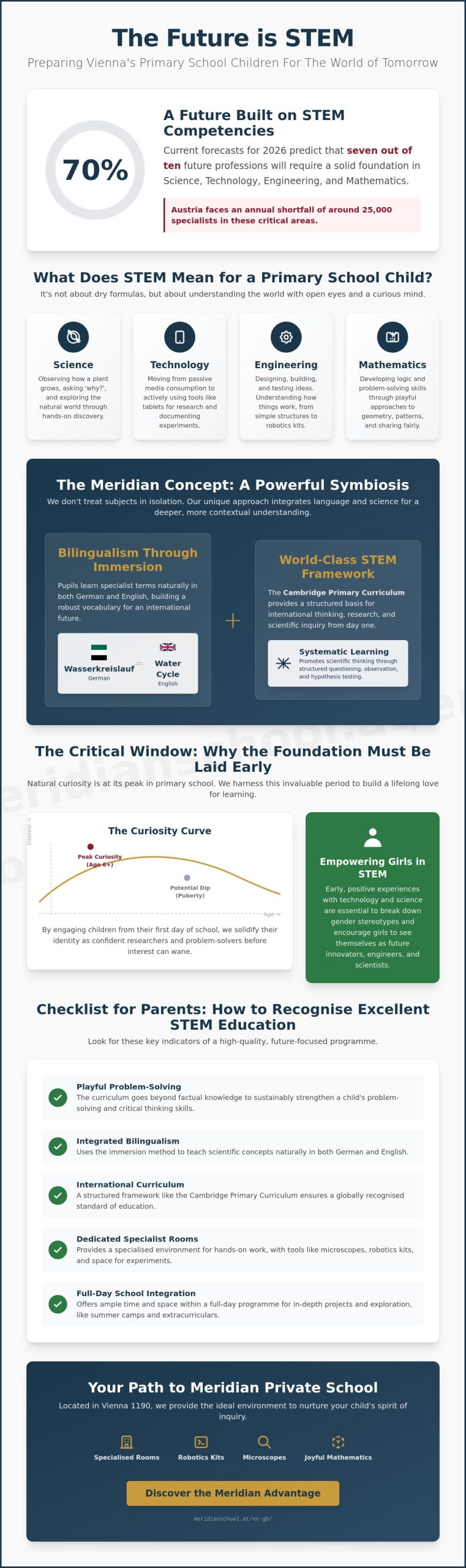
Choosing the right primary school is a matter of the heart that lays the foundation for the entire educational career. Many educational institutions advertise with modern terms, but how do you recognise truly profound STEM education for primary school children in Vienna? A first glance should always be at the facilities. Does the school have its own research rooms where children can safely experiment with materials? In a high-quality learning environment, STEM is not an isolated subject, but a common thread that runs throughout the entire day.
Excellent STEM education for primary school children in Vienna is characterised by consistency and networking. When making your choice, pay attention to the following criteria:
You don't need a laboratory to foster your child's spirit of inquiry. The kitchen is often the best place for first chemical discoveries. Observe together how yeast dough rises when baking fresh bread rolls; that's hands-on biology and chemistry. A walk in the Vienna Woods also offers countless opportunities to talk about ecosystems or the stability of treehouses. For the digital level, there are recommended apps that promote logical thinking without overwhelming children.
Technology and rooms are important, but the passion of the teaching staff is the core. Qualified educators act as learning facilitators who ask questions instead of just providing answers. Through continuous professional development, for example within the Cambridge International Network, they stay up-to-date. This pedagogical excellence guarantees that your child not only consumes knowledge but actively wants to understand the world. If you would like to personally experience the quality of our STEM focus, we will be happy to inform you about the enrolment process for the upcoming school year.
Choosing the right educational institution in the 19th district is a decision for your child's long-term future. On Grinzinger Straße, we combine a green, nature-oriented environment with an infrastructure that meets the most modern pedagogical demands. As a private full-day school, we offer the decisive advantage of time. Excellent STEM education for primary school children in Vienna needs space for experiments that don't have to end after a short hour. Our pupils delve deeply into projects without a hectic timetable interrupting their urge to explore.
We continue this commitment during the holidays. In our Bilingual Summer Day Camp, we combine language and the joy of experimentation in a relaxed setting. It is the ideal opportunity to playfully discover scientific connections whilst naturally applying the English language. We warmly invite you to visit our location in person and experience the special atmosphere of our learning environment.
The process for school enrolment in Vienna for the 2026/2027 school year is clearly defined. The enrolment period for this timeframe is between 10 November and 21 November 2025. For admission to our bilingual community, we are looking for children who bring curiosity and openness to new experiences. Specific prior knowledge in technology or computer science is not necessary. It is important to us that children enjoy actively exploring the world and seeking solutions as a team.
Parents often express concern about whether musical or sports education is neglected with a strong focus on natural sciences. The opposite is true. Our curriculum is designed to be so balanced that STEM projects often merge with creative elements. We foster the child as a whole. Detailed information on school fees and services can be found clearly on our website. We see ourselves as a reliable partner for your family and accompany your child with pedagogical expertise on their path to an international identity.
Choosing first-class STEM education for primary school children in Vienna is an investment that extends far beyond primary school. In this article, we have highlighted how the synergy of bilingual immersion and scientific research sustainably strengthens problem-solving skills. Your child not only learns dry facts but develops a proactive attitude towards the technical challenges of our time. By combining the Austrian curriculum with the Cambridge Primary Curriculum, we offer education at an international top level.
In our private school in Vienna 1190, we create an atmosphere where the spirit of inquiry and individual development go hand in hand. As a certified Cambridge International School, we consistently focus on STEM from the 1st class onwards, which is ideally complemented by our professional full-day care. This ensures that there is ample room in the school day for in-depth experiments, creative music projects, and sports activities. This holistic preparation secures your child a decisive advantage for secondary schools.
Arrange a consultation appointment now and experience our STEM focus live!
We accompany your child with heart and pedagogical excellence in discovering their talents and laying the foundation for a successful, global future.
STEM education at our school begins on the very first day of school in the first year of primary school. We utilise the window of natural curiosity, which is particularly wide open for school beginners, to playfully integrate scientific phenomena into everyday life. This early STEM education for primary school children in Vienna ensures that mathematical and technical questions are perceived as an exciting journey of discovery from the outset.
No, your child does not need any prior English knowledge to start in our bilingual primary school. We work according to the immersion method, where children learn the language naturally through doing and experiencing. Since STEM topics are taught visually and experimentally, pupils grasp the English specialist terms effortlessly alongside the German vocabulary in the respective context.
Our pedagogical concept fully meets the Austrian curriculum for primary schools and extends it with the international standards of the Cambridge Primary Curriculum. Whilst regular lessons often remain theoretical, we focus on inquiry-based learning and interdisciplinary projects. Children regularly spend time in our specialised research room, where they can formulate their own hypotheses and verify or correct them through practical experiments.
We specifically use modern tablets and interactive whiteboards as tools to promote digital competence in an age-appropriate manner. The devices serve, for example, to photographically document the progress of a biological experiment or to create simple command chains for robotics kits. We strictly ensure that technology meaningfully supports the learning process and that children move from passive consumers to active creators of digital content.
We foster girls through inclusive pedagogy that prevents gender stereotypes from arising in the first place and encourages them to confidently take on technical tasks. In our working groups, we ensure that girls actively take on leadership roles in experimenting and constructing. This integrative STEM education for primary school children in Vienna ensures that all children, regardless of gender, develop the same enthusiasm for computer science and technology and can freely unfold their talents.