What if your child's school day consisted not of rigid rote learning, but of bravely discovering their own talents? Many parents share the legitimate concern that individual potential gets lost in purely theoretical lessons or that early pressure to perform stifles natural curiosity. We understand this desire for a stable learning environment that appeals to both heart and mind. In this article, you will learn how creative learning for children helps lay the foundation for a successful school career and purposefully uses imagination as a tool for the future.
We show you how modern approaches in primary school 2026, for instance through the STEM focus or the international Cambridge Primary Curriculum, go far beyond mere factual knowledge. Through the clever combination of the new Austrian curriculum and bilingual teaching in German and English, we foster problem-solving skills at the highest level. Discover how competence-oriented education in 1190 Vienna ensures that your child genuinely enjoys going to school and is optimally prepared for a global world.
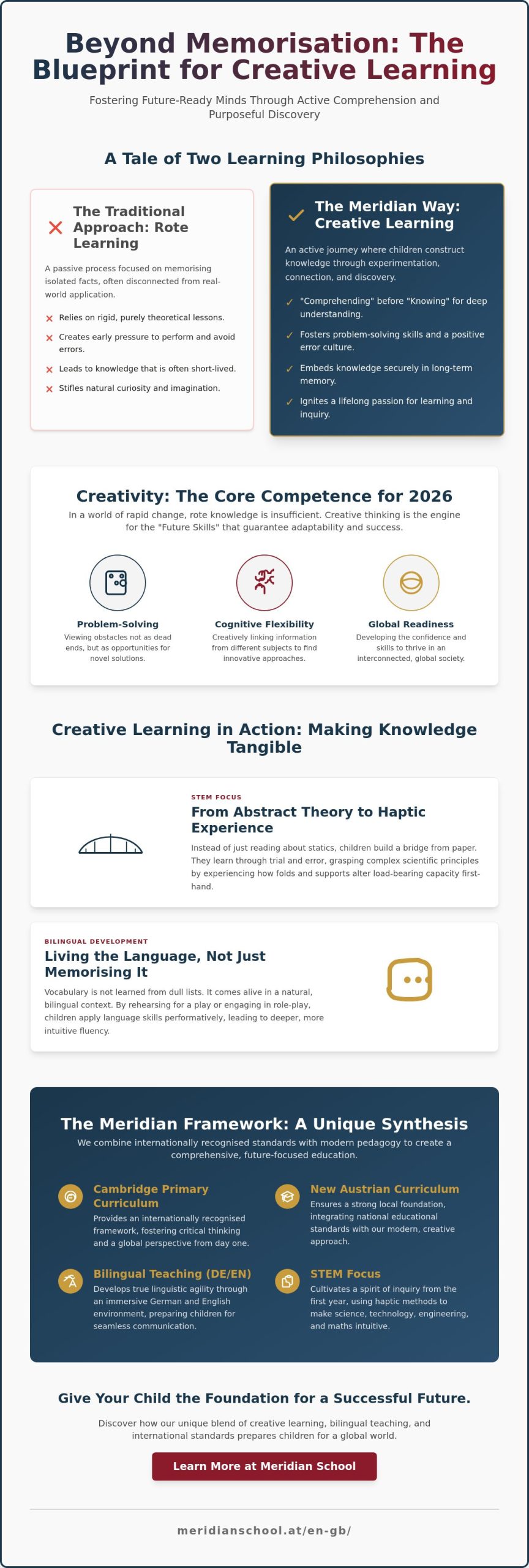
Creativity is often mistakenly dismissed as mere pastime. However, in modern pedagogy, we understand it to be far more than simply painting colourful pictures. It is an active process of knowledge construction, where the child does not merely consume information but processes it and independently reassembles it. Anyone who wants to know what creativity means in an educational context will find the answer in "comprehending" before "knowing". It's about grasping connections through personal experimentation, rather than rigidly memorising facts.
Curiosity acts as a crucial driving force. When children ask questions, their brains open up to new content. Neurobiologically, this state is particularly valuable in 6- to 10-year-olds, as synaptic networking is in full swing during this phase. Connected thinking arises precisely when children are allowed to experiment playfully. This way, creative learning for children becomes deeply embedded in long-term memory and creates a stable foundation for later academic success.
To better understand this concept, let's look at practical applications in everyday life:
We live in a time of rapid change. Rigid knowledge alone is no longer sufficient to thrive in a complex, digital world. Creativity is at the core of problem-solving skills. Children learn to see obstacles not as dead ends, but as opportunities for new solutions. This cognitive flexibility is one of the crucial "Future Skills" that we specifically foster in our private primary school through specialised focuses.
Adaptability will be an absolute key qualification in 2026. When a child learns to creatively link information from different areas – such as STEM subjects and languages – they develop a confidence that goes far beyond the traditional curriculum. A well-rounded personality emerges, one that bravely asks questions and proactively seeks answers. This way, creative learning for children optimally prepares them for the challenges of a globalised society.
Creativity is not an isolated school subject but permeates every area of the curriculum. In mathematics, for example, abstract geometry transforms into a haptic experience when children not only draw shapes but construct them themselves from various materials. This tangible approach to content ensures that creative learning for children not only keeps them engaged but also creates a deep understanding of logical structures. Language development also benefits massively from performative methods: vocabulary is not dully memorised but applied in a natural, bilingual context during rehearsals for a play.
A classic example from our daily routine is constructing a bridge from simple paper. While a textbook merely explains the theory of statics, children learn through trial and error during construction. They immediately grasp how folds and supports alter load-bearing capacity. Such experiments, where the outcome is deliberately left open, greatly foster a spirit of inquiry. The targeted integration of our STEM focus enables even the youngest children to playfully decipher complex scientific phenomena.
Rhythm and melody are far more than mere pastimes; they serve as cognitive anchors. Special rhythm exercises support the reading acquisition process by motorically solidifying syllable comprehension. Music thus becomes an integral part of overall development. Those who wish to learn more about this connection will find valuable details in our guide on Music in Primary School Vienna. Additionally, we use "Digital Art" on tablets to bridge the gap between classical art and modern technology. If you would like to know how we tailor these methods individually to your child, take a look at our versatile educational offering.
Creativity needs space, both in the mind and in the child's room. Parents can foster creative learning for children by creating a "Prepared Environment". A small table with paper, glue, and natural materials invites experimentation, while the television remains deliberately switched off. In this productive quiet, the most original ideas often emerge. Boredom here is not an enemy, but a valuable impulse generator. It forces the brain to create its own play worlds and develop cognitive self-initiative.
A crucial cornerstone is a living culture of error. If your child chooses a "wrong" colour for the sun or the proportions of a drawing are incorrect, that is a valuable part of knowledge construction. Praise the process and the brave experimentation, not just the flawless result. Everyday situations also offer ample material for education: cooking together transforms the kitchen into a laboratory. Weighing ingredients trains mathematical understanding, while chemical processes can be observed during heating.
Even preparing the snack box can become a journey of discovery. When children cut fruit and vegetables into different shapes or sort them by colour, they train their fine motor skills and their awareness of high-quality nutrition. Such small rituals strengthen self-efficacy and make the school day more tangible. Valuable inspiration for design can be found in our guide for a healthy snack.
When choosing the right primary school in the 19th district, parents should specifically look for open learning formats and regular project days. A private full-day school often provides the necessary time frame to integrate additional musical or sports activities into the day without time pressure. This structure ensures that creative learning for children takes place not just as a side issue, but as a central component of their education. If you would like to experience the atmosphere of our school personally, we cordially invite you to get to know us: Arrange an appointment for enrolment now.
The Meridian Way represents the consistent further development of pedagogical excellence by harmonising the Austrian curriculum with the globally recognised Cambridge Primary Curriculum. This exclusive interface ensures that creative learning for children not only fosters them at a local level but also prepares them as open-minded individuals for a complex future. In small groups, our educators have the necessary time to accompany each child on the individual "steps" of their personal development. This structure creates security and trust, while critical thinking and self-initiative function as central pillars of instruction.
A crucial factor for this cognitive flexibility is our active bilingualism. Constantly switching between German and English acts like a mental turbocharger. It trains the ability to view problems from different perspectives and find innovative solutions. Our holistic offering, ranging from sports activities to challenging musical projects, ensures that all talents find equal room for development.
Through the immersion method, children playfully dive into the English language. They learn not about the language, but in the language. This natural approach develops entirely new thought structures that go far beyond mere vocabulary knowledge. Those seeking a future-oriented education will find the ideal environment in our Bilingual School in Vienna to combine language proficiency and creative intelligence.
We understand education as a continuous process. That is why we lay the foundation for creative learning for children already in our Bilingual Pre-School Course. Here, the course is set for a gentle but ambitious transition into primary school. Throughout all four school years, the promotion of creativity runs as a common thread through daily life, right up to the acquisition of international certificates that open doors for graduates worldwide.
The education of our youngest today requires far more than merely imparting facts. We have seen that creative learning for children empowers them to solve complex problems independently and to respond to a rapidly changing world with cognitive flexibility. Whether through haptic experiences in STEM subjects or playful language acquisition in bilingual education; the goal always remains the individual development of full potential in an appreciative atmosphere. Parents and educators together create the framework in which curiosity can grow and mistakes are understood as valuable developmental steps.
As a certified Cambridge International School, we combine the Austrian curriculum with global educational standards. In our private primary school in 1190 Vienna, in addition to the STEM focus, we offer reliable full-day care that allows ample space for musical and sports projects. Accompany your child on this exciting journey and choose an environment that harmoniously unites innovation and tradition. Find out more about school enrolment for Meridian Private School now!
We look forward to supporting your child in discovering their talents and jointly creating the basis for lifelong enjoyment of learning.
Creative learning is a profound cognitive process of active knowledge construction, whereas crafting often represents a purely manual activity following given instructions. The primary aim of the creative approach is to develop independent solutions for complex questions. The child transforms from a passive consumer to an active creator of their knowledge, which goes far beyond merely sticking paper and encompasses all subject areas.
Yes, creativity can be sustainably strengthened through a targeted pedagogical approach and a prepared environment. It is less about an isolated talent and more about the consistent promotion of curiosity and the courage to experiment. Through open-ended tasks and an appreciative error culture, little ones learn to see obstacles as opportunities. This way, creative learning for children becomes firmly embedded as a core competence for their entire further educational journey.
Bilingual education acts as a cognitive accelerator because the brain constantly switches between two language systems, thereby training mental flexibility. This process compels children to view abstract concepts from different linguistic perspectives. This increased agility in thinking is an essential component of creative intelligence and helps develop unconventional solutions in all areas of life.
Absolutely, because the new Austrian curriculum, since the 2023/24 school year, explicitly focuses on competence orientation rather than mere rote learning of facts. Creative methods are not a contradiction to academic achievement but are the decisive tool for achieving the required educational goals more deeply and sustainably. Furthermore, in a full-day school, there is enough time to integrate cross-curricular projects into daily life without time pressure.
In modern primary schools, digital media serve as versatile tools for individual expression and active creation. Instead of passive screen consumption, production is prioritised, for example, by creating presentations or digital art on tablets. This way, children learn early on to use technology meaningfully and creatively to convey their own ideas and research findings clearly.