What if the supposed mixing of languages isn't a sign of confusion, but the first step towards your child's confident, global identity? Many Viennese parents are rightly concerned about whether their children will have sufficiently strong German language skills by the start of school in September 2026 if a second language is present in everyday life. You surely share the desire to provide the best possible support without hindering the natural joy of speaking through rigid rules or too much pressure in daily life.
In this article, you will receive valuable tips for raising children bilingually, showing you how to playfully overcome linguistic hurdles and embrace bilingual development as a genuine asset for the future. We present a clear roadmap for family life and explain why the targeted choice of a Viennese primary school forms the foundation for this success. Discover how an international curriculum and a warm learning atmosphere contribute to your child developing academic excellence in both languages, going far beyond mere vocabulary learning.
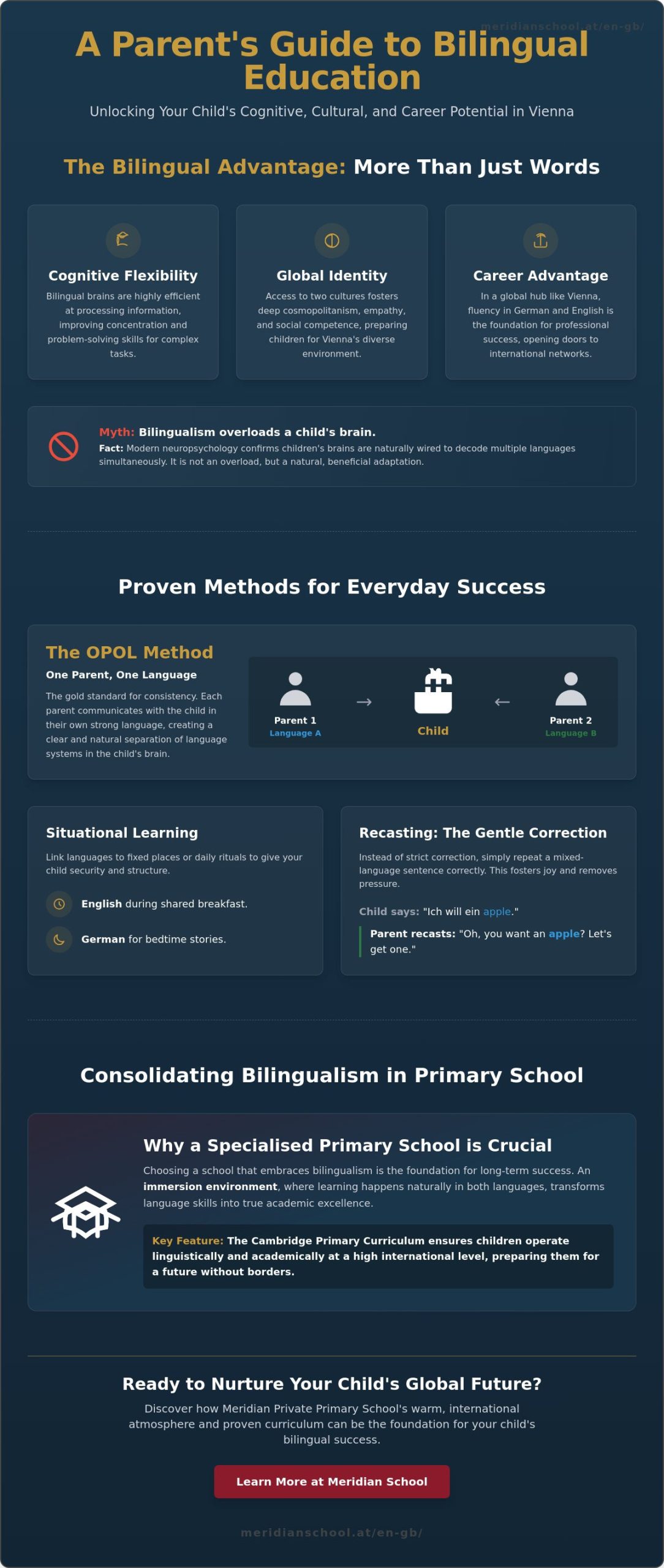
Bilingual education is far more than just learning vocabulary. It's an invitation for the child's brain to develop exceptional cognitive flexibility. Those who consider the fundamentals of multilingualism quickly realise that children who grow up with two or more languages filter and process information more efficiently. In a global city like Vienna, which by 2026 has established itself even more strongly as an international hub for business and research, English is no longer an additional qualification. It is the basis for professional success.
Parents looking for tips for raising children bilingually are acting proactively. In the Viennese job market, from the UN organisations in Donaustadt to the burgeoning tech start-ups in the second district, the ability to switch fluently between German and English is essential. It opens doors to global networks that often remain closed to monolingual applicants.
To better understand this concept, watch this helpful video:
A persistent myth suggests that the double language load could overwhelm children. Modern neuropsychology consistently refutes this. Children's brains are biologically programmed to decode multiple language systems simultaneously. There is no overload, but a natural adaptation. In addition to language proficiency, identity formation plays a central role. Children gain a deeper cosmopolitanism through access to two cultures. They learn that there are different terms and perspectives for one thing, which strengthens their empathy and social competence.
The positive effects are evident daily in the school routine. Bilingual children often show superior concentration skills, as their brains are constantly trained to choose between language systems and ignore distractions. This problem-solving competence is an invaluable advantage in complex tasks in mathematics or topic work.
In Vienna, children experience diversity on every street corner. A bilingual focus fosters an understanding of this diversity from an early age. Structured preparation for global educational paths, for example, through the Cambridge Primary Curriculum, ensures that the little ones not only operate linguistically but also academically at an international level. This lays the foundation for a career that extends far beyond Austria's borders. Those seeking tips for raising children bilingually
Those looking for well-founded tips for raising children bilingually quickly realise that consistency is the most important pillar. According to the Viennese Education Monitoring from January 2025, over 52% of children in the federal capital are already growing up multilingual. To sustainably consolidate this valuable competence, situational language learning has proven effective. Here, families link the respective language to fixed places or daily rituals. This could be English during a shared breakfast with a fresh bread roll or telling stories about experiences on the stairs before bedtime. Such anchor points give the child security and structure the learning process playfully.
In an environment where German dominates as the ambient language, the minority language needs conscious strengthening in the private sphere. Parents ideally act as authentic role models, without strictly correcting the child for mistakes. An effective tool from modern pedagogy is called "recasting". If the child mixes languages, parents simply repeat the statement correctly in the desired target language. This approach avoids unnecessary pressure and fosters the joy of expression, which forms the basis for a lifelong enthusiasm for language.
The "One Parent, One Language" (OPOL) concept is considered the gold standard for consistent multilingualism in international research. Each parent consistently communicates with the child in their own strong language. This creates a clear separation of language systems in the child's brain. Even parents who are not native speakers themselves can successfully apply this method, provided they maintain a deep emotional connection to the language. It is primarily about the quality of interaction and the joy of dialogue. Those who wish to professionally support this development will find the bilingual pre-school course an ideal complement to home education.
These practical tips for raising children bilingually help to break down language barriers and strengthen the child's identity:
Raising children in two languages is best achieved when it flows organically into daily Viennese life. It's about creating learning moments that don't feel like traditional lessons. Those looking for tips for raising children bilingually will find ideal conditions in the federal capital. The city offers a rich infrastructure that supports parents in establishing English as a living language.
Social interaction with peers often acts as a catalyst for language development. When children realise that English is a real form of communication among friends, motivation skyrockets. Vienna offers numerous international playgroups in public parks such as Türkenschanzpark or the Prater. A special highlight for the holiday period is the Bilingual Summer Day Camp, where children can deepen their language skills in a relaxed atmosphere. These social experiences sustainably strengthen self-confidence in their own expressive abilities.
Clear structures help children switch safely between languages. A proven model is separation by situation. Ordering a bread roll at the baker's is consistently done in German. The story before bedtime is read exclusively in English. Involve relatives too; an uncle or grandmother who consistently communicate in one language become important language role models. This consistency creates a secure framework for language development. Would you like to learn more about our holistic support? Discover our pedagogical offerings for a first-class bilingual education.
The transition from nursery to primary school marks a crucial turning point in the educational biography for Viennese families. For your efforts to raise your child bilingually to bear fruit in the long term, high-level pedagogical continuity is needed. In Vienna, more and more parents are opting for the concept of immersion. Here, language learning happens through active experience, rather than through dry vocabulary memorisation. The child deeply immerses themselves in both languages, as lessons are often designed using a team-teaching model by German and English-speaking educators.
The choice of the right school determines success, as it links the Austrian curriculum with an international standard. This ensures that children meet local educational standards while simultaneously developing a global identity. An excellent private primary school offers the necessary environment to consolidate this language competence without performance pressure, but through the joy of discovery.
International standards complement home education in a professional manner. As the first Cambridge International School in Vienna, Meridian Private Primary School offers a programme that focuses on critical thinking and problem-solving skills. The advantages of a bilingual school in Vienna from the first year are obvious: children develop a natural flexibility between languages that goes far beyond mere translation. Targeted preparation for the start of school in Vienna is particularly successful through a bilingual pre-school course, which playfully imparts the necessary confidence for this new phase of life.
These structured frameworks support the valuable tips for raising children bilingually that parents have already heeded in early childhood. Thus, bilingualism becomes not only a useful additional qualification but a firm, living part of your child's identity in a connected world.
Bilingual education in 2026 requires more than just goodwill; it demands a clear structure and the right local partners. You have learned that the consistent application of proven methods and integration into a vibrant, international environment significantly promote language acquisition. Our tips for raising children bilingually illustrate the importance of the seamless connection between family life and professional academic excellence for long-term success. Meridian Private Primary School accompanies this journey as the first certified Cambridge International School in Vienna with the highest pedagogical precision and warmth. Through our state accreditation, we guarantee a legally recognised education according to the Austrian curriculum, complemented by the globally recognised Cambridge Primary Curriculum. Lessons are taught simultaneously in German and English from the first year of primary school. In this way, children develop not only a natural feel for language but a truly global identity in a stable environment. Take the decisive next step now for your child's linguistic and personal development.
Register now for the bilingual pre-school course in Vienna
We look forward to accompanying your child on this exciting journey and together discovering the joy of lived multilingualism.
No, bilingual education demonstrably does not lead to cognitive confusion in children. Recent studies from the University of Vienna in 2024 confirm that infants as young as 4 months can precisely distinguish between different language systems. If you apply valuable tips for raising children bilingually, such as consistent separation by person or situation, you will sustainably foster your child's neural plasticity and concentration skills.
This phase of passive bilingualism is a normal developmental stage that occurs in around 60 percent of bilingual children of primary school age. It is crucial to remain steadfast in your chosen language and create positive incentives for the second language, without exerting direct pressure. At Meridian Private Primary School, we support this process through an immersive environment that playfully encourages the natural urge to communicate in German and English from the first day of school.
The ideal time to start bilingual education is from your child's first day of life. The neurological window for effortless, accent-free language acquisition often closes before the age of 7, according to experts. Those looking for tips for raising children bilingually for everyday life should focus on early consistency. The earlier contact is made with both languages, the more firmly grammatical structures are anchored in the brain, which significantly facilitates the later educational path.
No, the linguistic perfection of the parents is less crucial than authenticity and emotional connection when speaking. It is perfectly sufficient for one parent to consistently use their native language, as children primarily learn language through social interaction and bonding. Additionally, the Cambridge Primary Curriculum at our Viennese school provides a professional academic basis that systematically and expertly compensates for any deficits in the home environment through qualified native speakers.
When choosing, primarily look for a combination of state accreditation and international certifications, such as the status as a Cambridge International School. In Vienna, there are only a few institutions that guarantee this high quality standard while also pursuing a clear STEM focus. Visit the open days in November or January to ensure that the pedagogical concept offers genuine equality of languages in the school day and optimally prepares your child for a global future.