What if the next maths homework at the kitchen table in Vienna doesn't end in frustration, but instead marks the start of a career as a researcher or engineer? Many parents know the feeling of uncertainty when it comes to how best to support primary school maths at home without stifling the joy of learning. The Austrian curriculum sets high standards, but the worry about complex calculations doesn't have to be a constant companion in family life.
We understand your desire for a stable foundation for your child's academic journey. In this article, you'll discover how to playfully and sustainably strengthen mathematical abilities through targeted STEM enthusiasm and bilingual approaches. We'll provide an overview of practical tips for 2026 that foster a deep fundamental understanding of logic and confidently prepare your child for an international future. Discover how the combination of the Cambridge Primary Curriculum and local expertise makes all the difference.
Mathematics is far more than simply memorising times tables or quickly solving sums. When we specifically support primary school maths, we help children develop universal problem-solving strategies. It's about recognising logical patterns and making abstract connections tangible. This educational work is based on the scientific principles of mathematics education, which prove that a deep understanding of number ranges significantly increases cognitive flexibility. In Vienna, performance in the fourth school year often determines the further educational path, particularly eligibility for a Gymnasium (secondary school).
To better understand the typical hurdles and misconceptions in third-year maths lessons, this video can help:
An often underestimated aspect of supporting primary school maths is its close connection to reading comprehension. Those who don't read word problems with full understanding often fail at the mathematical application, even if they possess the purely computational skills. Therefore, modern educational concepts link linguistic education with logical training. Positive experiences in the first school years also prevent a lasting aversion to numbers from taking root. Children who grasp mathematics as a tool for discovering the world start their later school careers with significantly more self-confidence.
In primary school, we focus on making complex concepts playfully understandable. The STEM focus forms the basis for understanding technology and natural sciences. We harness children's natural urge to explore to translate abstract formulas into exciting experiments. This way, we optimally prepare pupils for the demands of a digitalised world. Learn more about our STEM focus in primary school here.
Mathematics is far more than simply calculating with numbers; it is a universal language. If parents want to specifically support primary school maths, the bilingual approach offers enormous advantages for cognitive development. At Meridian School, we use the renowned Cambridge Primary Curriculum to teach mathematical logic in both German and English. This constant language switching forces the brain to understand abstract concepts independently of a single vocabulary word. A child who confidently uses terms like "addition" and "subtraction" in two languages develops deeper neural connections than in monolingual teaching.
The international orientation trains abstract thinking in a way that goes beyond memorising formulas. By applying global benchmarks, Viennese children learn to measure themselves against peers worldwide. This not only strengthens self-confidence but also ensures a mathematical understanding that is essential in a globalised world in 2026 and beyond. We consistently reinforce mathematical terms in both languages, ensuring a smooth transition between logical systems.
At our school campus on Grinzinger Straße, we combine public status with the high demands of the Cambridge model. While the Austrian curriculum specifies clear competence areas for primary school, the Cambridge system offers structured, step-by-step objectives that guarantee an international standard. Bilingual teaching demonstrably increases cognitive flexibility in complex calculations, as the brain switches between different linguistic representations of logic.
| Feature | Austrian Curriculum | Cambridge Primary Curriculum |
|---|---|---|
| Core Focus | Competence Areas (Operating, Modelling) | Problem Solving and Reasoning |
| Structure | Framework Curriculum of the Directorate of Education | Detailed Stage-by-Stage Learning Objectives |
| Comparability | National Standard | Global Benchmark (160+ Countries) |
Through this symbiosis, we optimally prepare pupils for secondary schools, whether at home or abroad. Children learn to understand mathematical problems as logical puzzles that can be solved independently of language. Those who wish to learn more about our holistic educational offering will find an environment with us that combines academic excellence with warmth.
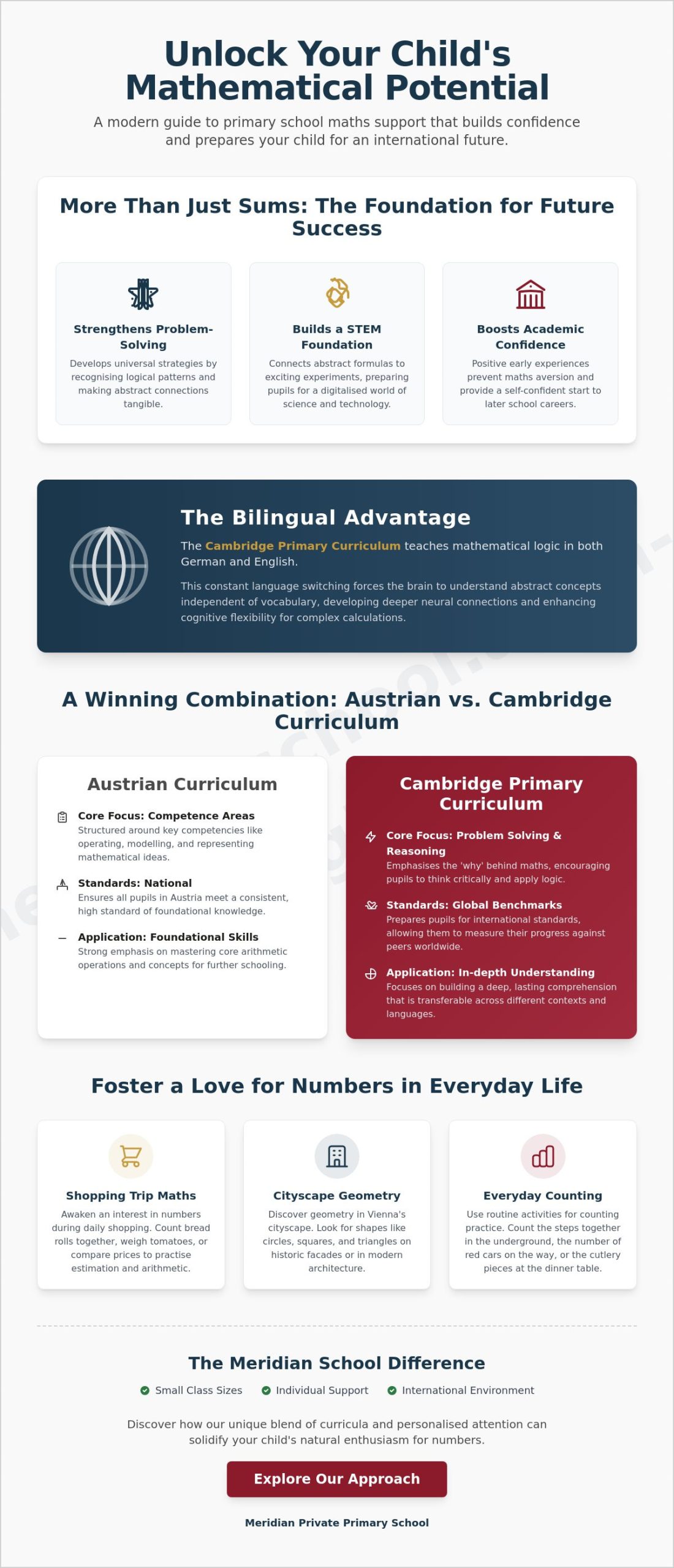
Mathematical concepts are hidden around every corner in Vienna. When you put five tomatoes into a bag at the market or order exactly six bread rolls from the baker, your child is already training their understanding of quantity. Let them compare prices on signs. Does a bunch of radishes cost €1.50 or €1.90? Such small estimation tasks help to support primary school maths without it feeling like dry lessons.
Viennese architecture also provides a perfect backdrop for geometry. Count the steps together when exiting an underground station like Karlsplatz. Look for symmetries on the ornate facades of the Ringstraße. Circles, squares, and triangles can be found everywhere there. Even snack time is an ideal learning opportunity. A quark pastry can be wonderfully halved or quartered. This way, children grasp fractions tactilely before seeing them abstractly on paper.
Playful learning is often more effective than mere worksheets. Dice games challenge the quick recognition of quantities, while logical puzzles strengthen problem-solving skills. The focus here is on the process, not just the result. This reduces pressure and awakens a natural curiosity for numbers.
To consolidate an understanding of quantities within the number range up to 100, we recommend dedicated game nights. These three classics are particularly good at fostering mathematical thinking:
An important factor is how errors are handled. See incorrect results as valuable learning opportunities. When a child understands why a calculation method didn't lead to the goal, they learn more sustainably than through mere correction. Errors are simply intermediate steps on the path to a solution. Discover our offering for children to further develop your child's mathematical talents in a supportive environment.
Meridian Private Primary School employs a concept that goes far beyond the standard. Small class sizes form the foundation for providing targeted support to each child in their mathematical development. In an environment with a maximum of 20 children per class, there is ample time in the school day to build on individual strengths and identify hurdles early on. If parents wish to sustainably support primary school maths, they will find the necessary educational depth and attention here.
Our team consists of dedicated educators who foster enthusiasm for numbers in both German and English. As the first Cambridge International School in Vienna, we link the Austrian curriculum with the Cambridge Primary Curriculum. This means that mathematical concepts are taught bilingually. Children naturally learn to grasp and apply logical connections in two languages. This international orientation optimally prepares them for a globalised world.
At our campus in Vienna Döbling, we offer comprehensive full-day care that stimulates a spirit of discovery. After lessons, there is ample space for exciting STEM projects and experiments. This playful approach to technology and natural sciences ensures that mathematics is not just perceived as an abstract school subject. Rather, children understand numbers as a tool for comprehending their environment.
A key focus is on preparing for the next big step. We equip our pupils for the transition to secondary schools, be it a Gymnasium with public status or an international institution. Through the combination of academic rigour and a warm atmosphere, we create a secure foundation for success from the 2026 school year.
Interested parents can find out more about the registration process for the upcoming school year directly online. A personal visit to Grinzinger Straße offers the ideal opportunity to experience our bilingual concept and modern facilities first-hand. The individual learning support at Meridian School ensures that every child is optimally supported and valued on their personal educational journey.
Mathematics forms the foundation for logical thinking and lifelong success. When parents sustainably support primary school maths, they create the basis for a strong academic career from 2026. At Meridian Private School in Vienna's 19th district, we combine playful approaches with the highest academic excellence. As the first Cambridge International School in Vienna, we offer bilingual instruction in German and English from the 1st school year. This approach not only fosters an understanding of numbers but also linguistic flexibility in an international environment.
Our educational concept is based on the Cambridge Primary Curriculum and is officially secured by state public status. We support each child individually and strengthen their natural curiosity through modern STEM focuses. This way, we transform abstract formulas into tangible successes for everyday school life. Opt for an education that harmoniously combines local tradition and global perspectives. We support you in unleashing your child's full potential.
Arrange a consultation appointment for school registration in Vienna now
Together, we lay the foundation for your child's enthusiasm for the world of numbers.
Targeted mathematical support ideally begins in kindergarten, from around 4 years of age, through playful understanding of quantities. In primary school, we consolidate these fundamentals from the very first day through our bilingual concept. Studies show that 90% of children who are introduced to number ranges up to 10 early on find a significantly easier entry into the regular curriculum.
Dyscalculia often manifests as persistent finger-counting beyond the 2nd school year or significant difficulties with crossing the ten barrier. If your child regularly takes longer than 20 seconds per sum for simple addition tasks in January of Year 2, an educational assessment is advisable. Approximately 5 to 7% of all primary school pupils in Austria are affected by dyscalculia and require specific, professional support.
Bilingual mathematics teaching by no means overburdens children; instead, it strengthens cognitive flexibility through the parallel use of technical terms in German and English. We combine the Cambridge Primary Curriculum with the Austrian curriculum to align logical thinking internationally. Studies show that 85% of pupils in bilingual programmes develop higher problem-solving skills than their peers in purely monolingual classes.
Digital media serve as interactive tools that make abstract number ranges tangible through modern visualisations. In Vienna, 65% of innovative schools already use learning apps like Anton or Geogebra to specifically support primary school maths. These tools offer immediate feedback and allow for individual learning paces, which is particularly essential for fostering STEM skills from Year 1.
For word problems, it helps to first read the problem aloud and jointly highlight the relevant information with colours. Since mathematical difficulties in 40% of cases are based on a lack of reading comprehension, sketching the calculation operation is a proven method. Use the step-by-step method: circle numbers and underline keywords such as "total" or "difference" to clarify the logical structure of the task.