Did you know that, according to a May 2025 study, over 60 per cent of primary school teachers have barely integrated digital media into their lessons so far? While the City of Vienna is investing over 100 million Euros in the “Digital School” initiative, many parents are desperately searching for an educational institution that, as a modern digital primary school, prioritises pedagogical quality over mere screen time. You might be concerned about whether your child will develop the necessary media literacy for the 2026 curriculum or lose focus in the digital jungle. The Meridian Private Primary School understands these concerns very well, because excellent education requires clear structure and warmth, rather than just technology.
In this article, discover how we link technology and pedagogy so that your child learns a competent approach to media. We will show you how, as the first Cambridge International School in Vienna, we use digital tools to promote a STEM focus and bilingual learning from the first year of primary school. We will take a look at the innovations for the 2026/27 academic year, explain the benefits of the nationwide child protection filter from March 2026, and demonstrate how we safely prepare your child for the demands of secondary schools.
What exactly is a digital primary school? In 2026, we certainly do not understand it to be an educational institution where children passively stare at screens all day. Rather, a digital primary school is a modern learning environment where hardware serves as a natural tool. Tablets and interactive whiteboards complement the haptic experience here, instead of replacing it. It's about integrating technology meaningfully into everyday life so that it supports the learning process and does not dominate it.
In Vienna, we play a pioneering role, legally enshrined by the School Education Digitalisation Act (SchulDigiG). While the Austrian curriculum prescribes basic digital literacy from the first year of primary school, at Meridian Private Primary School, we go a decisive step further. We link these state requirements with the internationally renowned Cambridge Primary Curriculum. The goal is clear: children should not just consume technology, but actively shape and understand it from the outset.
To see this modern concept in practice, watch this video:
Computational thinking sounds complicated, but with us, it begins playfully and is absolutely age-appropriate. Without overwhelming the children, we introduce them to the logic of coding. Through simple robotics projects, pupils learn how commands work and how to create their own small programmes. This fosters structured problem-solving skills that extend far beyond the digital classroom. Detailed information on our educational offering can be found directly on our website.
Reading, writing, and arithmetic are essential, but in the 21st century, that alone is no longer enough. Media literacy has long since developed into the fourth cultural technique. We teach children to critically question information on the internet. Who wrote this text? Is the source trustworthy? These questions are more important than ever in 2026 to navigate the digital world safely and autonomously. This is how we prepare children for a responsible approach to media that will shape their entire school career.
At Meridian Private Primary School, the tablet is not a toy, but a window to the world. We use these tools specifically to prepare our pupils as best as possible for the future. In our small class groups at the Grinzinger Straße campus, we ensure that every child receives the attention they deserve. Our digital primary school specifically relies on adaptive learning software. These programmes recognise strengths and weaknesses in real-time and adapt tasks individually. This way, no one is overwhelmed, while talented children can already master more complex challenges.
German and English from the first day of school is our central brand promise. Digital media make this goal tangible and lively for the children. We access the exclusive Cambridge network to integrate high-quality English-language learning resources directly into lessons. Children listen to audio examples from native speakers, record their own pronunciation, and playfully compare it. This trains listening comprehension and breaks down language barriers before they can even arise. Through interactive exercises, the foreign language becomes a natural part of everyday life, which massively facilitates preparation for international secondary schools.
A key pillar of our education is the STEM focus. When children experiment in the laboratory or outdoors, the tablet serves as a digital research logbook. They photograph experimental setups, document chemical reactions in slow-motion videos, or create initial diagrams of their observations. This combination of natural sciences and IT practice ensures that STEM subjects in primary school are not dry, but highly exciting. Children record their progress in personal portfolios, which visibly fosters pride in their achievements. If you would like to learn more about our path to excellence, please visit our detailed offering.
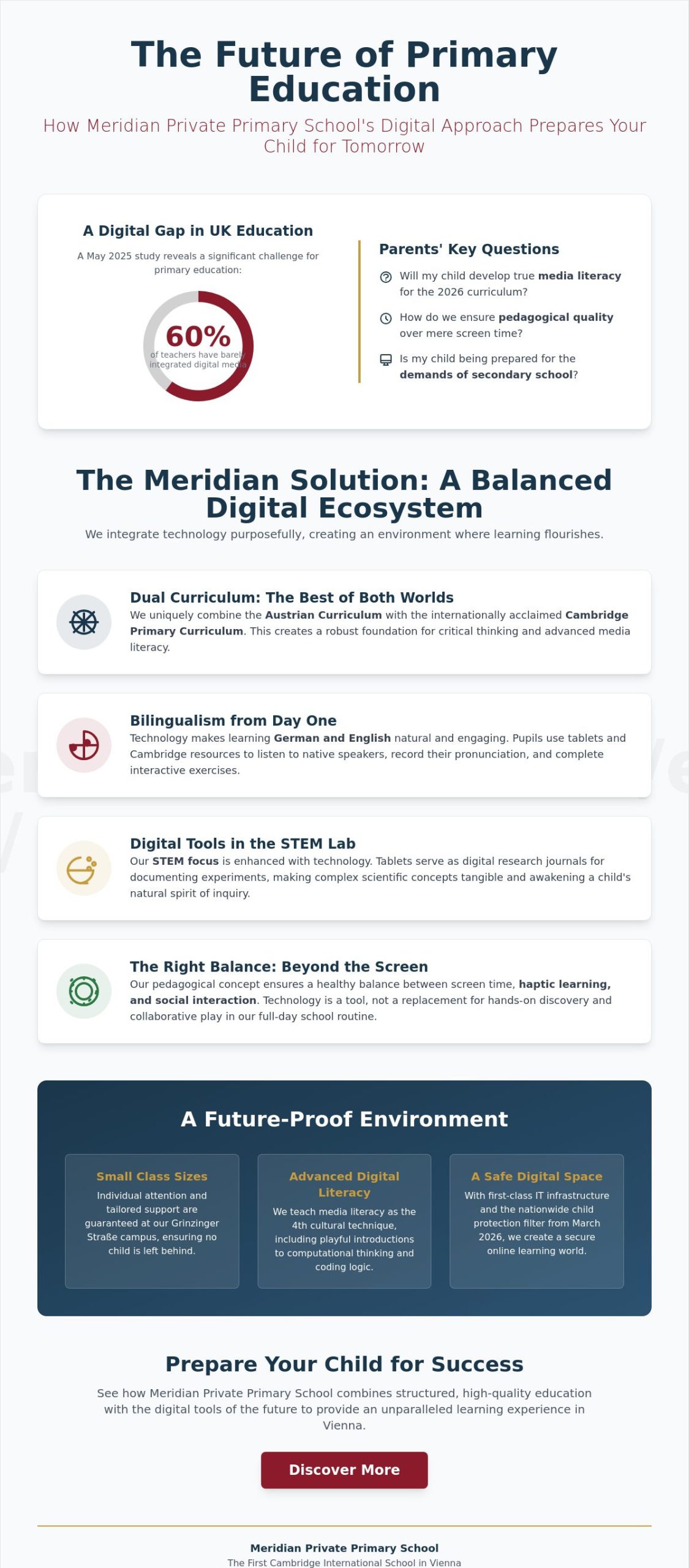
Many parents fear that a digital primary school automatically leads to an overload of screen time. This myth persists, but it certainly does not correspond to the pedagogical reality at the Meridian Private Primary School. We consistently adhere to the official 8-point plan for digitalisation, but we set clear boundaries. Technology is a tool for us, not an end in itself. In our school routine in Vienna 1190, there are fixed media-free zones and times where social interaction and shared play take precedence.
We pay particular attention to fine motor skills. Despite tablet use, good handwriting remains a central skill that we practise daily. Children continue to use traditional exercise books, draw, and craft. These haptic experiences are irreplaceable for cognitive development. We thus build a bridge between proven traditions and modern innovation, so that children master both worlds with confidence.
To truly understand abstract concepts, children must literally grasp things. In maths, we therefore continue to use traditional Montessori materials. The haptic experience of quantities and shapes forms the indispensable basis for later logical thinking on the computer. If you want to know how we specifically foster maths in primary school, you will find valuable practical tips for everyday life in our related article.
A responsible approach to technology also includes physical health. We meticulously pay attention to ergonomics at the desk. Whether working concentrated in the classroom or briefly pausing on the stairs; the correct sitting position is crucial to prevent postural damage early on. To balance screen work, active breaks are firmly anchored in our timetable. Children need regular outdoor exercise to clear their heads and recharge for the next learning steps.
Discover our holistic educational offering and see for yourself our balanced learning environment that appeals to both heart and mind.
A private digital primary school offers advantages that go far beyond mere hardware. While in large class groups there is often insufficient time for individual technical questions, at Meridian Private School, we focus on small groups. This enables our educators to precisely support each child in using devices. At our Grinzinger Straße campus, pupils benefit from modern infrastructure and IT support that is available directly on-site. There are no long waiting times; the technology simply functions as a reliable part of the learning routine.
We maintain transparent and regular communication with parents about learning progress. Through digital portfolios, you can promptly see which projects your child is implementing. This close collaboration builds trust and security, especially with regard to competent media use. This is how we jointly prepare children for the world of tomorrow.
Choosing the right school is a far-reaching decision for the entire family. We support you in finding the ideal educational path for your child. Take your time to explore the diverse offering of Meridian School, which ranges from bilingual lessons to a STEM focus. For all further steps, please use our direct link to school enrolment in Vienna. We are happy to take the time for a personal discussion to answer your questions about daily school life.
The decisive advantage of our education lies in the combination of the Austrian curriculum with the Cambridge Primary Curriculum. Your child receives an education that has both local roots and a global horizon. Through the Cambridge certificate, we optimally prepare pupils for transfer to secondary schools, be it a grammar school in Vienna or an international educational institution. This combination ensures that our graduates are excellently equipped not only academically but also linguistically and digitally. We foster an international identity that lays the foundation for success in a connected world.
The educational landscape in Vienna is changing rapidly, but the goal remains the same: to prepare children as best as possible for a successful life. A modern digital primary school is far more than just a technical upgrade; it is a place where innovation meets pedagogical consistency. As we have seen, the targeted use of tablets in bilingual lessons and STEM projects awakens the natural spirit of inquiry, without neglecting the importance of traditional cultural techniques such as handwriting.
As the first Cambridge International School in Vienna, we guarantee the highest quality through international standards and a certified STEM focus. Our bilingual lessons from the first year of primary school ensure that your child understands German and English as natural tools for their future. In a time when digital competence is becoming a basic prerequisite according to current educational reports, we offer a stable framework for excellent development in a warm environment.
Arrange a consultation appointment for the digital primary school in Vienna 1190 now
Let us together lay the foundation for your child's international school career. We look forward to welcoming you and your child to Meridian Private School and jointly setting the course for a successful future.
Children at our school start using tablets from the first year of primary school. In this phase, technology primarily serves to support bilingual language acquisition and to promote the STEM focus. We gently introduce pupils to the devices, with tablets being used as supplementary tools in lessons to convey interactive learning content playfully and age-appropriately.
We ensure safety through a multi-stage protection mechanism. Since the end of March 2026, we have been using the nationwide child protection filter for pupil tablets, which reliably blocks unsuitable content. Additionally, our teachers personally supervise every online activity during lessons. This ensures that children learn in a protected digital space while developing a critical and responsible approach to information.
No, at Meridian Private School, parents do not have to purchase the devices for daily lessons themselves. We provide the necessary IT infrastructure and tablets directly at our campus. This guarantees that all children work with the same modern hardware and that IT support is immediately available on-site for technical questions. The provision of devices is part of our comprehensive pedagogical concept.
Handwriting does not suffer at all, as we place great importance on traditional handwriting. In our pedagogical work, haptic writing with a fountain pen or pencil remains a central pillar of fine motor skills. Digital devices merely supplement lessons where they offer genuine added value. Children continue to use traditional exercise books, thereby maintaining a balanced approach between traditional cultural techniques and modern media literacy.
The actual screen time is strictly limited and constitutes only a small part of the entire school day. A digital primary school does not mean that children passively sit in front of a device for hours. Rather, we use tablets selectively for targeted exercises of approximately 20 to 40 minutes per session. The majority of the day is spent by pupils on social interaction, sports, haptic experiments, and traditional lessons.